


Wydawcy
Katalog tematyczny
- Archeologia (109)
- Ekonomia, finanse, business (13704)
- Filozofia (1445)
- Historia (3040)
- Języki i językoznawstwo (2356)
- Lifestyle, hobby i rozrywka (475)
- Medycyna (9704)
- Nauki humanistyczne (4)
- Nauki o Ziemi i środowisku (2638)
- Nauki ścisłe (20412)
- Astronomia (294)
- Biologia (5119)
- Chemia (6540)
- Chemia analityczna (361)
- Chemia fizyczna (346)
- Chemia nieorganiczna (137)
- Chemia organiczna (535)
- Krystalografia (27)
- Minerologia (46)
- Fizyka (3309)
- Matematyka (4574)
- Nauki ścisłe, ogólnie (503)
- Nauki społeczne (8486)
- Nauki techniczne (13450)
- Prawo (1696)
- Publikacje informacyjne i interdyscyplinarne (1288)
- Religia i wierzenia (917)
- Technika komputerowa (4067)
- Zdrowie, relacje międzyludzkie i rozwój osobisty (657)





Informacje szczegółowe o książce
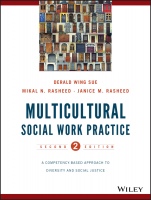
Multicultural Social Work Practice: A Competency–Based Approach to Diversity and Social Justice
ISBN 9781118536100
Autor: Derald Wing Sue, Mikal N. Rasheed, Janice Matthews Rasheed
Wydawca: Wiley
Dostępność: 3-6 tygodni
Cena: 449,40 zł
Przed złożeniem zamówienia prosimy o kontakt mailowy celem potwierdzenia ceny.
ISBN13: |
9781118536100 |
ISBN10: |
111853610X |
Autor: |
Derald Wing Sue, Mikal N. Rasheed, Janice Matthews Rasheed |
Oprawa: |
Paperback |
Rok Wydania: |
2016-02-16 |
Numer Wydania: |
2nd Edition |
Ilość stron: |
544 |
Wymiary: |
246x172 |
Tematy: |
PN |
AN UPDATED EXAMINATION OF DIVERSITY AND SOCIAL JUSTICE WITHIN THE FIELD OF SOCIAL WORK
Multicultural Social Work Practice: A Competency–Based Approach to Diversity and Social Justice offers a practical guide for developing an understanding of cultural differences and the sociopolitical dimensions of culturally competent care. Thoroughly revised and updated, the second edition is aligned with the Council on Social Work Education′s 2015 Educational Policy and Standards and incorporates the National Association of Social Workers Standards of Cultural Competence.
The second edition addresses the inclusion of theoretical perspectives of critical race theory and anti–oppression social work practice models. The revised text contains illustrative examples of micro–aggressions (forms of interpersonal and environmental oppression towards marginalized populations). The authors also review evidence–based practice on research–supported approaches for understanding the influence of cultural difference, and the importance of considering client characteristics, culture, and preferences in assessment, intervention plans, and therapeutic outcomes.
The thoroughly revised second edition offers new content and pedagogical features, including:
Theoretical frameworks for multicultural social work practice An expanded discussion of religion and spirituality Emerging issues of diverse population such as women in the military New chapter overviews, learning objectives, and reflection questionsMulticultural Social Work Practice, Second Edition is filled with culturally appropriate intervention strategies for working with a diverse clientele and a primer for becoming aware of systemic forces affecting both their clients and clinicians.
Preface
About the Authors
Part I Principles and Assumptions of Multicultural Social Work Practice
Chapter 1 Cultural Diversity and Implications for Multicultural Social Work Practice
Chapter Learning Objectives
Overview
Voices of Diversity and Marginalization
African American Male
Gay American
Female Worker
Person with a Disability
Person in Poverty
Undocumented Immigrant Family
The Diversification of the United States and Implications for Social Work
The Multiple Dimensions of Human Identity
Individual Level
Group Level
Universal Level
Individual and Universal Biases in Social Work
Multicultural Challenges in Social Work Practice
Implications for Multicultural Social Work Practice
Summary
Chapter 2 Theoretical Frameworks for Multicultural Social Work Practice
Chapter Learning Objectives
Overview
Theoretical Frameworks for Multicultural Social Work Practice
Ecological Systems Perspective
Strengths Perspective
Social Justice and Human Rights
A Critical and Anti–Oppressive Perspective
Anti–Racism as a Social Work Agenda
Intersectionality Perspective
Implications for Multicultural Social Work Practice
Chapter 3 Becoming Culturally Competent in Social Work Practice
Chapter Learning Objectives
Overview
Is Being Culturally Competent Possible?
Defining Cultural Competence in Social Work Practice
The Four Components of Cultural Competence
Competency One: Becoming Aware of One s Own Assumptions, Values, and Biases about Human Behavior
Competency Two: Understanding the Worldview of Culturally Diverse Clients
Competency Three: Developing Appropriate Intervention Strategies and Techniques
Competency Four: Understanding Organizational and Institutional Forces that Enhance or Negate Cultural Competence
A Working Definition of Cultural Competence
Multidimensional Model of Cultural Competence in Social Work
Dimension I: Group–Specific Worldviews
Dimension II: Components of Cultural Competence
Dimension III: Foci of Social Work Interventions
What Is Multicultural Social Work Practice?
Implications for Multicultural Social Work Practice
Summary
Part II Multicultural Social Work Practice: Systemic Oppression and Social Justice
Chapter 4 Understanding the Sociopolitical Implications of Oppression and Power in Social Work Practice
Chapter Learning Objectives
Overview
A Clash of Expectations
Effects of Historical and Current Oppression
Ethnocentric Monoculturalism
Belief in Superiority
Belief in the Inferiority of Others
Power to Impose Standards
Manifestation in Institutions
The Invisible Veil
Historical Manifestations of Ethnocentric Monoculturalism
Impact of Ethnocentric Monoculturalism in Helping Relationships
Credibility, Expertness, and Trustworthiness in Multicultural Social Work Practice
Credibility of the Social Worker
Implications for Multicultural Social Work Practice
Summary
Chapter 5 Microaggressions in Social Work Practice
Chapter Learning Objectives
Overview
What Did He Really Mean?
Microaggression as a Form of Oppression
Microaggression and the Clash of Sociodemographic Realities
Microaggressions and the Invisibility of Unintentional Expressions of Bias
Microaggression and the Perceived Minimal Harm
The Catch–22 of Responding to Microaggressions
Categories of Microaggressions
Microaggression and Social Worker Practice
Microaggressions and Social Work Practice
Microinsult and Direct Social Work Practice
Microinvalidation and Direct Social Work Practice
Implications for Direct Social Work Practice
Summary
Part III Racial/Cultural Identity Development and Multicultural Social Work Practice
Chapter 6 Racial/Cultural Minority Identity Development
Chapter Learning Objectives
Overview
Who Am I?
Racial/Cultural Identity Development Models
Black Identity Development Models
Other Racial/Ethnic Identity Development Models
Feminist Identity Theory
A Working Racial/Cultural Identity Development Model
Conformity Stage
Dissonance Stage
Resistance and Immersion Stage
Introspection Stage
Integrative Awareness Stage
Implications of the R/CID Model for Multicultural Social Work Practice
Summary
Chapter 7 White Racial Identity Development
Chapter Learning Objectives
Overview
What Does It Mean to Be White?
42–Year–Old White Businessman
26–Year–Old White Female College Student
65–Year–Old White Male Retired Construction Worker
34–Year–Old White Female Stockbroker
29–Year–Old Latina Administrative Assistant
39–Year–Old Black Male Salesman
21–Year–Old Chinese American Male College Student (majoring in ethnic studies)
The Invisible Whiteness of Being
Understanding the Dynamics of Whiteness
Models of White Racial Identity Development
The Hardiman White Racial Identity Development Model
The Helms White Racial Identity Model
The Process of White Racial Identity Development: A Descriptive Model
Conformity Phase
Dissonance Phase
Resistance and Immersion Phase
Introspection Phase
Integrative Awareness Phase
Implications for Multicultural Social Work Practice
Summary
Part IV The Practice Dimensions of Multicultural Social
Chapter 8 Barriers to Effective Multicultural Clinical Practice
Chapter Learning Objectives
Overview
Cultural Barriers: A Case Example
Generic Characteristics of Counseling/Therapy
Sources of Conflict and Misinterpretation in Clinical Practice
Culture–Bound Values
Class–Bound Values
Language Barriers
Generalizations and Stereotypes: Some Cautions
Implications for Multicultural Social Work Practice
Summary
Chapter 9 Cultural Styles in Multicultural Intervention Strategies
Chapter Learning Objectives
Overview
Speaking from My Cultural Space : A Case Example
Communication Styles
Nonverbal Communication
Proxemics
Kinesics
Paralanguage
High–/Low–Context Communication
Sociopolitical Facets of Nonverbal Communication
Nonverbals as Reflections of Bias
Nonverbals as Triggers to Biases and Fears
Differential Skills in Multicultural Social Work Practice
Implications for Multicultural Social Work Practice
Summary
Chapter 10 Multicultural Family–Based Social Work Interventions
Chapter Learning Objectives
Overview
Family Life, Mental Health and Culture: A Case Study
Family Systems Approaches and Assumptions
Issues in Working with Ethnic Minority Families
Ethnic Minority Reality
Conflicting Value Systems
Biculturalism and Acculturation
Ethnic Differences in Minority Status
Ethnicity and Language
Ethnicity and Social Class
Multicultural Family Social Work: A Conceptual Model
People Nature Relationship
Time Dimension
Relational Dimension
Activity Dimension
Nature of People Dimension
Implications for Multicultural Social Work Practice
Summary
Chapter 11 Religion, Spirituality and Indigenous Methods of Healing
Chapter Learning Objectives
Overview
Religion, Spirituality and Social Work Education
Religious Affiliation and Ethnic Identity
Asian Americans and Religious Identity
African American Religious Identity
Hispanic Religious Identity and Affiliation
Native American Spirituality
Muslim American and Religious Affiliation
Spiritual Assessments in Social Work Practice
Indigenous Spirituality and Healing
Spirit Attacks: The Case of Vang Xiong
The Legitimacy of Culture–Bound Syndromes: Nightmare Deaths and the Hmong Sudden Death Phenomenon
Causation and Spirit Possession
The Shaman as Therapist: Commonalities
The Principles of Indigenous Healing
Holistic Outlook, Interconnectedness, and Harmony
Belief in Metaphysical Levels of Existence
Spirituality in Life and the Cosmos
Implications for Multicultural Social Work Practice
Summary
Chapter 12 Multicultural Organizational Change: Antiracism Practice and Social Justice
Chapter Learning Objectives
Overview
Where Do Social Workers Do Social Work?
Monocultural versus Multicultural Organizational Perspectives in Social Work
Lesson One: A failure to develop a balanced perspective between person focus and system focus can result in false attribution of the problem.
Lesson Two: A failure to develop a balanced perspective between person focus and system focus can result in an ineffective and inaccurate treatment plan that is potentially harmful toward the client.
Lesson Three: When the client is the organization or a larger system and not an individual, it requires a major paradigm shift to attain a true understanding of problem and solution identification.
Lesson Four: Organizations are microcosms of the wider society from which they originate. As a result, they are likely to be reflections of the monocultural values and practices of the larger culture.
Lesson Five: Organizations are powerful entities that inevitably resist change and possess within their arsenal many ways to force compliance in individuals.
Lesson Six: When multicultural organizational development is required, alternative helping roles that emphasize systems intervention must be part of the role repertoire of the social worker.
Lesson Seven: Although remediation will always be needed, prevention is better.
Models of Multicultural Organizational Development
Culturally Competent Social Service Agencies
The Social Justice Agenda of Multicultural Social Work
Antiracism Practice and Social Justice
Principle One: Having Intimate and Close Contact With Others
Principle Two: Cooperating Rather Than Competing
Principle Three: Sharing Mutual Goals
Principle Four: Exchanging Accurate Information
Principle Five: Sharing an Equal Relationship
Principle Six: Supporting Racial Equity by Leaders and Groups in Authority
Principle Seven: Feeling Connected and Experiencing a Strong Sense of Belonging
Implications for Multicultural Social Work Practice
Summary
Chapter 13 Evidence–Based Multicultural Social Work Practice
Chapter Learning Objectives
Overview
From Doing Good to Doing Well
What Is Evidence–Based Practice?
Evidence–Based Practice with Ethnic Minorities
Empirically Supported Interventions (EST) and Empirically Supported Relationships (ESR)
Integration of EBP and EST to Enhance Multicultural Sensitivity
Empirically Supported Treatment
Implications
Empirically Supported Relationships
The Working Alliance
Emotional or Interpersonal Bond
Empathy
Positive Regard, Respect, Warmth, and Genuineness
Self–Disclosure
Management of Countertransference
Goal Consensus
Implications for Multicultural Social Work Practice
Summary
Part V Culturally Competent Social Work Practice with Diverse Populations
Chapter 14 Profiles of Diverse Populations
Chapter Learning Objectives
Overview
Culturally Competent Social Work Practice with African Americans
Important Dimensions
Culturally Competent Social Work Practice with Asian American and Pacific Islanders
Important Dimensions
Culturally Competent Social Work Practice with Native American/First Nations Peoples and Alaska Natives
Important Dimensions
Culturally Competent Social Work Practice with Latino/Hispanic Populations
Important Dimensions
Culturally Competent Social Work Practice with Immigrants and Refugees
Important Dimensions
Culturally Competent Social Work Practice with Biracial/Multiracial Populations
Important Dimensions
Culturally Competent Social Work Practice with Women
Important Dimensions
Culturally Competent Social Work Practice with LBGT Individuals
Important Dimensions
Culturally Competent Social Work Practice with Older Adults
Important Dimensions
Culturally Competent Social Work Practice with Persons with Disabilities
Important Dimensions
Summary
Author Index
Subject Index
DERALD WING SUE, PHD, is a Professor of Psychology and Education in the Department of Counseling and Clinical Psychology at Teachers College, Columbia University, where he also holds a joint appointment with the School of Social Work.
MIKAL N. RASHEED, PHD, LCSW, is a Professor of Social Work and Director of the Master of Social Work Program at Chicago State University and Director of the Urban Solutions Institute at Chicago State University.
JANICE MATTHEWS RASHEED, PHD, LCSW, is a Professor of Social Work at Loyola University Chicago′s School of Social Work.
Koszyk
Książek w koszyku: 0 szt.
Wartość zakupów: 0,00 zł
Informacje


Kontakt
Gambit
Centrum Oprogramowania
i Szkoleń Sp. z o.o.
Al. Pokoju 29b/22-24
31-564 Kraków
Siedziba Księgarni
ul. Kordylewskiego 1
31-542 Kraków
+48 12 410 5991
+48 12 410 5987
+48 12 410 5989
Subskrypcje
Administratorem danych osobowych jest firma Gambit COiS Sp. z o.o. Na podany adres będzie wysyłany wyłącznie biuletyn informacyjny.
Autoryzacja płatności

Informacje na temat autoryzacji płatności poprzez PayU.

© Copyright 2012: GAMBIT COiS Sp. z o.o. Wszelkie prawa zastrzeżone.
Projekt i wykonanie: Alchemia Studio Reklamy