


Wydawcy
Katalog tematyczny
- Archeologia (109)
- Ekonomia, finanse, business (13704)
- Filozofia (1445)
- Historia (3040)
- Języki i językoznawstwo (2356)
- Lifestyle, hobby i rozrywka (475)
- Medycyna (9704)
- Nauki humanistyczne (4)
- Nauki o Ziemi i środowisku (2638)
- Nauki ścisłe (20412)
- Nauki społeczne (8486)
- Nauki techniczne (13450)
- Prawo (1696)
- Publikacje informacyjne i interdyscyplinarne (1288)
- Religia i wierzenia (917)
- Technika komputerowa (4067)
- Zdrowie, relacje międzyludzkie i rozwój osobisty (657)





Informacje szczegółowe o książce
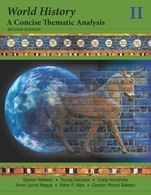
World History: A Concise Thematic Analysis, Volume 2
ISBN 9781118532720
Autor: Steven Wallech, Touraj Daryaee, Craig Hendricks, Anne Lynne Negus, Peter P. Wan, Gordon Morris Bakke
Wydawca: Wiley
Dostępność: 3-6 tygodni
Cena: 195,30 zł
Przed złożeniem zamówienia prosimy o kontakt mailowy celem potwierdzenia ceny.
ISBN13: |
9781118532720 |
ISBN10: |
1118532724 |
Autor: |
Steven Wallech, Touraj Daryaee, Craig Hendricks, Anne Lynne Negus, Peter P. Wan, Gordon Morris Bakke |
Oprawa: |
Paperback |
Rok Wydania: |
2012-12-19 |
Numer Wydania: |
2nd Edition |
Ilość stron: |
448 |
Wymiary: |
279x215 |
Tematy: |
HB |
Developed after years of experience teaching world history, the second, substantially revised edition of this pioneering text deftly guides the student reader through the vast array of details that litters the landscape of humanity′s past, breaking down an otherwise unwieldy narrative into meaningful and comprehensive chapters. The use of central, recurrent themes in the text enables a comparative analysis of the great civilizations that developed in Eurasia, Africa, and the Americas. These themes also address problems of food production, population dynamics, disease history, warfare, the ecological impact of human activity, and the role climate played in the history of civilization. This new edition of World History: A Concise Thematic Analysis features a newly–designed interior organization to enhance navigation and comprehension of the material. An instructors’ test bank is available online.
Volume 2 Introduction x Unit Three: The Modern World 371 Themes: Modernization Globalization The differential of power Chapter 18: Spontaneous European Modernization: Phase One The Process of Change Begins 375 Simultaneous Revolutions: Phase I, New Trade Routes 376 Simultaneous Revolutions: Phase II, Biology and Europe 377 Simultaneous Revolutions: Phase III, Warfare, Politics, and Religion 380 Simultaneous Revolutions: Phase IV, Commerce 386 Simultaneous Revolutions: Phase V, the State 402 special topic: The Elizabethan Era 406 Suggested Reading 413 Chapter 19: The Differential of Power: Phase One The Americas and Africa 415 Ship Technology in 1500 416 Spain′s Rapid Success in the Americas after a Slow Start 422 special topic New Spain 422 A Hidden Agent in the Differential of Power: Disease 423 Native American Vulnerability 427 The Aztecs 429 The Incas 432 Brazil 433 Africa′s Indigenous Slave Tradition 35 special topic: The Middle Passage: The Transport of Slaves on the Trans–Atlantic Trip 436 The Arrival of Europe 439 The Sale of Slaves 441 Consequences of the Slave Trade 442 Suggested Reading 446 Chapter 20: Spontaneous European Modernization: Phase Two The Origins of Public Opinion, the Concept of Culture, and the Nation–State 447 Science, Knowledge, and Faith 447 The Scientific Revolution 449 Locke′s Philosophy and the Idea of Public Opinion 452 The Enlightenment 458 The Nation–State 470 The Ideology of Revolution 472 The French Revolution 474 Great Britain 478 Suggested Reading 482 Chapter 21: The Nation–State Diffusion of the French–British Model 484 The Central European Experience 485 Central Europeans and Internal Coherence 487 Suggested Reading 495 Chapter 22: The Differential of Power, Phase Two Ideology, Medicine, and Technology Redefine Global Power 497 The New Teleology 499 Nation–States and Industry 510 Suggested Reading 514 Chapter 23: Nation–State Formation outside Europe The United States and Japan 515 The United States 516 Japan 525 Suggested Reading 533 Chapter 24: Internal Divisions and Contradictions Russia and Latin America 534 Russia 534 Latin America 550 Suggested Reading 556 Chapter 25: In the Crosshairs of Modernity India and China 557 India 557 Late Imperial China: The Ming and Qing Dynasties 564 Suggested Reading 583 Chapter 26: Targets of Imperialism Africa and the Middle East 585 Africa 586 The Middle East 596 Suggested Reading 605 Unit Four: Global Violence and the Postmodern Era 607 Themes: Postmodern Era Decolonization Globalization Chapter 27: World War I The Consequences of Power 611 The Illusion of Progress 612 The Quest for Empire and the Habits of Violence 613 Danger Signs in the Short–War Phenomenon 615 Misunderstanding the Short–War Phenomenon 617 World War I: Total War, the Geographic Arena of Combat, Victory, and Defeat 618 Suggested Reading 623 Chapter 28: Totalitarianism The Soviet Union and Nazi Germany 624 Totalitarianism 625 The Soviet Union 625 special topic: Abandoned Marxism 631 special topic: The Versailles Treaty 634 Nazi Germany 634 Suggested Reading 641 Chapter 29: The Inheritors of Power The United States and Japan 642 The United States 642 Japan 647 Suggested Reading 655 Chapter 30: Decolonization Phase One 656 China′s Republican Revolution 656 India 663 The Middle East 665 Latin America 670 Suggested Reading 674 Chapter 31: World War II and the Beginning of the Cold War Expanding the Potential of Self–Destruction 676 World War II 676 special topic Mussolini′s Italy 681 Mass Murder: A New Dimension to Global Warfare 686 The Cold War: Redefining World Power after 1945 690 Suggested Reading 695 Chapter 32: Global Decolonization Phase Two 696 China 696 Japan 705 India 711 Africa 714 special topic: AIDS 721 The Middle East 722 Latin America 728 Suggested Reading 737 Chapter 33: The End of the Cold War and the Contemporary World The Complex Problems Facing a Multicultural Era 739 The End of the Cold War 739 special topic: The Legacy of Vietnam 743 The Contemporary World 745 Status, Freedom, and Equality 751 Population Dynamics 757 Suggested Reading 760 Credits C–1 Index I–1 MAPS The Columbian Exchange and the Slave Trade 374 The World Between World War I and II 610 The Imperial Era (1850–1914) 584 1945 to the Present 740
Steven Wallech is the senior Professor of World History at Long Beach City College. He developed the world history program there, and integrated the world history curriculum with community colleges and universities throughout California. Craig Hendricks is Emeritus Professor of History at Long Beach City College. He has written on Latin America for history journals and edited four books of American social history readings. Touraj Daryaee is theHoward C. Baskerville Professor of Iran and the Persianate World and the Associate Director of the Dr. Samuel Jordan Center for Persian Studies and Culture at the University of California, Irvine. He is editor of the Name–ye–Iran–e Bastan : The International Journal of Ancient Iranian Studies and the creator of Sasanika : The Late Antique Near East Project. Anne Lynne Negus received her Ph.D. in Ancient Near Eastern Languages and Cultures, specializing in Egyptology. Currently she is Professor of History at Fullerton College and Co–Coordinator of the Honors Program. Peter P. Wan received his B.A. from East China Normal University and taught American literature in China until he came to the United States on a Harvard–Yanching fellowship. He received his Ph.D. in the History of American Civilization from Harvard University. His major interests are American history, East Asian history, and U.S.–China relations. Gordon Morris Bakken earned his degrees at the University of Wisconsin and joined the faculty of California State University, Fullerton, in 1969. He teaches courses on American legal history, women in American history, westward movement, and American military heritage.
Koszyk
Książek w koszyku: 0 szt.
Wartość zakupów: 0,00 zł
Informacje


Kontakt
Gambit
Centrum Oprogramowania
i Szkoleń Sp. z o.o.
Al. Pokoju 29b/22-24
31-564 Kraków
Siedziba Księgarni
ul. Kordylewskiego 1
31-542 Kraków
+48 12 410 5991
+48 12 410 5987
+48 12 410 5989
Subskrypcje
Administratorem danych osobowych jest firma Gambit COiS Sp. z o.o. Na podany adres będzie wysyłany wyłącznie biuletyn informacyjny.
Autoryzacja płatności

Informacje na temat autoryzacji płatności poprzez PayU.

© Copyright 2012: GAMBIT COiS Sp. z o.o. Wszelkie prawa zastrzeżone.
Projekt i wykonanie: Alchemia Studio Reklamy