


Wydawcy
Katalog tematyczny
- Archeologia (109)
- Ekonomia, finanse, business (13704)
- Filozofia (1445)
- Historia (3040)
- Języki i językoznawstwo (2356)
- Lifestyle, hobby i rozrywka (475)
- Medycyna (9704)
- Nauki humanistyczne (4)
- Nauki o Ziemi i środowisku (2638)
- Nauki ścisłe (20412)
- Nauki społeczne (8486)
- Nauki techniczne (13450)
- Prawo (1696)
- Publikacje informacyjne i interdyscyplinarne (1288)
- Religia i wierzenia (917)
- Technika komputerowa (4067)
- Zdrowie, relacje międzyludzkie i rozwój osobisty (657)





Informacje szczegółowe o książce
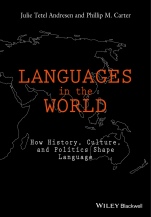
Languages In The World: How History, Culture, and Politics Shape Language
ISBN 9781118531280
Autor: Julie Tetel Andresen, Phillip M. Carter
Wydawca: Wiley
Dostępność: 3-6 tygodni
Cena: 238,35 zł
Przed złożeniem zamówienia prosimy o kontakt mailowy celem potwierdzenia ceny.
ISBN13: |
9781118531280 |
ISBN10: |
1118531280 |
Autor: |
Julie Tetel Andresen, Phillip M. Carter |
Oprawa: |
Paperback |
Rok Wydania: |
2016-01-01 |
Ilość stron: |
400 |
Wymiary: |
257x165 |
Tematy: |
CF |
Including detailed linguistic analysis of an array of languages,coupled with sociological, historical, and biologicalinsight, Languages in the World provides auniquely interdisciplinary account of the evolution of languageover the past 200,000 years. Tetel Andresen and Carter expertlyillustrate the reciprocal nature of the relationship betweenlanguage and society by balancing detailed discussion of thestructure and distribution of specific languages with engagingpersonal and political narratives. Exercises and questions forfurther discussion are included at the end of each chapter and acompanion website features sound files and a host of additionalsupplementary material.
From the role of Sanskrit in philology to a detailed analysis ofthe effects of globalization on world language, this innovative newbookwill be an essential tool for anyone interested in betterunderstanding how language has evolved and where it is going.Map of the Languages of the World i
IPA Consonant and Vowel Charts ii
List of Images iii
List of Maps iv
Preface: To Our Readers iv
PART I. LINGUISTIC PRELIMINARIES: APPROACH AND THEORY
Introductory Note: On Language
Chapter One All Languages Were Once Spanglish
The Mexican State of Coahuila y Tejas
1. What is Language?
2. How Many Languages are There?
3. How and When did Language Get Started?
4. The Structure of Spanglish
Final Note: The Encounter of Spanish and English on AmericanTelevision
Exercises
Discussion Questions
Chapter Two The Language Loop
The Australian Walkabout
1. Introducing the Language Loop
2. Language and Cognition
3. Language, the World, and Culture
4. Language and Linguistic Structure
5. Language, Discourse, and Ideology
6. On Major and Minor Languages
Final Note: The Contingencies of Time, Place, and Biology
Exercises
Discussion Questions
Chapter Three Linguistics and Classification
The Role of Sanskrit in Philology
1. On Linguistics, Philology, Linguists, and Grammarians
2. Genetic Classification
3. Areal Classification
4. Typological Classification
5. Functional Classification
Final Note: The Role of Sanskrit in India Today
Exercises
Discussion Questions
PART II. EFFECTS OF POWER
Introductory Note: On Power
Chapter Four Effects of the Nation–State and the Possibilityof Kurdistan
Lines Are Drawn in the Sand
1. The Status of Language on the Eve of the Nation–State
2. The Epistemology of the Nation–State
3. The French Revolution, German Romanticism, and PrintCapitalism
4. Standardization and the Instilling of Vergonha
5. Language and Individual Identity
6. What s Race Got to do With It?
7. The Problematic Race–Nation–Language Triad: Three CaseStudies
Final Note: The Kurds Today Different Places, DifferentOutcomes
Language Profile: Kurdish
Exercises
Discussion Questions
Chapter Five The Development of Writing in the Litmus ofReligion and Politics
The Story of the Qur ân
1. The Magico–Religious Interpretations of the Origins ofWriting
2. Steps Toward the Representation of Speech
3. Types of Writing Systems
4. Religion and the Spread of Writing
5. The Always Already Intervention of Politics
6. Orality and Literacy
Final Note: Azerbaijan Achieves Alphabetic Autonomy
Language Profile: Arabic
Exercises
Discussion Questions
Chapter Six Language Planning and Language Law: Shaping theRight to Speak
Melting Snow and Protests at the Top of the World
1. Language Academies: The First Enforcers
2. Another Look at Prescriptivism
3. Making Language Official: A Tale of Three Patterns
4. Language Policy and Education: A Similar Tale of ThreePatterns
5. Language Planners and Language Police
Final Note: Choosing Death or Life
Language Profile: Tibetan
Exercises
Discussion Questions
PART III: EFFECTS OF MOVEMENT
Introductory Note: On Movement
Chapter Seven A Mobile History: Mapping Language Stocks andFamilies
Austronesian Origin Stories
1. Population Genetics and Links to Language
2. A Possible Polynesian Reconstruction
3. Linguistic Reconstructions Revisited
4. Proto–Indo–European and its Homeland
5. Other Language Stocks and Their Homelands
6. Models of Language Spread
7. Lost Tracks
Final Note: On Density and Diversity
Language Profile: Hawaiian
Exercises
Discussion Questions
Chapter Eight Colonial Consequences: Language Stocks andFamilies Remapped
Eiffel Towers in Vietnam
1. Time–Depths and Terminology
2. The Middle Kingdom: Government Encouraged Migrations
3. Linguistic Geography: Residual Zones and Spread Zones
4. Eurasian Empires: Persians, Mongols, Slavs, and Romans
5. Religions as Proto–Nations and Missionaries as Colonizers
6. English as an Emergent Language Family
Final Note: Creoles and the Case of Kreyòl Ayisyen
Language Profile: Vietnamese
Exercises
Discussion Questions
Chapter Nine Postcolonial Complications: ViolentOutcomes
Tamil Tigers Create New Terrorist Techniques
1. What s in a Name? Burma/Myanmar
2. Modern Sudan: The Clash of Two Colonialisms
3. The Caucasian Quasi–States: Two Types of Conflict
4. Poland s Shifting Borders
5. Basque and the Terrorist ETA
6. The Zapatista Uprising and Indigenous Languages inChiapas
Final Note: The Parsley Massacre
Language Profile: Tamil
Exercises
Discussion Questions
PART IV: EFFECTS OF TIME
Introductory Note: On Time
Chapter Ten The Remote Past: Language BecomesEmbodied
Look there!
1. Seeking Linguistic Bedrock
2.The Primate Body and Human Adaptations to Language
3. Evolution in Four Dimensions
4. The Genetic Story
5. Grammatical Categories and Deep–Time Linguistics
6. Complexity and the Arrow of Time
Final Note: The Last Stone Age Man in North America
Language Profile: !Xóõ
Exercises
Discussions Questions
Chapter Eleven The Recorded Past: Catching up toConditions Made Visible
Mongolian Horses
1. Chapter Three. The Invariable Word in English
2. Chapter Four. The Shift to Head–Marking in French
3. Chapter Five. Writing and e–Arabic
4. Chapter Six. Mongolian Cases
5. Chapter Seven. Reformulating Hawaiian Identity
6. Chapter Eight. Varieties of Chinese: Yesterday and Today
7. Chapter Nine. Juba Arabic Pidgin, Nubi, and Other AfricanCreoles
Final Note: Language Change in Progress
Language Profile: Mongolian
Exercises
Discussion Questions
Chapter Twelve The Imagined Future: Globalization and TheFate of Endangered Languages
Gold in the Mayan Highlands
1. Beyond the Nation–State: The Globalized New Economy
2. Money Talks: What Language Does it Speak?
3. When the Language Loop Unravels
4. Language Hotspots
5. Rethinking Endangerment
6. Technology to the Rescue
7. Anishinaabemowin Revitalization in Wisconsin
8. What Is Choice?
Final Note: Our Advocacies
Language Profile: Quiché
Discussion Questions
References
Subject Index
Language Index
Julie Tetel Andresen is Professor of English and formerChair of Linguistic at Duke University. A linguistichistoriographer focusing on French, German, British, and Americantheories of language from the eighteenth to the twenty–firstcenturies, she is the author of Linguistics and Evolution:A Developmental Approach (2013) and Linguistics inAmerica 1769 1924: A Critical History (1996).
Phillip M. Carter is Assistant Professor of English andLinguistics at Florida International University. Specializing inimmigrant and ethnolinguistic minority communities in the UnitesStates, his work on the language varieties and cultural practicesof U.S. Latinos has been published in leading journals,including Language in Society, EnglishWorldwide, Journal ofSociolinguistics, American Speech,and Language in Linguistics Compass.
Koszyk
Książek w koszyku: 0 szt.
Wartość zakupów: 0,00 zł
Informacje


Kontakt
Gambit
Centrum Oprogramowania
i Szkoleń Sp. z o.o.
Al. Pokoju 29b/22-24
31-564 Kraków
Siedziba Księgarni
ul. Kordylewskiego 1
31-542 Kraków
+48 12 410 5991
+48 12 410 5987
+48 12 410 5989
Subskrypcje
Administratorem danych osobowych jest firma Gambit COiS Sp. z o.o. Na podany adres będzie wysyłany wyłącznie biuletyn informacyjny.
Autoryzacja płatności

Informacje na temat autoryzacji płatności poprzez PayU.

© Copyright 2012: GAMBIT COiS Sp. z o.o. Wszelkie prawa zastrzeżone.
Projekt i wykonanie: Alchemia Studio Reklamy