


Wydawcy
Katalog tematyczny
- Archeologia (109)
- Ekonomia, finanse, business (13704)
- Filozofia (1445)
- Historia (3040)
- Języki i językoznawstwo (2356)
- Lifestyle, hobby i rozrywka (475)
- Medycyna (9704)
- Nauki humanistyczne (4)
- Nauki o Ziemi i środowisku (2638)
- Nauki ścisłe (20412)
- Nauki społeczne (8486)
- Nauki techniczne (13450)
- Prawo (1696)
- Publikacje informacyjne i interdyscyplinarne (1288)
- Religia i wierzenia (917)
- Technika komputerowa (4067)
- Zdrowie, relacje międzyludzkie i rozwój osobisty (657)





Informacje szczegółowe o książce
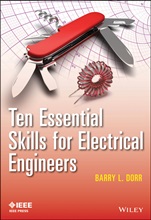
Ten Essential Skills for Electrical Engineers
ISBN 9781118527429
Autor: Barry L. Dorr
Wydawca: Wiley
Dostępność: 3-6 tygodni
Cena: 260,40 zł
Przed złożeniem zamówienia prosimy o kontakt mailowy celem potwierdzenia ceny.
ISBN13: |
9781118527429 |
ISBN10: |
1118527429 |
Autor: |
Barry L. Dorr |
Oprawa: |
Paperback |
Rok Wydania: |
2014-06-03 |
Ilość stron: |
268 |
Wymiary: |
233x156 |
Tematy: |
KM |
Presents an uncommonly insightful perspective of the insights, experience, and wisdom of the author regarding the craft of electrical engineering. This book is a must have on the bookshelf of any newly practicing hardware engineer and those who mentor them.
Roger Colbath, Engineering Director, ViaSat, Inc.
In today s competitive marketplace, engineering students and professionals need every advantage to succeed in job interviews and in the industry. This insightful book will serve as a valuable reference for them throughout the interview process and while on the job.
Ten Essential Skills for Electrical Engineers applies the fundamentals learned in school to the practical tasks required by employers. With the ultimate goal of helping readers land a job and succeed at it, the book offers insightful chapters that teach them how to: design resistive circuits; prevent thermal failures; analyze circuits; use statistics to design manufacturable products; design feedback control systems; design op–amp circuits; design analog and digital filters; and work with high–frequency digital and RF signals.
Written in an intuitive, easy–to–follow style, the book:
Enables recent graduates in engineering to succeed in challenging technical interviews Reviews practical skills using the latest tools and techniques Focuses on the intersection between company–specific knowledge and engineering fundamentals Offers real–life, industry case studies, examples, and commentary from employers and practicing engineers Provides a companion website containing interview practice problems and advanced material for readers seeking additional expertiseTen Essential Skills for Electrical Engineers is a must–have book for aspiring and current engineers who wish to approach their next job interview confident in their grasp of the engineering skills that employers are seeking.
Preface xi
Acknowledgments xiii
About the Author xv
About the Reviewers xvii
Note to Instructors xxi
1 HOW TO DESIGN RESISTIVE CIRCUITS 1
1.1 Design of a Resistive Thevenin Source 2
1.2 Design of a Coupling Circuit 4
1.3 Design of a Pi Attenuator 8
Problems 14
References 17
2 HOW TO PREVENT A POWER TRANSISTOR FROM OVERHEATING19
2.1 Electrical Model for Heat Transfer 20
2.2 Using Manufacturer s Data for Thermal Analysis 23
2.3 Forced–Air Cooling 26
2.4 Dynamic Response of a Thermal System 27
Problems 30
Reference 32
3 HOW TO ANALYZE A CIRCUIT 33
3.1 Frequency Response of a Transfer Function 34
3.2 Frequency Response and Impedance of Simple Circuits 38
3.3 Frequency Response for Ladder Networks 51
3.4 Generalized Technique for Determining Frequency Response54
Problems 58
References 60
4 HOW TO USE STATISTICS TO ENSURE A MANUFACTURABLE DESIGN61
4.1 Independent Component Failures 62
4.2 Using the Gaussian Distribution 63
4.3 Setting a Manufacturing Test Limit 68
4.4 Procuring a Custom Component 71
Problems 76
References 77
5 HOW TO DESIGN A FEEDBACK CONTROL SYSTEM 79
5.1 Intuitive Description of a Control System 80
5.2 Review of Control System Operation 81
5.3 Performance of Control Systems 84
5.4 First–Order Control System Design 84
5.5 Second–Order Control System Design 88
5.6 Circuit Realization of a Second–Order Control System 94
5.7 First–Order Discrete Control System 95
Problems 101
References 102
6 HOW TO WORK WITH OP–AMP CIRCUITS 103
6.1 The Ideal Op–Amp 104
6.2 Practical Op–Amps 108
6.2.1 Effect of Input Offset Voltage 108
6.2.2 Noise Contribution from Op–Amp Circuits 110
6.2.3 Dynamic Characteristics of Op–Amp Circuits 113
6.2.4 Effect of Capacitive Loading 116
6.2.5 A Nagging Issue 118
Problems 119
References 121
7 HOW TO DESIGN ANALOG FILTERS 123
7.1 Passive Versus Active Filters 124
7.2 The Lowpass RC Filter 125
7.3 Filter Response Characteristics 129
7.4 Specification of Filter Type 131
7.5 Generalized Filter Design Procedure 132
7.6 Design of Active Lowpass Filters 136
7.7 Design of Passive RF Filters 139
Problems 146
References 148
8 HOW TO DESIGN DIGITAL FILTERS 149
8.1 Review of Sampling 150
8.2 Using the z–Transform to Determine the Transfer Function andFrequency Response of Digital Filters 155
8.3 FIR and IIR Digital Filters 161
8.3.1 FIR Filters 162
8.3.2 IIR Filters 165
8.3.3 Comparisons between FIR and IIR Filters 167
8.4 Design of Simple and Practical Digital Filters 168
8.4.1 Averaging Lowpass FIR Filter 168
8.4.2 Lowpass FIR/IIR Filter 171
Problems 177
References 181
9 HOW TO WORK WITH RF SIGNALS 183
9.1 Energy Transfer 185
9.2 Signal Reflections 187
9.3 Effect of Signal Reflections on Digital Signals 190
9.4 Effect of Signal Reflections on Narrowband Signals 195
9.5 The Smith Chart 198
9.6 Using the Smith Chart to Display Impedance Versus Frequency205
9.7 Final Comments Regarding the Smith Chart 205
Problems 206
References 209
10 GETTING A JOB KEEPING A JOB ENJOYING YOUR WORK211
10.1 Getting a Job 212
10.1.1 Getting an Interview 214
10.1.2 Preparing for an Interview 216
10.1.3 The Interview 217
10.1.4 Selecting the Right Offer 220
10.2 Keeping a Job 221
10.2.1 The First Year 221
10.2.2 After the First Year 224
10.3 Enjoying Your Work 227
Afterword 231
Answers to Problems 233
Index 243
BARRY L. DORR, PE, is a Principal Design Engineer at Datron World Communications. He has taught Circuit Analysis at San Diego State University, Servo Systems for the IEEE, and numerous industrial seminars. He holds eight patents for signal processing and communication devices, and has contributed articles to Embedded Computing Magazine, Electronic Design News, and various trade publications.
Koszyk
Książek w koszyku: 0 szt.
Wartość zakupów: 0,00 zł
Informacje


Kontakt
Gambit
Centrum Oprogramowania
i Szkoleń Sp. z o.o.
Al. Pokoju 29b/22-24
31-564 Kraków
Siedziba Księgarni
ul. Kordylewskiego 1
31-542 Kraków
+48 12 410 5991
+48 12 410 5987
+48 12 410 5989
Subskrypcje
Administratorem danych osobowych jest firma Gambit COiS Sp. z o.o. Na podany adres będzie wysyłany wyłącznie biuletyn informacyjny.
Autoryzacja płatności

Informacje na temat autoryzacji płatności poprzez PayU.

© Copyright 2012: GAMBIT COiS Sp. z o.o. Wszelkie prawa zastrzeżone.
Projekt i wykonanie: Alchemia Studio Reklamy