


Wydawcy
Katalog tematyczny
- Archeologia (109)
- Ekonomia, finanse, business (13704)
- Filozofia (1445)
- Historia (3040)
- Języki i językoznawstwo (2356)
- Lifestyle, hobby i rozrywka (475)
- Medycyna (9704)
- Nauki humanistyczne (4)
- Nauki o Ziemi i środowisku (2638)
- Nauki ścisłe (20412)
- Nauki społeczne (8486)
- Nauki techniczne (13450)
- Prawo (1696)
- Publikacje informacyjne i interdyscyplinarne (1288)
- Religia i wierzenia (917)
- Technika komputerowa (4067)
- Zdrowie, relacje międzyludzkie i rozwój osobisty (657)





Informacje szczegółowe o książce
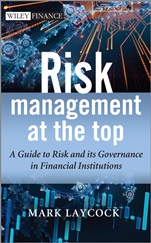
Risk Management At The Top: A Guide to Risk and its Governance in Financial Institutions
ISBN 9781118497425
Autor: Mark Laycock
Wydawca: Wiley
Dostępność: 3-6 tygodni
Cena: 260,40 zł
Przed złożeniem zamówienia prosimy o kontakt mailowy celem potwierdzenia ceny.
ISBN13: |
9781118497425 |
ISBN10: |
1118497422 |
Autor: |
Mark Laycock |
Oprawa: |
Hardback |
Rok Wydania: |
2014-01-06 |
Ilość stron: |
336 |
Wymiary: |
231x159 |
Tematy: |
KF |
In the years since the financial crisis of 2007–2009, expectations and requirements for financial institutions have changed dramatically. Aside from technical issues, such as changes to capital requirements, there is an increased expectation of revitalised oversight of risk issues by the board and executive management.
Risk Management at the Top supports Non–Executive Directors and executive management in this by giving a comprehensive and succinct, nontechnical overview of risk and its governance in financial institutions. It outlines a number of governance perspectives, for the board and executive management, before exploring the main risk types experienced by banks. Key terminology and concepts are defined and explained, enabling improved communication between NEDs, executive management and the risk managers. Each chapter also contains a detailed bibliography to enable wider reading around the areas discussed.
By reading Risk Management at the Top, current and aspiring Non–Executive Directors will receive a thorough grounding in all the relevant elements of risk, enabling them to participate effectively in its oversight and management.
About the Author xiii
1 Introduction 1
1.1 Introduction 2
1.2 Boards 3
1.3 Why Now? 5
1.4 Rest of the Book 7
Further Reading 9
PART I RISK OVERSIGHT 11
2 Risk An Overview 15
2.1 Terminology 16
2.2 Role of Banks and Risk 22
2.3 Sources of Risk and Uncertainty 25
2.4 Capital 28
2.5 Issues to Consider 34
Further Reading 35
3 Risk Oversight 37
3.1 Introduction 38
3.2 Perspective 39
3.3 Models 43
3.4 Risk Framework 45
3.5 Biases 54
3.6 Issues to Consider 56
Further Reading 57
4 Risk Management 59
4.1 Introduction 60
4.2 Terminology and Components 61
4.3 Risk Management Cycle 65
4.4 Issues to Consider 73
Further Reading 74
5 Risk Appetite 75
5.1 Introduction 76
5.2 Terminology and Concept 77
5.3 Stakeholders 79
5.4 Expressions of Risk Appetite 82
5.5 Framework 87
5.6 Risk Reporting 91
5.7 Issues to Consider 94
Further Reading 95
6 RiskCulture 97
6.1 Introduction 98
6.2 Terminology 100
6.3 Assessing and Influencing Risk Culture 108
6.4 Monitoring Risk Culture 117
6.5 Issues to Consider 118
Further Reading 119
PART II SPECIFIC RISKS 121
7 Credit Risk 125
7.1 Introduction 126
7.2 Definition of Credit Risk 127
7.3 Framework 130
7.4 Risk Appetite Metrics 134
7.5 Credit Risk Management 149
7.6 Issues to Consider 158
Further Reading 158
8 Market Risk 159
8.1 Introduction 160
8.2 Definition of Market Risk 161
8.3 Market Risk Framework 164
8.4 Market Risk Estimation 171
8.5 Market Risk Management 183
8.6 Issues to Consider 188
Further Reading 188
9 Operational Risk 191
9.1 Introduction 192
9.2 Definition of Operational Risk 193
9.3 Operational Risk Framework 196
9.4 Operational Risk Estimation 202
9.5 Operational Risk Management 208
9.6 Issues to Consider 213
Further Reading 214
10 Liquidity Risk 215
10.1 Introduction 216
10.2 Definition of Liquidity Risk 217
10.3 Liquidity Risk Framework 220
10.4 Liquidity Risk Measurement 224
10.5 Liquidity Risk Management 229
10.6 Issues to Consider 233
Further Reading 234
11 Other Risks 235
11.1 Introduction 236
11.2 Reputational Risk 237
11.3 Strategic Risk 239
11.4 Business Risk 241
11.5 Other Market Risks 242
11.6 Model Risk 244
11.7 Supplier Risk 247
11.8 Resources 249
11.9 Issues to Consider 251
Further Reading 252
12 Risk Interactions 253
12.1 Introduction 254
12.2 Risks as Frequency and Severity Drivers 256
12.3 Risk Interactions 259
12.4 Implications for Risk Management and Measurement 266
12.5 Issues to Consider 269
Further Reading 269
PART III REGULATORY ENVIRONMENT 271
13 Regulatory Environment 275
13.1 Introduction 276
13.2 Structure of Prudential Regulatory Process 277
13.3 Scope of Prudential Regulation 286
13.4 Regulatory Influence 299
Further Reading 303
Disclaimer Regarding Excerpts from S&P Materials 305
Index 307
Mark Laycock has experience across the risk disciplines that attract regulatory capital. He is highly regarded within the Operational Risk discipline. He began working on Operational Risk in 1998 whilst at Deutsche Bank, which he joined in 1996. In 1999 banking regulators wanted an explicit capital requirement for operational risk. He worked with several industry groups developing practices and helped to establish the Operational Risk Data eXchange (ORX) in 2002. His involvement in Market Risk spans a decade from the mid–1980s. He was also a trader of Fixed Income and Equity strategies, such as equity index arbitrage. The later part of his Market Risk decade was spent at the Bank of England, Banking Supervision Division. Since 2008 Mark has worked for ORX on topics such as the categorisation of Operational Risk, Scenarios and Operational Risk Appetite. He also has a consulting company Alder Partners. Mark has an MBA, from Manchester Business School, where his dissertation was on Maturity and Interest Rate Mis–Matching of Banks.
Koszyk
Książek w koszyku: 0 szt.
Wartość zakupów: 0,00 zł
Informacje


Kontakt
Gambit
Centrum Oprogramowania
i Szkoleń Sp. z o.o.
Al. Pokoju 29b/22-24
31-564 Kraków
Siedziba Księgarni
ul. Kordylewskiego 1
31-542 Kraków
+48 12 410 5991
+48 12 410 5987
+48 12 410 5989
Subskrypcje
Administratorem danych osobowych jest firma Gambit COiS Sp. z o.o. Na podany adres będzie wysyłany wyłącznie biuletyn informacyjny.
Autoryzacja płatności

Informacje na temat autoryzacji płatności poprzez PayU.

© Copyright 2012: GAMBIT COiS Sp. z o.o. Wszelkie prawa zastrzeżone.
Projekt i wykonanie: Alchemia Studio Reklamy