


Wydawcy
Katalog tematyczny
- Archeologia (109)
- Ekonomia, finanse, business (13704)
- Filozofia (1445)
- Historia (3040)
- Języki i językoznawstwo (2356)
- Lifestyle, hobby i rozrywka (475)
- Medycyna (9704)
- Nauki humanistyczne (4)
- Nauki o Ziemi i środowisku (2638)
- Nauki ścisłe (20412)
- Astronomia (294)
- Biologia (5119)
- Chemia (6540)
- Chemia analityczna (361)
- Chemia fizyczna (346)
- Chemia nieorganiczna (137)
- Chemia organiczna (535)
- Krystalografia (27)
- Minerologia (46)
- Fizyka (3309)
- Matematyka (4574)
- Nauki ścisłe, ogólnie (503)
- Nauki społeczne (8486)
- Nauki techniczne (13450)
- Prawo (1696)
- Publikacje informacyjne i interdyscyplinarne (1288)
- Religia i wierzenia (917)
- Technika komputerowa (4067)
- Zdrowie, relacje międzyludzkie i rozwój osobisty (657)





Informacje szczegółowe o książce
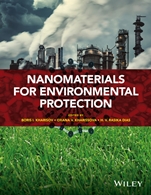
Nanomaterials for Environmental Protection
ISBN 9781118496978
Autor: Boris I. Kharisov, Oxana Vasilievna Kharissova, H. V. Rasika Dias
Wydawca: Wiley
Dostępność: 3-6 tygodni
Cena: 708,75 zł
Przed złożeniem zamówienia prosimy o kontakt mailowy celem potwierdzenia ceny.
ISBN13: |
9781118496978 |
ISBN10: |
1118496973 |
Autor: |
Boris I. Kharisov, Oxana Vasilievna Kharissova, H. V. Rasika Dias |
Oprawa: |
Hardback |
Rok Wydania: |
2015-03-17 |
Ilość stron: |
592 |
Wymiary: |
287x217 |
Tematy: |
PN |
Provides interdisciplinary approach to applying nanomaterials to disinfect water, air and soil Environmental applications of nanotechnology have, for decades, been productive in the treatment of surface water, groundwater and wastewater. With emerging nano–based products, nanotechnology continues to deal efficiently with contaminants, including toxic metal ions, organic and inorganic solutes and microorganisms , in water treatment systems. Comprehensively written by experts in the field, Nanomaterials for Environmental Protection presents and covers in depth the various nanomaterial processing methods for water, air, and soil solutions, with an emphasis on environmental risks. This book is divided into four main sections and provides: – Background review on nanomaterials′ two–decade study – Discussion of the characterization and application of unconventional disinfectants, namely antimicrobial nanomaterials – Special attention to the process of remediation, synthetics techniques, and properties of nanomaterials – Examples to which readers, with or without afore knowledge of the field, can relate and apply their research Despite the continuous struggle with contamination and pollution in our everyday environments, the research and development of nano–based technologies continue to expand and discover the ultimate purification solution. This book reflects the endeavour of renowned experts in the ever–growing field by sharing and informing readers of the state–of–the–art techniques for environmental protection, taking into account the nonconventional ones, as well as the hazardous implications of certain methods.
Remediation with use of metals, metal oxides, complexes and composites 1. Groundwater water remediation by static diffusion using nano–zero valent metals [ZVM](Fe 0 , Cu 0 , Al 0 ), n–FeH n+ , n–Fe(OH) x , n–FeOOH, n–Fe–[O x H y ] (n+/–) David D. J. Antia 2. Nanostructured metal oxides for waste–water disinfection Erick R. Bandala, Marco A. Quiroz, Mónica Cerro–López, and Miguel A. Méndez–Rojas 3. Cu 2 O based nanocomposites for environmental protection: relationship between structure and photocatalytic activity, application and mechanism Liangbin Xiong, Xin Ba, Wenpei Zhang, Huaqing Yu, and Ying Yu 4. Multifunctional Nanocomposites for Environmental Remediation Suying Wei, Jiahua Zhu, Hongbo Gu, Huige Wei, Xingru Yan, Yudong Huang, and Zhanhu Guo 5. Nanomaterials for the Removal of Volatile Organic Compounds from Aqueous Solutions Amro El Badawy and Hafiz H.M. Salih 6. Hybrid metal nanoparticle–containing polymer nanofibers for environmental applications Yunpeng Huang, Shige Wang, Mingwu Shen, and Xiangyang Shi 7. Nanomaterials on the basis of chelating agents, metal complexes and organometallics for environmental purposes Boris I. Kharisov, Oxana V. Kharissova, and Ubaldo Ortiz Méndez Remediation with use of carbon nanotubes 8. Carbon nanotubes: Next–generation nanomaterials for clean water technologies Yit Thai Ong, Kian Fei Yee, Qian Wen Yeang, Sharif Hussein, Sharif Zein, and Soon Huat Tan Photocatalytical remediation 9. New advances of heterogeneous photocatalysis for treatment of toxic metals and arsenic Marta I. Litter and Natalia Quici 10. Nanostructured Titanium Dioxide for Photocatalytic Water Treatment David G. Rickerby 11. Destruction of chloroorganic compound with nanophotocatalysts Rashid A. Khaydarov, Renat R. Khaydarov, and Olga Gapurova 12. Semiconductor nanomaterials for organic dye degradation and hydrogen production via photocatalysis Leticia M. Torres–Martínez, Isaías Juárez–Ramírez, and Mayra Z. Figueroa–Torres Nanoadsorbents and Nanofiltration 13 Advanced oxidation processes, nanofiltration and application of bubble column reactor Sukanchan Palit 14 Carbon Nanomaterials (CNMs) as Adsorbents for Environmental Analysis Chaudhery Mustansar Hussain 15 Application of nano–adsorbents in water treatment Amit Bhatnagar and Mika Sillanpää 16 Organo–clay nanohybrid adsorbents for removal of toxic metal ions Peng Liu Membranes on nanomaterials basis 17 Water remediation using nanoparticle and nanocomposite membranes Kian Fei Yee, Qian Wen Yeang, Yit Thai Ong, Vel Murugan Vadivelu, and Soon Huat Tan Green methods in nanomaterials synthesis 18 Greener methodologies in the synthesis of metal and metal oxide nanoparticles Aniruddha B. Patil and Bhalchandra M. Bhanage 19 An Environmentally Friendly and Green Approach for Synthesis and Applications of Silver nanoparticles Muralidharan Murugan, Kevin John Pulikotil Anthony, Muniyandi Jeyaraj, and Sangiliyandi Gurunathan 20 Green synthesis of nanomaterials using biological routes Rajesh Ramanathan, Ravi Shukla, Suresh K. Bhargava, and Vipul Bansal CO 2 adsorption 21 Nanomaterials for carbon dioxide adsorption Luis Ángel Garza Rodríguez and Elsa Nadia Aguilera González Intelligent nanomaterials 22. Development of Intelligent Nanomaterials as a Strategy to Solve Environmental Problems Jose Ruben Morones–Ramírez Desalination 23. Engineered Nanomaterials for Purification and Desalination of Palatable Water Vijay C. Verma, Swechha Anand, Mayank Gangwar, and Santosh K. Singh Nanocatalysis 24 Nanocatalytic wastewater treatment system for the removal of toxic organic compounds Sodeh Sadjadi 25 Catalyst design based on nano–sized inorganic core of enzymes: design of environmentally friendly catalysts Mohammad Mahdi Najafpour Nanosensors 26 Neutron–Fluence Nanosensors Based on Boron–Containing Materials Levan Chkhartishvili Nanoreservoirs for hydrogen storage 27 Hydrogen nanoreservoirs made of boron nitride L evan Chkhartishvili Fuel cells on nanomaterials basis 28 Fuel cells with nanomaterials for ecologically pure transport Gennady Ya. Gerasimov Remediation of radionuclides 29 Humic Functional Derivatives and Nanocoatings for Remediation of Actinide Contaminated Environments I rina V. Perminova, Stepan N. Kalmykov, Natalia S. Shcherbina, Sergey A. Ponomarenko, Vladimir A. Kholodov, Alexander P. Novikov, Richard G. Haire, and Kirk Hatfield Environmental risks and toxicity 30 Environmental risks of nanotechnology: Evaluating the ecotoxicity of nanomaterials Miguel Angel Méndez–Rojas, José Luis Sánchez–Salas, and Aracely Angulo–Molina 31 Environmental risk, human health and toxic effects in nanoparticles Jamuna Bai A. and Ravishankar Rai V. 32 Implications of the use of nanomaterials for environmental protection – Challenges in designing environmentally relevant toxicological experiments Rute F. Domingos and José P. Pinheiro Concluding remarks The Editors
Boris I. Kharisov, PhD, is Professor and Researcher at the Universidad Autónoma de Nuevo León (UANL). He received his PhD in inorganic chemistry from the Moscow State University, Russia, in 1993. He holds two patents, has co–authored six books, five book chapters, 127 articles, and co–edited three invited special issues of international journals, and is the member of the editorial board of four journals. His specialties include coordination and inorganic chemistry, phthalocyanines, ultrasound, and nanotechnology. Oxana V. Kharissova, PhD, is Professor and Researcher at the UANL. She received her PhD in Materials from the Universidad Autónoma de Nuevo León, Mexico. She has co–authored three books, 60 articles, and has two patents. Her specialties include nanotechnology (carbon nanotubes, nanometals, fullerenes), and crystallography. H.V. Rasika Dias, PhD, is Professor of Chemistry at the University of Texas at Arlington. He received his PhD from University of California, Davis. Specializing in inorganic and organometallic chemistry, he has co–authored several patents and over 160 publications. His accolades include the 2009 Southwest Regional American Chemical Society Award.
Koszyk
Książek w koszyku: 0 szt.
Wartość zakupów: 0,00 zł
Informacje


Kontakt
Gambit
Centrum Oprogramowania
i Szkoleń Sp. z o.o.
Al. Pokoju 29b/22-24
31-564 Kraków
Siedziba Księgarni
ul. Kordylewskiego 1
31-542 Kraków
+48 12 410 5991
+48 12 410 5987
+48 12 410 5989
Subskrypcje
Administratorem danych osobowych jest firma Gambit COiS Sp. z o.o. Na podany adres będzie wysyłany wyłącznie biuletyn informacyjny.
Autoryzacja płatności

Informacje na temat autoryzacji płatności poprzez PayU.

© Copyright 2012: GAMBIT COiS Sp. z o.o. Wszelkie prawa zastrzeżone.
Projekt i wykonanie: Alchemia Studio Reklamy