


Wydawcy
Katalog tematyczny
- Archeologia (109)
- Ekonomia, finanse, business (13704)
- Filozofia (1445)
- Historia (3040)
- Języki i językoznawstwo (2356)
- Lifestyle, hobby i rozrywka (475)
- Medycyna (9704)
- Nauki humanistyczne (4)
- Nauki o Ziemi i środowisku (2638)
- Nauki ścisłe (20412)
- Nauki społeczne (8486)
- Nauki techniczne (13450)
- Prawo (1696)
- Publikacje informacyjne i interdyscyplinarne (1288)
- Religia i wierzenia (917)
- Technika komputerowa (4067)
- Zdrowie, relacje międzyludzkie i rozwój osobisty (657)





Informacje szczegółowe o książce
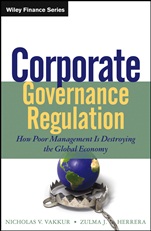
Corporate Governance Regulation: How Poor Management Is Destroying the Global Economy
ISBN 9781118496374
Autor: Nicholas V. Vakkur, Zulma J. Herrera
Wydawca: Wiley
Dostępność: 3-6 tygodni
Cena: 354,90 zł
Przed złożeniem zamówienia prosimy o kontakt mailowy celem potwierdzenia ceny.
ISBN13: |
9781118496374 |
ISBN10: |
111849637X |
Autor: |
Nicholas V. Vakkur, Zulma J. Herrera |
Oprawa: |
Hardback |
Rok Wydania: |
2013-03-12 |
Ilość stron: |
288 |
Wymiary: |
236x153 |
Tematy: |
KM |
Praise for Corporate Governance Regulation "Nicholas Vakkur has written an excellent critique of Sarbanes-Oxley and has made a very useful contribution, correctly pointing out that Sarb-Ox requirements would not have prevented some of the staggering corporate stock market losses that preceded the adoption of those requirements, or those that have come sincein part, because they were caused by intentional management activities, not unintended and undetected failures in control. As Vakkur points out, Sarb-Ox is 'impotent in the face of managerial override.'" Robert Grady, Chairman, New Jersey State Investment Council; Managing Partner, Cheyenne Capital Fund; former chairman, National Venture Capital Association; Lecturer in Public Management, Stanford Graduate School of Business; and member of the Management Committee, The Carlyle Group "Professor Vakkur makes a timely and vital contribution, showing how transparency can be achieved through developing an ethical climate rather than through a focus on regulation. This makes it essential reading for policymakers, students, and those in the corporate world." Des Laffey, Senior Lecturer, Kent Business School, UK; Co-Editor in Chief, Journal of Strategic Management Education "For those who seek to be informed about the need to change accounting . . . this is a promising and potentially valuable study addressing issues that are timely and relevant." Gary John Previts, E. Mandell de Windt Professor, Case Western Reserve University "This book is unique, as it seeks a restoration of the prior focus on ethical development (e.g., common within the U.S. prior to the 1950s), that trumps complex legal machinations as an efficacious means of achieving 'transparent' financial markets." Teresa T. Kaldor, PhD, former task manager of public sector reforms, USAID project (Manila, Philippines) "In this era of heightened regulation, we must critically analyze previous regulations to understand whether the objectives have been achieved, to improve or eliminate existing regulations, and to serve as a guide as more regulations are promulgated. Professor Vakkur's analysis provides an innovative and fresh look at whether Sarbanes-Oxley achieved its objectives of corporate transparency and accountability." Michael H. Messaglia, Partner, Krieg DeVault LLP "Vakkur's extensive research, valuable insights, and evaluation tools will help companies and their stakeholders." Timothy H. Carmon, CPA financial reporting/risk manager for a leading Fortune 500 firm "The impact of comprehensive financial regulations, properly envisaged at the global level, is not confined to the home country, write Nicholas Vakkur and Zulma Herrera. . . . A useful read for financial researchers." D. Murali, Deputy Editor, The Hindu Business Line
Preface ix Introduction xiii CHAPTER 1 Virtue Lost 1 Introduction 1 Methodology 4 Methodological Limitations 4 The Modern Corporation and Virtue 5 The Policy Framework 26 Conclusions 41 CHAPTER 2 An Introduction to WorldCom: A Policy Primer 47 Introduction 47 WorldCom 48 The Source of Conflict 50 Rules versus Laws 51 The Case for Intentionality 53 Regulatory Contribution 55 WorldCom as a Basis for the Sarbanes–Oxley Act 56 CHAPTER 3 The Enactment Process 59 Introduction 59 The Enactment Process 62 The Law’s Effects 69 Current Arguments in Favor of the Sarbanes–Oxley Act 75 Institutional Precedents 78 CHAPTER 4 CEO Perception 81 Summary 81 Introduction 81 Summary of Relevant Literature 82 Survey 83 Results 84 Discussion 88 Appendix to Chapter 4 89 CHAPTER 5 Sarbanes–Oxley’s Effect on Investor Risk 97 Summary 97 Introduction 98 Extending CAPM 99 Hypotheses 100 Evaluation of Risk 102 Estimation and Results 105 Discussion 114 CHAPTER 6 An Audit of Sarbanes–Oxley 125 Introduction 125 A Conceptual Foundation 126 Internal Controls 128 The Audit Framework 130 Effect on Unintentional Sources of Error 134 Effect on Corporate Malfeasance 138 Conclusions 146 CHAPTER 7 The Underlying Vision 149 Econometrics in Policy Analysis 149 A Model Predicated on ‘‘Unobservables’’ 151 Conclusions 165 CHAPTER 8 The Argument for Accountability 169 Introduction 169 Professional Liability 170 Policy Misuse 172 The Case for Culpability 174 The Improbability of Accountability 177 Conclusions 180 CHAPTER 9 Why Sarbanes–Oxley? 183 Introduction 183 Methodology 186 The Port Huron Statement 190 Why Sarbanes–Oxley? 202 Notes 205 About the Authors 263 Index 265
NICHOLAS V. VAKKUR is the founder of Vakkur.org, a non-partisan think tank that helps corporations manage risk while positively influencing corporate governance policy. Widely published in leading U.S. and international scholarly journals, Mr. Vakkur has been cited before the U.S. Supreme Court, the U.S. Senate, the U.S. Department of Justice, and various foreign entities; has been covered frequently in the news media; and has been invited to speak to Wall Street CEOs. He is an assistant professor of accounting at Trident University and has served as the CFO of a global nonprofit organization. Mr. Vakkur graduated summa cum laude from the University of Notre Dame and has a master's degree in public policy. ZULMA J. HERRERA, while with Goldman Sachs, participated at a senior level in various mergers of global corporations. Ms. Herrera has worked in-house with the executive teams of two global corporations and has served in a variety of senior roles within the technology industry. A noted corporate governance scholar, Ms. Herrera serves as the CEO of Vakkur.org, which enables corporate clients to manage risk effectively. Ms. Herrera graduated with honors from the University of Notre Dame and is acquiring an MBA.
Koszyk
Książek w koszyku: 0 szt.
Wartość zakupów: 0,00 zł
Informacje


Kontakt
Gambit
Centrum Oprogramowania
i Szkoleń Sp. z o.o.
Al. Pokoju 29b/22-24
31-564 Kraków
Siedziba Księgarni
ul. Kordylewskiego 1
31-542 Kraków
+48 12 410 5991
+48 12 410 5987
+48 12 410 5989
Subskrypcje
Administratorem danych osobowych jest firma Gambit COiS Sp. z o.o. Na podany adres będzie wysyłany wyłącznie biuletyn informacyjny.
Autoryzacja płatności

Informacje na temat autoryzacji płatności poprzez PayU.

© Copyright 2012: GAMBIT COiS Sp. z o.o. Wszelkie prawa zastrzeżone.
Projekt i wykonanie: Alchemia Studio Reklamy