


Wydawcy
Katalog tematyczny
- Archeologia (109)
- Ekonomia, finanse, business (13704)
- Filozofia (1445)
- Historia (3040)
- Języki i językoznawstwo (2356)
- Lifestyle, hobby i rozrywka (475)
- Medycyna (9704)
- Nauki humanistyczne (4)
- Nauki o Ziemi i środowisku (2638)
- Nauki ścisłe (20412)
- Nauki społeczne (8486)
- Nauki techniczne (13450)
- Prawo (1696)
- Publikacje informacyjne i interdyscyplinarne (1288)
- Religia i wierzenia (917)
- Technika komputerowa (4067)
- Zdrowie, relacje międzyludzkie i rozwój osobisty (657)





Informacje szczegółowe o książce
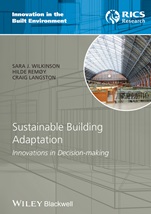
Sustainable Building Adaptation: Innovations in Decision–making
ISBN 9781118477106
Autor: Sara J. Wilkinson, Hilde Remøy, Craig Langston
Wydawca: Wiley
Dostępność: 3-6 tygodni
Cena: 496,65 zł
Przed złożeniem zamówienia prosimy o kontakt mailowy celem potwierdzenia ceny.
ISBN13: |
9781118477106 |
ISBN10: |
1118477103 |
Autor: |
Sara J. Wilkinson, Hilde Remøy, Craig Langston |
Oprawa: |
Hardback |
Rok Wydania: |
2014-03-28 |
Ilość stron: |
294 |
Wymiary: |
250x178 |
Tematy: |
AM |
How to adapt existing building stock is a problem being addressed by local and state governments worldwide. In most developed countries we now spend more on building adaptation than on new construction and there is an urgent need for greater knowledge and awareness of what happens to commercial buildings over time.
Sustainable Building Adaptation: Innovations in Decision–making is a significant contribution to understanding best practice in sustainable adaptations to existing commercial buildings by offering new knowledge–based theoretical and practical insights. Models used are grounded in results of case studies conducted within three collaborative construction project team settings in Australia and the Netherlands, and exemplars are drawn from the Americas, Asia, Japan, Korea, and Europe to demonstrate the application of the knowledge more broadly.
Results clearly demonstrate that the new models can assist with informed decision–making in adaptation that challenges some of the prevailing solutions based on empirical approaches and which do not accommodate the sustainability dimension. The emphasis is on demonstrating how the new knowledge can be applied by practitioners to deliver professionally relevant outcomes.
The book offers guidance towards a balanced approach that incorporates sustainable and optimal approaches for effective management of adaptation of existing commercial buildings.
About the Authors xi
Preface xiii
Part I Building Adaptation 1
Sara J. Wilkinson
Chapter 1 Defining Adaptation 3
1.1 Introduction 3
1.2 Terminology 4
1.3 The Significance of Building Adaptation 4
1.4 Decision–Making Issues in Building Adaptation 10
1.5 Decision Options and Levels of Adaptation 11
1.6 Adaptation and Different Land Uses 13
1.7 Conclusion 14
References 15
Chapter 2 Drivers and Barriers for Adaptation 18
2.1 Introduction 18
2.2 Building Life Cycle Theory 18
2.3 Building Performance Theory 20
2.4 Building Adaptation Theory and Sustainability 21
2.4.1 Social Factors 22
2.4.2 Environmental Factors 27
2.4.3 Cost and Economic Factors 30
2.5 Other Attributes Associated with Adaptation 34
2.5.1 Physical Attributes 34
2.5.2 Locational and Land Use Attributes 36
2.5.3 Legal Attributes 37
2.6 Conclusion 38
References 39
Chapter 3 Assessing Adaptation Using PAAM 42
3.1 Introduction 42
3.2 Preliminary Assessment 42
3.3 Principal Component Analysis 47
3.4 Preliminary Adaptation Assessment Model 49
3.5 Illustrative Case Study 54
3.5.1 Building Description 54
3.5.2 Assessing a Building for Alterations Adaptation 54
3.6 Conclusion 56
References 58
Chapter 4 Sustainable Adaptation: A Case Study of the Melbourne CBD 59
4.1 Introduction 59
4.2 The Context for Adaptation 59
4.3 Typical Sustainability Measures Used in Commercial Building Adaptation 60
4.4 Sustainable Adaptation Case Studies 62
4.4.1 131 Queen Street 62
4.4.2 Alto Hotel (636 Bourke Street) 64
4.4.3 247 Flinders Lane (Ross House) 66
4.4.4 490 Spencer Street 68
4.4.5 500 Collins Street 70
4.4.6 406 Collins Street 73
4.4.7 182 Capel Street 75
4.4.8 115 Batman Street 77
4.4.9 385 Bourke Street 79
4.4.10 530 Collins Street 81
4.5 Comparative Analysis of Sustainable Adaptation Measures 82
4.5.1 Owners 83
4.5.2 Age 83
4.5.3 Location 84
4.5.4 Aesthetics 85
4.5.5 Location of Vertical Services 85
4.5.6 Existing Land Use 85
4.5.7 Floor Area 86
4.5.8 Street Frontage 86
4.5.9 Historic Listing 86
4.5.10 Number of Storeys 87
4.5.11 PCA Grade 87
4.5.12 Attachment to Other Buildings 88
4.5.13 Site Access 88
4.6 Conclusion 89
References 90
Part II Adaptive Reuse 93
Hilde Remøy
Chapter 5 Building Obsolescence and Reuse 95
5.1 Introduction 95
5.2 Conversion Research Worldwide 97
5.3 Building Lifespan and Obsolescence 100
5.3.1 Technical Lifespan 100
5.3.2 Functional Lifespan 101
5.3.3 Economic Lifespan 101
5.4 Obsolescence and Vacancy 102
5.5 Quality and Obsolescence: User–Based Property Assessment 104
5.6 The Physical Characteristics of Structurally Vacant Office Buildings 106
5.6.1 Structure and Floors 107
5.6.2 Floor Layout, Building Length and Depth 107
5.6.3 Façade 108
5.6.4 Stairs and Elevators 108
5.6.5 Location Characteristics 108
5.7 Selected Adaptive Reuse Projects 109
5.8 Conclusion 117
References 118
Chapter 6 Reuse versus Demolition 121
6.1 Introduction 121
6.2 Decision–Making Criteria 122
6.3 Tools, Scans and Instruments 123
6.3.1 The Transformation Meter 124
6.3.2 Programmatic Quick Scan 127
6.3.3 Architectural Value 127
6.3.4 The Architects Method 128
6.3.5 The ABT Method: An Instrument Developed in Practice 128
6.4 Decisions–Based on Financial Arguments 129
6.5 Durability and Sustainability 131
6.6 Conclusion 132
References 133
Chapter 7 Examples of Successful Adaptive Reuse 135
7.1 Introduction 135
7.2 Dutch Conversion Projects (Office to Residential) 136
7.2.1 Stadhouder in Alphen aan den Rijn 137
7.2.2 Lodewijk Staete in Appingedam 137
7.2.3 Enka in Arnhem 138
7.2.4 Schuttersveld in Delft 139
7.2.5 Westplantsoen in Delft 139
7.2.6 Wilhelminastaete in Diemen 140
7.2.7 Granida in Eindhoven 141
7.2.8 Residentie de Deel in Emmeloord 141
7.2.9 Twentec in Enschede 142
7.2.10 Eendrachtskade in Groningen 143
7.2.11 Billiton in Den Haag 143
7.2.12 Hof ter Hage in Den Haag 144
7.2.13 Churchill Towers in Rijswijk 145
7.2.14 Puntegale in Rotterdam 145
7.2.15 Westerlaan Tower in Rotterdam 146
7.3 Discussion 147
7.3.1 Data Analysis 147
7.3.2 Conversion Risks 147
7.3.3 Conversion Opportunities 150
7.3.4 Typology 152
7.3.5 Structure and Floors 152
7.3.6 Floor Layout, Building Length and Depth 153
7.3.7 Façade 153
7.3.8 Stairs and Elevators 154
7.3.9 Location 154
7.3.10 Building 155
7.4 Conclusion 157
References 158
Chapter 8 Preserving Cultural and Heritage Value 159
8.1 Introduction 159
8.2 Historic Heritage 159
8.3 The Value of Heritage 160
8.3.1 The Value of Place 160
8.3.2 Cultural Capital 161
8.3.3 Benefits of Heritage Conservation 162
8.4 Assessing Economic Value of Heritage 163
8.4.1 The Market Value of Heritage 163
8.4.2 Direct Market Value 164
8.4.3 Indirect Value 164
8.4.4 Indirect Value of Heritage Tourism 165
8.4.5 Heritage as a Source of Skills and Competencies 165
8.4.6 Private/Public Value 166
8.5 Heritage Value and Adaptation 166
8.6 Architectonic and Aesthetic Value 167
8.7 Experience Value 170
8.7.1 Familiar Ugliness 170
8.7.2 Cultural Historical Value 170
8.7.3 Symbolic Value 171
8.7.4 Traumatic Experience Value 173
8.7.5 Value in Use 174
8.7.6 Intrinsic Value (Highest and Best Use) 174
8.7.7 Heritage as a Source of Social Value 176
8.8 Conclusion 180
References 181
Part III Adaptation Decision–Making and Optimisation 183
Craig Langston
Chapter 9 Identifying Adaptive Reuse Potential 187
9.1 Introduction 187
9.2 ARP Model 188
9.3 Obsolescence Rates 191
9.3.1 Physical Obsolescence 191
9.3.2 Economic Obsolescence 192
9.3.3 Functional Obsolescence 193
9.3.4 Technological Obsolescence 194
9.3.5 Social Obsolescence 194
9.3.6 Legal Obsolescence 195
9.3.7 Political Obsolescence 196
9.4 Case Study: GPO Building, Melbourne 197
9.5 Discussion 201
9.6 Conclusion 205
Note 206
References 206
Chapter 10 MCDA and Assessing Sustainability 208
10.1 Introduction 208
10.2 Background 209
10.3 A New Approach 211
10.3.1 Conceptual Framework 211
10.3.2 Value for Money 213
10.3.3 Quality of Life 214
10.3.4 Sustainability Risk 215
10.4 Life–Cost Planning 215
10.5 Case Study: Bond University Mirvac School of Sustainable Development (MSSD) Building, Gold Coast 217
10.5.1 Method 217
10.5.2 Return on Investment 218
10.5.3 Energy Usage 220
10.5.4 Functional Performance 220
10.5.5 Loss of Habitat 221
10.5.6 Sustainability Index 221
10.6 Discussion 223
10.7 Conclusion 227
Notes 227
References 228
Chapter 11 Modelling Building Performance Using iconCUR 230
11.1 Introduction 230
11.2 Visual MCDA 231
11.3 iconCUR Model 232
11.4 Case Study: 88 George Street, Sydney 235
11.4.1 Overview 235
11.4.2 Before Intervention 237
11.4.3 After Intervention 239
11.5 Discussion 241
11.6 Conclusion 247
Notes 247
References 248
Chapter 12 Designing for Future Adaptive Reuse 250
12.1 Introduction 250
12.2 Rationale 251
12.3 AdaptSTAR Framework 254
12.4 International Case Studies 259
12.4.1 1881 Heritage, Hong Kong SAR (PRC) 261
12.4.2 Peranakan Museum, City Hall (Singapore) 261
12.4.3 Corso Karlín, Prague (Czech Republic) 262
12.4.4 Arsenal de Metz, Metz (France) 262
12.4.5 The Candy Factory Lofts, Toronto (Canada) 263
12.4.6 Punta Della Dogana Contemporary Art Centre, Venice (Italy) 263
12.4.7 Andel s Hotel, Lódz (Poland) 264
12.4.8 Sugar Warehouse Loft, Amsterdam (The Netherlands) 264
12.4.9 The Powerhouse, Long Island City (USA) 265
12.4.10 John Knox Church, Melbourne (Australia) 265
12.5 Discussion 266
12.6 Conclusion 268
References 268
Index 273
Sara J. Wilkinson is Associate Professor of Property and Construction at the University of Technology, Sydney, Australia
Hilde Remøy is Assistant Professor of Real Estate Management at Delft University of Technology, The Netherlands
Craig Langston is Professor of Construction and Facilities Management at Bond University, Queensland, Australia
Koszyk
Książek w koszyku: 0 szt.
Wartość zakupów: 0,00 zł
Informacje


Kontakt
Gambit
Centrum Oprogramowania
i Szkoleń Sp. z o.o.
Al. Pokoju 29b/22-24
31-564 Kraków
Siedziba Księgarni
ul. Kordylewskiego 1
31-542 Kraków
+48 12 410 5991
+48 12 410 5987
+48 12 410 5989
Subskrypcje
Administratorem danych osobowych jest firma Gambit COiS Sp. z o.o. Na podany adres będzie wysyłany wyłącznie biuletyn informacyjny.
Autoryzacja płatności

Informacje na temat autoryzacji płatności poprzez PayU.

© Copyright 2012: GAMBIT COiS Sp. z o.o. Wszelkie prawa zastrzeżone.
Projekt i wykonanie: Alchemia Studio Reklamy