


Wydawcy
Katalog tematyczny
- Archeologia (109)
- Ekonomia, finanse, business (13704)
- Filozofia (1445)
- Historia (3040)
- Języki i językoznawstwo (2356)
- Lifestyle, hobby i rozrywka (475)
- Medycyna (9704)
- Nauki humanistyczne (4)
- Nauki o Ziemi i środowisku (2638)
- Nauki ścisłe (20412)
- Nauki społeczne (8486)
- Nauki techniczne (13450)
- Budownictwo lądowe (1045)
- Chemia przemysłowa (2258)
- Elektronika i telekomunikacja (3287)
- Energetyka (1122)
- Inne nauki stosowane (363)
- Inżynieria biochemiczna (507)
- Inżynieria transportu (232)
- Mechanika i materiały (3316)
- Nauka o środowisku (321)
- Rolnictwo (507)
- Technika, ogólnie (475)
- Prawo (1696)
- Publikacje informacyjne i interdyscyplinarne (1288)
- Religia i wierzenia (917)
- Technika komputerowa (4067)
- Zdrowie, relacje międzyludzkie i rozwój osobisty (657)





Informacje szczegółowe o książce
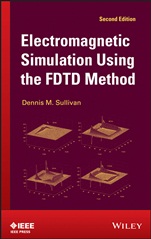
Electromagnetic Simulation Using the FDTD Method
ISBN 9781118459393
Autor: Dennis M. Sullivan
Wydawca: Wiley
Dostępność: 3-6 tygodni
Cena: 437,85 zł
Przed złożeniem zamówienia prosimy o kontakt mailowy celem potwierdzenia ceny.
ISBN13: |
9781118459393 |
ISBN10: |
1118459393 |
Autor: |
Dennis M. Sullivan |
Oprawa: |
Hardback |
Rok Wydania: |
2013-09-13 |
Numer Wydania: |
2nd Edition |
Ilość stron: |
192 |
Wymiary: |
236x165 |
Tematy: |
TG |
A straightforward, easy–to–read introduction to the finite–difference time–domain (FDTD) method Finite–difference time–domain (FDTD) is one of the primary computational electrodynamics modeling techniques available. Since it is a time–domain method, FDTD solutions can cover a wide frequency range with a single simulation run and treat nonlinear material properties in a natural way. Written in a tutorial fashion, starting with the simplest programs and guiding the reader up from one–dimensional to the more complex, three–dimensional programs, this book provides a simple, yet comprehensive introduction to the most widely used method for electromagnetic simulation. This fully updated edition presents many new applications, including the FDTD method being used in the design and analysis of highly resonant radio frequency (RF) coils often used for MRI. Each chapter contains a concise explanation of an essential concept and instruction on its implementation into computer code. Projects that increase in complexity are included, ranging from simulations in free space to propagation in dispersive media. Additionally, the text offers downloadable MATLAB and C programming languages from the book support site. Simple to read and classroom–tested, Electromagnetic Simulation Using the FDTD Method is a useful reference for practicing engineers as well as undergraduate and graduate engineering students.
Preface ix Guide to the Book xi 1 One–Dimensional Simulation with the FDTD Method 1 1.1 One–Dimensional Free Space Simulation, 1 1.2 Stability and the FDTD Method, 5 1.3 The Absorbing Boundary Condition in One Dimension, 5 1.4 Propagation in a Dielectric Medium, 7 1.5 Simulating Different Sources, 8 1.6 Determining Cell Size, 10 1.7 Propagation in a Lossy Dielectric Medium, 10 1.A Appendix, 13 References, 14 2 More on One–Dimensional Simulation 21 2.1 Reformulation Using the Flux Density, 21 2.2 Calculating the Frequency Domain Output, 24 2.3 Frequency–Dependent Media, 27 2.3.1 Auxiliary Differential Equation Method, 30 2.4 Formulation Using Z Transforms, 32 2.4.1 Simulation of Unmagnetized Plasma, 33 2.5 Formulating a Lorentz Medium, 36 2.5.1 Simulation of Human Muscle Tissue, 39 References, 41 3 Two–Dimensional Simulation 53 3.1 FDTD in Two Dimensions, 53 3.2 The Perfectly Matched Layer (PML), 56 3.3 Total/Scattered Field Formulation, 65 3.3.1 A Plane Wave Impinging on a Dielectric Cylinder, 67 3.3.2 Fourier Analysis, 70 References, 71 4 Three–Dimensional Simulation 85 4.1 Free Space Simulation, 85 4.2 The PML in Three Dimensions, 89 4.3 Total/Scattered Field Formulation in Three Dimensions, 92 4.3.1 A Plane Wave Impinging on a Dielectric Sphere, 92 References, 96 5 Examples of Electromagnetic Simulation Using FDTD 113 5.1 Nonlinear Optical Pulse Simulation, 113 5.2 Finding the Eigenfunctions of a Two–Dimensional EM Cavity, 120 5.3 Simulation of RF Coils, 127 References, 136 6 Quantum Simulation 151 6.1 Simulation of the One–Dimensional, Time–Dependent Schrodinger Equation, 151 6.2 Tunneling, 156 6.3 Why Semiconductors Have Energy Bands, 157 References, 160 Appendix A The Z Transform 169 A.1 The Sampled Time Domain and the Z Transform, 169 A.1.1 Delay Property, 172 A.1.2 Convolution Property, 172 A.2 Examples, 174 A.3 Approximations in Going from the Fourier to the Z Domain, 176 References, 178 Index 179
DENNIS M. SULLIVAN is Professor of Electrical and Computer Engineering at the University of Idaho, Moscow. An award-winning author and researcher, he has done extensive work in several areas of simulation, including EM dosimetry, hyperthermia cancer treatment, nonlinear optics, and quantum semiconductors. In 1997, Dr. Sullivan won the R. P. W. King Award from the IEEE Antennas and Propagation Society for the "Best Paper by a Young Investigator" for his paper "Z Transform Theory and FDTD Method." He is an IEEE Fellow, and is also the author of Quantum Mechanics for Electrical Engineers, published by Wiley-IEEE Press.
Koszyk
Książek w koszyku: 0 szt.
Wartość zakupów: 0,00 zł
Informacje


Kontakt
Gambit
Centrum Oprogramowania
i Szkoleń Sp. z o.o.
Al. Pokoju 29b/22-24
31-564 Kraków
Siedziba Księgarni
ul. Kordylewskiego 1
31-542 Kraków
+48 12 410 5991
+48 12 410 5987
+48 12 410 5989
Subskrypcje
Administratorem danych osobowych jest firma Gambit COiS Sp. z o.o. Na podany adres będzie wysyłany wyłącznie biuletyn informacyjny.
Autoryzacja płatności

Informacje na temat autoryzacji płatności poprzez PayU.

© Copyright 2012: GAMBIT COiS Sp. z o.o. Wszelkie prawa zastrzeżone.
Projekt i wykonanie: Alchemia Studio Reklamy