


Wydawcy
Katalog tematyczny
- Archeologia (109)
- Ekonomia, finanse, business (13704)
- Filozofia (1445)
- Historia (3040)
- Języki i językoznawstwo (2356)
- Lifestyle, hobby i rozrywka (475)
- Medycyna (9704)
- Nauki humanistyczne (4)
- Nauki o Ziemi i środowisku (2638)
- Nauki ścisłe (20412)
- Nauki społeczne (8486)
- Nauki techniczne (13450)
- Prawo (1696)
- Publikacje informacyjne i interdyscyplinarne (1288)
- Religia i wierzenia (917)
- Technika komputerowa (4067)
- Zdrowie, relacje międzyludzkie i rozwój osobisty (657)





Informacje szczegółowe o książce
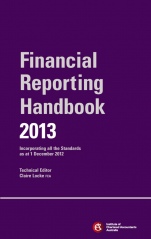
Financial Reporting Handbook 2013 + E–Text Registration Card: Incorporating all the Standards as at 1 December 2012
ISBN 9781118452349
Autor: ICAA (Institute of Chartered Accountants Australia), Claire Locke
Wydawca: Wiley
Dostępność: 3-6 tygodni
Cena: 476,70 zł
Przed złożeniem zamówienia prosimy o kontakt mailowy celem potwierdzenia ceny.
ISBN13: |
9781118452349 |
ISBN10: |
1118452348 |
Autor: |
ICAA (Institute of Chartered Accountants Australia), Claire Locke |
Oprawa: |
Paperback |
Rok Wydania: |
2013-09-20 |
Ilość stron: |
2240 |
Wymiary: |
245x156 |
Tematy: |
KF |
The Institute of Chartered AccountantsAustralia s Financial Reporting Handbook2013 incorporates a comprehensive listing of AustralianAccounting Standards and Interpretations applicable at 30 June2013, as issued at 1 December 2012.
The 2013 edition contains:
The AASB conceptual framework, Accounting Standards andInterpretations applicable for the 2013 reporting season, includingthe compiled versions of Standards issued to 1 December2012. AASB 10 Consolidated Financial Statements, AASB 11 JointArrangements, AASB 12 Disclosure of Interests in Other Entities,AASB 13 Fair Value Measurement and AASB 119 Employee Benefi ts,applicable from 1 January 2013, and AASB 9 Financial Instrumentsapplicable from 1 January 2015. A chapter explaining the AASB s Reduced DisclosureRegime, together with AASB 1053 Application of Tiers of AustralianAccounting Standards and AASB 2010–2 Amendments to AustralianAccounting Standards arising from Reduced DisclosureRequirements.The companion volume to this handbook, the Institute ofChartered Accountants Australia s Auditing, Assuranceand Ethics Handbook 2013, brings together all of the new andrevised Australian Auditing Standards in Clarity format, GuidanceStatements and professional and ethical standards as issued at 1December 2012.
For latest information relating to Australian AccountingStandards, refer to www.aasb.gov.au, which is regularlyupdated throughout the year. The AASB website also contains theAASB s versions of Standards and Interpretations amended forearly adopters of the Reduced Disclosure Regime, which have notbeen included in this handbook.
About the Technical Editor vi
About the Institute of Chartered Accountants Australia xii
Introduction xiii
Reduced Disclosure Regime xvi
Statements of Accounting Concepts
SAC 1 Definition of the Reporting Entity 1
SAC 2 Objective of General Purpose Financial Reporting 10
Accounting Standards (AASBs) Framework for the Preparation andPresentation of Financial Statements 19
AASB 1 First–time Adoption of Australian Accounting Standards40
AASB 2 Share–based Payment 69
AASB 3 Business Combinations 119
AASB 4 Insurance Contracts 158
AASB 5 Non–current Assets Held for Sale and DiscontinuedOperations 180
AASB 6 Exploration for and Evaluation of Mineral Resources198
AASB 7 Financial Instruments: Disclosures 209
AASB 8 Operating Segments 246
AASB 9 Financial Instruments 259
AASB 10 Consolidated Financial Statements 309
AASB 11 Joint Arrangements 340
AASB 12 Disclosure of Interests in Other Entities 364
AASB 13 Fair Value Measurement 380
AASB 101 Presentation of Financial Statements 412
AASB 102 Inventories 444
AASB 107 Statement of Cash Flows 459
AASB 108 Accounting Policies, Changes in Accounting Estimatesand Errors 481
AASB 110 Events after the Reporting Period 495
AASB 111 Construction Contracts 504
AASB 112 Income Taxes 516
AASB 116 Property, Plant and Equipment 561
AASB 117 Leases 581
AASB 118 Revenue 598
AASB 119 Employee Benefits (Compiled November 2010:applicable 30June 2013) 616
AASB 119 Employee Benefits (Revised September 2011:applicable toperiods beginning from 1 January 2013) 664
AASB 120 Accounting for Government Grants and Disclosure ofGovernment Assistance 698
AASB 121 The Effects of Changes in Foreign Exchange Rates708
AASB 123 Borrowing Costs 725
AASB 124 Related Party Disclosures 734
AASB 127 Consolidated and Separate Financial Statements(Compiled September 2011: applicable 30 June 2013) 754
AASB 127 Separate Financial Statements (Revised August 2011:applicable to periods beginning from 1 January 2013) 776
AASB 128 Investments in Associates (Compiled September 2011:applicable 30 June 2013) 783
AASB 128 Investments in Associates and Joint Ventures (RevisedAugust 2011: applicable to periods beginning from 1 January 2013)797
AASB 129 Financial Reporting in Hyperinflationary Economies808
AASB 131 Interests in Joint Ventures 818
AASB 132 Financial Instruments: Presentation 833
AASB 133 Earnings per Share 885
AASB 134 Interim Financial Reporting 923
AASB 136 Impairment of Assets 947
AASB 137 Provisions, Contingent Liabilities and ContingentAssets 1005
AASB 138 Intangible Assets 1030
AASB 139 Financial Instruments: Recognition and Measurement1059
AASB 140 Investment Property 1145
AASB 141 Agriculture 1164
AASB 1004 Contributions 1177
AASB 1023 General Insurance Contracts 1202
AASB 1031 Materiality 1238
AASB 1038 Life Insurance Contracts 1244
AASB 1039 Concise Financial Reports 1278
AASB 1048 Interpretation of Standards 1285
AASB 1049 Whole of Government and General Government SectorFinancial Reporting 1294
AASB 1050 Administered Items 1370
AASB 1051 Land Under Roads 1381
AASB 1052 Disaggregated Disclosures 1392
AASB 1053 Application of Tiers of Australian AccountingStandards 1402
AASB 1054 Australian Additional Disclosures 1428
AASB 2010–2 Amendments to Australian Accounting Standardsarising from Reduced Disclosure Requirements 1436
AASB 2010–7 Amendments to Australian Accounting Standardsarising from AASB 9 (December 2010) [AASB 1, 3, 4, 5, 7, 101, 102,108, 112, 118, 120, 121, 127, 128, 131, 132, 136,137, 139, 1023& 1038 and Interpretations 2, 5, 10, 12, 19 & 127] 1460
AASB 2011–2 Amendments to Australian Accounting Standardsarising from the Trans–Tasman Convergence Project ReducedDisclosure Requirements [AASB 101 & AASB 1054] 1498
AASB 2011–4 Amendments to Australian Accounting Standards toRemove Individual Key Management Personnel Disclosure Requirements[AASB 124] 1502
AASB 2011–6 Amendments to Australian Accounting Standards Extending Relief from Consolidation, the Equity Method andProportionate Consolidation Reduced Disclosure Requirements[AASB 127, AASB 128 & AASB 131] 1507
AASB 2011–7 Amendments to Australian Accounting Standardsarising from the Consolidation and Joint ArrangementsStandards[AASB 1, 2, 3, 5, 7, 101, 107, 112, 118, 121, 124, 132,133, 136, 138, 139, 1023 & 1038 and Interpretations 5, 9, 16& 17] 1516
AASB 2011–8 Amendments to Australian Accounting Standardsarising from AASB 13 [AASB 1, 2, 3, 4, 5, 7, 9, 101, 102, 108,110,116, 117, 118, 119, 120, 121, 128, 131, 132, 133, 134, 136,138,139, 140, 141, 1004, 1023 & 1038 and Interpretations 2, 4,12,13, 14, 17, 19, 131 & 132] 1536
AASB 2011–10 Amendments to Australian Accounting Standardsarising from AASB 119 (September 2011) [AASB 1, AASB 8, AASB 101,AASB 124, AASB 134, AASB 1049 & AASB 2011–8, and Interpretation14] 1569
AASB 2011–11 Amendments to AASB 119 (September 2011) arisingfrom Reduced Disclosure Requirements 1579
AASB 2011–12 Amendments to Australian Accounting Standardsarising from Interpretation 20 1583
AASB 2012–1 Amendments to Australian Accounting Standards Fair Value Measurement Reduced DisclosureRequirements [AASB 3, AASB 7, AASB 13, AASB 140 and AASB 141]1586
AASB 2012–2 Amendments to Australian Accounting Standards Disclosures Offsetting Financial Assets andFinancial Liabilities [AASB 7 and AASB 132] 1590
AASB 2012–3 Amendments to Australian Accounting Standards Offsetting Financial Assets and Financial Liabilities [AASB132] 1597
AASB 2012–4 Amendments to Australian Accounting Standards Government Loans [AASB 1] 1602
AASB 2012–5 Amendments to Australian Accounting Standardsarising from Annual Improvements 2009 2011 Cycle [AASB 1,AASB 101, AASB 116, AASB 132 & AASB 134 and Interpretation 2]1606
AASB 2012–7 Amendments to Australian Accounting Standardsarising from Reduced Disclosure Requirements [AASB 7, AASB 12, AASB101 and AASB 127] 1615 Accounting Standards (AAS)
AAS 25 Financial Reporting by Superannuation Plans 1620
Interpretations
Interpretation 1 Changes in Existing Decommissioning,Restoration and Similar Liabilities 1662
Interpretation 2 Members Shares in Co–operative Entitiesand Similar Instruments 1675
Interpretation 4 Determining whether an Arrangement contains aLease 1688
Interpretation 5 Rights to Interests arising fromDecommissioning, Restorationand Environmental Rehabilitation Funds1704
Interpretation 6 Liabilities arising from Participating in aSpecific Market Waste Electrical and Electronic Equipment1714
Interpretation 7 Applying the Restatement Approach under AASB129
Financial Reporting in Hyperinflationary Economies 1720
Interpretation 9 Reassessment of Embedded Derivatives 1732
Interpretation 10 Interim Financial Reporting and Impairment1741
Interpretation 12 Service Concession Arrangements 1746
Interpretation 13 Customer Loyalty Programmes 1778
Interpretation 14 AASB 119 The Limit on a DefinedBenefit Asset,
Minimum Funding Requirements and their Interaction 1789
Interpretation 15 Agreements for the Construction of Real Estate1806
Interpretation 16 Hedges of a Net Investment in a ForeignOperation 1822
Interpretation 17 Distributions of Non–cash Assets to Owners1840
Interpretation 18 Transfers of Assets from Customers 1855
Interpretation 19 Extinguishing Financial Liabilities withEquity Instruments 1866
Interpretation 20 Stripping Costs in the Production Phase of aSurface Mine 1875
Interpretation 107 Introduction of the Euro 1884
Interpretation 110 Government Assistance No SpecificRelation
to Operating Activities 1888
Interpretation 112 Consolidation Special PurposeEntities 1891
Interpretation 113 Jointly Controlled Entities Non–Monetary Contributions by Venturers 1897
Interpretation 115 Operating Leases Incentives 1901
Interpretation 125 Income Taxes Changes in the TaxStatus of an Entity or its Shareholders 1905
Interpretation 127 Evaluating the Substance of TransactionsInvolving the Legal Form of a Lease 1908
Interpretation 129 Service Concession Arrangements: Disclosures1916
Interpretation 131 Revenue Barter Transactions InvolvingAdvertising Services 1920
Interpretation 132 Intangible Assets Web Site Costs1924
Interpretation 1003 Australian Petroleum Resource Rent Tax1931
Interpretation 1019 The Superannuation Contributions Surcharge1936
Interpretation 1030 Depreciation of Long–Lived Physical Assets:Condition–Based
Depreciation and Related Methods 1940
Interpretation 1031 Accounting for the Goods and Services Tax(GST) 1945
Interpretation 1038 Contributions by Owners Made toWholly–Owned
Public Sector Entities 1949
Interpretation 1039 Substantive Enactment of Major Tax Bills inAustralia 1961
Interpretation 1042 Subscriber Acquisition Costs in theTelecommunications Industry 1965
Interpretation 1047 Professional Indemnity Claims Liabilities inMedical Defence
Organisations 1971
Interpretation 1052 Tax Consolidation Accounting 1978
Interpretation 1055 Accounting for Road Earthworks 2000
Professional Standards
APES 110 Code of Ethics for Professional Accountants 2005
APES 205 Conformity with Accounting Standards 2102
APES 315 Compilation of Financial Information 2107
Claire Locke, BA(Hons) (Dunelm), FCA is a member of theLeadership and Quality team at the Institute of CharteredAccountants Australia, and a sessional lecturer in the Masters ofAccounting program at Macquarie University, specialising infinancial reporting. Additionally, Claire presents seminars onfinancial reporting issues to a range of accounting firmsthroughout Australia. Claire s background is in the audit andtraining divisions of accounting firms in Australia and the UnitedKingdom.
Koszyk
Książek w koszyku: 0 szt.
Wartość zakupów: 0,00 zł
Informacje


Kontakt
Gambit
Centrum Oprogramowania
i Szkoleń Sp. z o.o.
Al. Pokoju 29b/22-24
31-564 Kraków
Siedziba Księgarni
ul. Kordylewskiego 1
31-542 Kraków
+48 12 410 5991
+48 12 410 5987
+48 12 410 5989
Subskrypcje
Administratorem danych osobowych jest firma Gambit COiS Sp. z o.o. Na podany adres będzie wysyłany wyłącznie biuletyn informacyjny.
Autoryzacja płatności

Informacje na temat autoryzacji płatności poprzez PayU.

© Copyright 2012: GAMBIT COiS Sp. z o.o. Wszelkie prawa zastrzeżone.
Projekt i wykonanie: Alchemia Studio Reklamy