


Wydawcy
Katalog tematyczny
- Archeologia (109)
- Ekonomia, finanse, business (13704)
- Filozofia (1445)
- Historia (3040)
- Języki i językoznawstwo (2356)
- Lifestyle, hobby i rozrywka (475)
- Medycyna (9704)
- Nauki humanistyczne (4)
- Nauki o Ziemi i środowisku (2638)
- Nauki ścisłe (20412)
- Nauki społeczne (8486)
- Nauki techniczne (13450)
- Prawo (1696)
- Publikacje informacyjne i interdyscyplinarne (1288)
- Religia i wierzenia (917)
- Technika komputerowa (4067)
- Zdrowie, relacje międzyludzkie i rozwój osobisty (657)





Informacje szczegółowe o książce
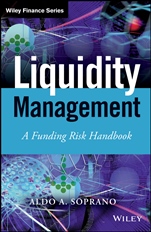
Liquidity Management: A Funding Risk Handbook
ISBN 9781118413999
Autor: Aldo Soprano
Wydawca: Wiley
Dostępność: 3-6 tygodni
Cena: 233,10 zł
Przed złożeniem zamówienia prosimy o kontakt mailowy celem potwierdzenia ceny.
ISBN13: |
9781118413999 |
ISBN10: |
1118413997 |
Autor: |
Aldo Soprano |
Oprawa: |
Hardback |
Rok Wydania: |
2015-04-03 |
Ilość stron: |
208 |
Wymiary: |
228x166 |
Tematy: |
KF |
Praise for Liquidity Management
′This book leverages on the author′s experience and it constitutes a valuable contribution from an expert market practitioner.′
Alberto Zorzi, Deputy General Manager and Chief Investment Officer at ARCA SGR
′The assessment of liquidity risk has certainly been under–represented in the literature and this book is a very useful addition to the field, bringing with it valuable insights and perspectives of an experienced market practitioner, with in–depth knowledge of the regulatory response to the crisis and its implications for the financial landscape.′
Matthew Stiles, Risk Manager at Abu Dhabi Investment Authority
′The book is recommended reading for anyone involved in liquidity management. It provides a comprehensive overview with valuable insights from a practitioner. The author illustrates the theory with well–chosen examples from a wide range of experiences in the financial sector.′
Willem van Oosten, Head of Treasury at Van Lanschot in The Netherlands
′A complete and rigorous contribution on how to measure and manage liquidity risk. A must–read for any banker and for any teacher.′
Giancarlo Giudici, Associate professor of Corporate Finance at Milan Politechnic
′The clear distinction between short– and long–term funding, with the specific risks related to each of them, and the relation to the new regulatory framework makes this book an updated and valuable tool for a wide audience who wants to delve deep into the recent evolution of banking activity.′
Antonio Castagna, Partner at Consulting Firm, Iason ltd.
′Liquidity in financial institutions is a key area of attention by regulators and hence management. Thanks to the author′s 20 years′ experience in risk management, he explains and clarifies the main topics of the subject.′
Andrea Bonfà, Equity Research at Banca Aletti
′A must–have reference for enterprise and market risk professionals, this guide succeeds in covering all aspects of liquidity risk management.′
Antony Jackson, PRM, PhD, Assistant Professor in Financial Economics, University of East Anglia, UK
′This study on liquidity risk is really welcome in a moment in which liquidity management is attracting attention; making this book of utmost relevance′
Elisabetta Magistretti, Independent Director
Acknowledgements xi
Introductory Note xiii
CHAPTER 1 Funding and Market Liquidity 1
1.1 Liquidity in the Financial Markets 1
1.1.1 Definition of funding and liquidity risks 4
1.2 Managing Liquidity Risk 9
1.2.1 Liquidity risk s framework 9
1.2.2 Chief Risk Officer s role 15
1.3 Regulatory Frameworks 15
1.3.1 Total net cash outflows 21
1.3.2 Long–term funding requirements 22
1.3.3 Banks funding 23
1.3.4 Funding through securitization 26
1.3.5 Behavioural changes of customers or investors 28
1.3.6 Payment systems 29
1.3.7 Correspondent and custody activities 30
1.3.8 Accounting treatment and liquidity 31
1.3.9 Diversification of funding sources 31
1.3.10 Rating agency approaches to internal methodologies 32
1.3.11 Transparency to the market 32
1.3.12 Contingency plans 33
CHAPTER 2 Short–Term Funding 37
2.1 Cash Flow Ladder 37
2.1.1 Contractual cash flows 40
2.1.2 Rules for mapping flows on the maturity ladder 42
2.1.3 Flows without contractual certainty 42
2.1.4 Unexpected cash flows 43
2.1.5 Funds available for refinancing 44
2.1.6 Funds transferability 44
2.1.7 Total ladder calculation 44
2.2 Liquidity Coverage Ratio 45
2.2.1 Regulatory prescriptions 45
2.2.2 Liquid assets available for refinancing 46
2.2.3 Total net cash outflows in the upcoming month 51
2.3 Liquidity Risk Indicators 58
2.3.1 Using indicators 59
2.3.2 Testing indicators 60
2.3.3 Government bond yield curves and cross–spreads 61
2.3.4 Credit default swap levels 61
2.3.5 Foreign exchange cross–values 61
2.3.6 Central bank refinancing 62
2.3.7 Crisis indicators 62
2.3.8 Risk aversion indexes 65
2.4 Intraday Liquidity Risk 66
2.4.1 Intraday liquidity management 67
2.4.2 Cooperative mechanism 71
2.4.3 Analysing the possible impact of the stressed scenario on intraday liquidity risk 73
2.4.4 Haircuts to pledges 75
2.4.5 Monitoring requirements 76
2.4.6 Structural and intraday liquidity needs 76
2.4.7 Payment systems liquidity saving features 78
2.4.8 Intraday liquidity risk in the case of Lehman Brothers 79
2.4.9 Some intraday liquidity monitoring indicators 80
2.4.10 Intraday liquidity stress scenarios 82
2.5 Funding Concentration 83
2.5.1 Significant counterparties 85
2.5.2 Significant instruments/products 86
2.5.3 Significant currencies 86
2.5.4 Time buckets 87
2.6 Measuring Asset Liquidity 87
2.6.1 Standard liquidity ratio 89
2.6.2 Determining implied spread 90
CHAPTER 3 Long–Term Balance 93
3.1 Structural Funding 94
3.1.1 Determining the available funding 95
3.1.2 Required stable funding for assets 97
3.2 Customer Deposit Modelling 99
3.2.1 Regulatory approaches on deposit stability 103
3.2.2 Depositor behaviours 104
3.2.3 Modelling assumptions and impacts on funding costs 106
3.2.4 Dynamic regression models 109
3.3 Stress Testing and Scenario Analysis 111
3.3.1 Using stress testing to improve banks own risk governance 112
3.3.2 Liquidity stress testing rationale 113
3.3.3 Improving controls 117
3.3.4 Stress testing methodology 117
3.3.5 Reverse stress testing 118
3.3.6 Scenario analysis 119
3.3.7 Internal capital and stress testing 122
CHAPTER 4 Liquidity Value At Risk 123
4.1 Market Liquidity Effects 123
4.1.1 Market volatility 124
4.2 Market Liquidity Value At Risk 124
4.3 VaR Liquidation–Adjusted 133
4.3.1 Exogenous and endogenous liquidity risk in the VaR model 137
4.3.2 Liquidity risk horizons 138
4.4 Cash Flows At Risk 140
CHAPTER 5 Control Framework 143
5.1 Governance Principles 143
5.2 Control Processes 148
5.2.1 Functions in charge of liquidity risk management and control 150
5.2.2 Risk committees 151
5.2.3 Coordinating liquidity management 152
5.2.4 Liquidity risk monitoring function 153
5.2.5 Addressing documentation–related liquidity risks 154
5.3 Monitoring Liquidity Exposure 155
5.3.1 Available assets for refinancing 156
5.3.2 Funding concentration 157
5.3.3 Liquidity coverage ratio and NSFR in the various currencies 157
5.3.4 Market–related monitoring tools 158
5.3.5 Overall market information 158
5.3.6 Information on the financial sector 159
5.3.7 Company–specific information 160
5.3.8 Recommendations on the monitoring process 160
5.3.9 Reporting frequency and distribution 160
5.4 Setting Liquidity Risk Limits 161
5.4.1 Limit setting and review 162
5.4.2 Reporting and escalation procedures 163
5.4.3 Internal rules on limit setting and management 164
5.5 Contingency Liquidity Plan 164
5.5.1 Outlining the contingency funding plans 167
5.5.2 Internal procedures for CFP 168
CHAPTER 6 Conclusions 169
6.1 Funding Liquidity 169
6.2 Profitability Impact of Larger Counterbalancing Asset Stocks 170
6.3 Pricing and Liquidity 171
6.4 Lessons Learnt 171
Bibliography 173
Index 181
ALDO SOPRANO is Head of Group Price Control at Unicredit and prior to that was in charge of Short Term Liquidity Risks and Operational Risk Management. He worked at Barclays Capital in London, served on the board of Pioneer Alternative Investments and Chaired the IIF working group on operational risks and is Board member of UniCredit Bank Ireland. He is the author of articles on risk management and presents at international conferences.
Koszyk
Książek w koszyku: 0 szt.
Wartość zakupów: 0,00 zł
Informacje


Kontakt
Gambit
Centrum Oprogramowania
i Szkoleń Sp. z o.o.
Al. Pokoju 29b/22-24
31-564 Kraków
Siedziba Księgarni
ul. Kordylewskiego 1
31-542 Kraków
+48 12 410 5991
+48 12 410 5987
+48 12 410 5989
Subskrypcje
Administratorem danych osobowych jest firma Gambit COiS Sp. z o.o. Na podany adres będzie wysyłany wyłącznie biuletyn informacyjny.
Autoryzacja płatności

Informacje na temat autoryzacji płatności poprzez PayU.

© Copyright 2012: GAMBIT COiS Sp. z o.o. Wszelkie prawa zastrzeżone.
Projekt i wykonanie: Alchemia Studio Reklamy