


Wydawcy
Katalog tematyczny
- Archeologia (109)
- Ekonomia, finanse, business (13704)
- Filozofia (1445)
- Historia (3040)
- Języki i językoznawstwo (2356)
- Lifestyle, hobby i rozrywka (475)
- Medycyna (9704)
- Nauki humanistyczne (4)
- Nauki o Ziemi i środowisku (2638)
- Nauki ścisłe (20412)
- Astronomia (294)
- Biologia (5119)
- Chemia (6540)
- Chemia analityczna (361)
- Chemia fizyczna (346)
- Chemia nieorganiczna (137)
- Chemia organiczna (535)
- Krystalografia (27)
- Minerologia (46)
- Fizyka (3309)
- Matematyka (4574)
- Nauki ścisłe, ogólnie (503)
- Nauki społeczne (8486)
- Nauki techniczne (13450)
- Prawo (1696)
- Publikacje informacyjne i interdyscyplinarne (1288)
- Religia i wierzenia (917)
- Technika komputerowa (4067)
- Zdrowie, relacje międzyludzkie i rozwój osobisty (657)







Informacje szczegółowe o książce
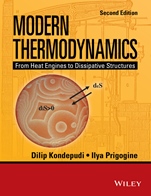
Modern Thermodynamics: From Heat Engines to Dissipative Structures
ISBN 9781118371817
Autor: Dilip Kondepudi, Ilya Prigogine
Wydawca: Wiley
Dostępność: 3-6 tygodni
Cena: 360,15 zł
Przed złożeniem zamówienia prosimy o kontakt mailowy celem potwierdzenia ceny.
ISBN13: |
9781118371817 |
ISBN10: |
111837181X |
Autor: |
Dilip Kondepudi, Ilya Prigogine |
Oprawa: |
Paperback |
Rok Wydania: |
2014-12-26 |
Numer Wydania: |
2nd Edition |
Ilość stron: |
552 |
Wymiary: |
246x189 |
Tematy: |
PN |
"Modern Thermodynamics: From Heat Engines to DissipativeStructures, Second Edition" presents a comprehensiveintroduction to 20th century thermodynamics that can be applied toboth equilibrium and non-equilibrium systems, unifying what wastraditionally divided into 'thermodynamics' and'kinetics' into one theory of irreversibleprocesses.This comprehensive text, suitable for introductory as well asadvanced courses on thermodynamics, has been widely used bychemists, physicists, engineers and geologists. Fully revisedand expanded, this new edition includes the following updates andfeatures: - Includes a completely new chapter on Principles ofStatistical Thermodynamics.- Presents new material on solar and wind energy flowsand energy flows of interest to engineering.- Covers new material on self-organization innon-equilibrium systems and the thermodynamics of smallsystems.- Highlights a wide range of applications relevant tostudents across physical sciences and engineering courses.- Introduces students to computational methods usingupdated Mathematica codes.- Includes problem sets to help the reader understandand apply the principles introduced throughout the text.- Solutions to exercises and supplementary lecturematerial provided online at http: //sites.google.com/site/modernthermodynamics/."Modern Thermodynamics: From Heat Engines to DissipativeStructures, Second Edition" is an essential resource forundergraduate and graduate students taking a course inthermodynamics.
Preface to the Second Edition xiii
Preface to the First Edition: Why Thermodynamics? xv
Acknowledgments xxi
Notes for Instructors xxiii
List of Variables xxv
I HISTORICAL ROOTS: FROM HEAT ENGINES TO COSMOLOGY
1 Basic Concepts and the Laws of Gases 3
Introduction 3
1.1 Thermodynamic Systems 4
1.2 Equilibrium and Nonequilibrium Systems 6
1.3 Biological and Other Open Systems 8
1.4 Temperature, Heat and Quantitative Laws of Gases 9
1.5 States of Matter and the van der Waals Equation 17
1.6 An Introduction to the Kinetic Theory of Gases 24
Appendix 1.1 Partial Derivatives 32
Appendix 1.2 Elementary Concepts in Probability Theory 33
Appendix 1.3 Mathematica Codes 34
References 39
Examples 39
Exercises 41
2 The First Law of Thermodynamics 45
The Idea of Energy Conservation Amidst New Discoveries 45
2.1 The Nature of Heat 46
2.2 The First Law of Thermodynamics: The Conservation of Energy50
2.3 Elementary Applications of the First Law 57
2.4 Thermochemistry: Conservation of Energy in ChemicalReactions 61
2.5 Extent of Reaction: A State Variable for Chemical Systems68
2.6 Conservation of Energy in Nuclear Reactions and Some GeneralRemarks 69
2.7 Energy Flows and Organized States 71
Appendix 2.1 Mathematica Codes 79
Appendix 2.2 Energy Flow in the USA for the Year 2013 79
References 82
Examples 82
Exercises 85
3 The Second Law of Thermodynamics and the Arrow of Time89
3.1 The Birth of the Second Law 89
3.2 The Absolute Scale of Temperature 96
3.3 The Second Law and the Concept of Entropy 99
3.4 Modern Formulation of the Second Law 104
3.5 Examples of Entropy Changes due to Irreversible Processes112
3.6 Entropy Changes Associated with Phase Transformations114
3.7 Entropy of an Ideal Gas 115
3.8 Remarks about the Second Law and Irreversible Processes116
Appendix 3.1 The Hurricane as a Heat Engine 117
Appendix 3.2 Entropy Production in Continuous Systems 120
References 121
Examples 122
Exercises 123
4 Entropy in the Realm of Chemical Reactions 125
4.1 Chemical Potential and Affinity: The Thermodynamic Force forChemical Reactions 125
4.2 General Properties of Affinity 132
4.3 Entropy Production Due to Diffusion 135
4.4 General Properties of Entropy 136
Appendix 4.1 Thermodynamics Description of Diffusion 138
References 139
Example 139
Exercises 140
II EQUILIBRIUM THERMODYNAMICS
5 Extremum Principles and General Thermodynamic Relations145
Extremum Principles in Nature 145
5.1 Extremum Principles Associated with the Second Law 145
5.2 General Thermodynamic Relations 153
5.3 Gibbs Energy of Formation and Chemical Potential 156
5.4 Maxwell Relations 159
5.5 Extensivity with Respect to N and Partial Molar Quantities160
5.6 Surface Tension 162
References 165
Examples 165
Exercises 166
6 Basic Thermodynamics of Gases, Liquids and Solids169
Introduction 169
6.1 Thermodynamics of Ideal Gases 169
6.2 Thermodynamics of Real Gases 172
6.3 Thermodynamics Quantities for Pure Liquids and Solids180
Reference 183
Examples 183
Exercises 184
7 Thermodynamics of Phase Change 187
Introduction 187
7.1 Phase Equilibrium and Phase Diagrams 187
7.2 The Gibbs Phase Rule and Duhem s Theorem 192
7.3 Binary and Ternary Systems 194
7.4 Maxwell s Construction and the Lever Rule 198
7.5 Phase Transitions 201
References 203
Examples 203
Exercises 204
8 Thermodynamics of Solutions 207
8.1 Ideal and Nonideal Solutions 207
8.2 Colligative Properties 211
8.3 Solubility Equilibrium 217
8.4 Thermodynamic Mixing and Excess Functions 222
8.5 Azeotropy 225
References 225
Examples 225
Exercises 227
9 Thermodynamics of Chemical Transformations 231
9.1 Transformations of Matter 231
9.2 Chemical Reaction Rates 232
9.3 Chemical Equilibrium and the Law of Mass Action 239
9.4 The Principle of Detailed Balance 243
9.5 Entropy Production due to Chemical Reactions 245
9.6 Elementary Theory of Chemical Reaction Rates 248
9.7 Coupled Reactions and Flow Reactors 251
Appendix 9.1 Mathematica Codes 256
References 260
Examples 260
Exercises 261
10 Fields and Internal Degrees of Freedom 265
The Many Faces of Chemical Potential 265
10.1 Chemical Potential in a Field 265
10.2 Membranes and Electrochemical Cells 270
10.3 Isothermal Diffusion 277
10.4 Chemical Potential for an Internal Degree of Freedom281
References 284
Examples 284
Exercises 285
11 Thermodynamics of Radiation 287
Introduction 287
11.1 Energy Density and Intensity of Thermal Radiation 287
11.2 The Equation of State 291
11.3 Entropy and Adiabatic Processes 293
11.4 Wien s Theorem 295
11.5 Chemical Potential of Thermal Radiation 296
11.6 Matter Antimatter in Equilibrium with ThermalRadiation: The State of Zero Chemical Potential 297
11.7 Chemical Potential of Radiation not in Thermal Equilibriumwith Matter 299
11.8 Entropy of Nonequilibrium Radiation 300
References 302
Example 302
Exercises 302
III FLUCTUATIONS AND STABILITY
12 The Gibbs Stability Theory 307
12.1 Classical Stability Theory 307
12.2 Thermal Stability 308
12.3 Mechanical Stability 309
12.4 Stability and Fluctuations in Nk 310
References 313
Exercises 313
13 Critical Phenomena and Configurational Heat Capacity315
Introduction 315
13.1 Stability and Critical Phenomena 315
13.2 Stability and Critical Phenomena in Binary Solutions317
13.3 Configurational Heat Capacity 320
Further Reading 321
Exercises 321
14 Entropy Production, Fluctuations and Small Systems323
14.1 Stability and Entropy Production 323
14.2 Thermodynamic Theory of Fluctuations 326
14.3 Small Systems 331
14.4 Size–Dependent Properties 333
14.5 Nucleation 336
References 339
Example 339
Exercises 340
IV LINEAR NONEQUILIBRIUM THERMODYNAMICS
15 Nonequilibrium Thermodynamics: The Foundations 343
15.1 Local Equilibrium 343
15.2 Local Entropy Production 345
15.3 Balance Equation for Concentration 346
15.4 Energy Conservation in Open Systems 348
15.5 The Entropy Balance Equation 351
Appendix 15.1 Entropy Production 354
References 356
Exercises 356
16 Nonequilibrium Thermodynamics: The Linear Regime357
16.1 Linear Phenomenological Laws 357
16.2 Onsager Reciprocal Relations and the Symmetry Principle359
16.3 Thermoelectric Phenomena 363
16.4 Diffusion 366
16.5 Chemical Reactions 371
16.6 Heat Conduction in Anisotropic Solids 375
16.7 Electrokinetic Phenomena and the Saxen Relations 377
16.8 Thermal Diffusion 379
References 382
Further Reading 382
Exercises 383
17 Nonequilibrium Stationary States and Their Stability:Linear Regime 385
17.1 Stationary States under Nonequilibrium Conditions 385
17.2 The Theorem of Minimum Entropy Production 391
17.3 Time Variation of Entropy Production and the Stability ofStationary States 398
References 400
Exercises 400
V ORDER THROUGH FLUCTUATIONS
18 Nonlinear Thermodynamics 405
18.1 Far–from–Equilibrium Systems 405
18.2 General Properties of Entropy Production 405
18.3 Stability of Nonequilibrium Stationary States 407
18.4 Linear Stability Analysis 411
Appendix 18.1 A General Property of dFP/dt 415
Appendix 18.2 General Expression for the Time Derivative of 2S416
References 418
Exercises 418
19 Dissipative Structures 421
19.1 The Constructive Role of Irreversible Processes 421
19.2 Loss of Stability, Bifurcation and Symmetry Breaking421
19.3 Chiral Symmetry Breaking and Life 424
19.4 Chemical Oscillations 431
19.5 Turing Structures and Propagating Waves 436
19.6 Dissipative Structures and Machines 440
19.7 Structural Instability and Biochemical Evolution 441
Appendix 19.1 Mathematica Codes 442
References 447
Further Reading 448
Exercises 449
20 Elements of Statistical Thermodynamics 451
Introduction 451
20.1 Fundamentals and Overview 452
20.2 Partition Function Factorization 454
20.3 The Boltzmann Probability Distribution and Average Values456
20.4 Microstates, Entropy and the Canonical Ensemble 457
20.5 Canonical Partition Function and Thermodynamic Quantities460
20.6 Calculating Partition Functions 461
20.7 Equilibrium Constants 467
20.8 Heat Capacities of Solids 469
20.9 Planck s Distribution Law for Thermal Radiation472
Appendix 20.1 Approximations and Integrals 474
Reference 475
Example 475
Exercises 475
21 Self–Organization and Dissipative Structures in Nature477
21.1 Dissipative Structures in Diverse Disciplines 477
21.2 Towards a Thermodynamic Theory of Organisms 483
References 485
Epilogue 487
Physical Constants and Data 489
Standard Thermodynamic Properties 491
Energy Units and Conversions 501
Answers to Exercises 503
Author Index 511
Subject Index 513
Koszyk
Książek w koszyku: 0 szt.
Wartość zakupów: 0,00 zł
Informacje


Kontakt
Gambit
Centrum Oprogramowania
i Szkoleń Sp. z o.o.
Al. Pokoju 29b/22-24
31-564 Kraków
Siedziba Księgarni
ul. Kordylewskiego 1
31-542 Kraków
+48 12 410 5991
+48 12 410 5987
+48 12 410 5989
Subskrypcje
Administratorem danych osobowych jest firma Gambit COiS Sp. z o.o. Na podany adres będzie wysyłany wyłącznie biuletyn informacyjny.
Autoryzacja płatności

Informacje na temat autoryzacji płatności poprzez PayU.

© Copyright 2012: GAMBIT COiS Sp. z o.o. Wszelkie prawa zastrzeżone.
Projekt i wykonanie: Alchemia Studio Reklamy