


Wydawcy
Katalog tematyczny
- Archeologia (109)
- Ekonomia, finanse, business (13704)
- Filozofia (1445)
- Historia (3040)
- Języki i językoznawstwo (2356)
- Lifestyle, hobby i rozrywka (475)
- Medycyna (9704)
- Nauki humanistyczne (4)
- Nauki o Ziemi i środowisku (2638)
- Nauki ścisłe (20412)
- Nauki społeczne (8486)
- Nauki techniczne (13450)
- Prawo (1696)
- Publikacje informacyjne i interdyscyplinarne (1288)
- Religia i wierzenia (917)
- Technika komputerowa (4067)
- Zdrowie, relacje międzyludzkie i rozwój osobisty (657)





Informacje szczegółowe o książce
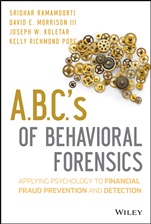
A.B.C.s of Behavioral Forensics: Applying Psychology to Financial Fraud Prevention and Detection
ISBN 9781118370551
Autor: Sridhar Ramamoorti, David E. Morrison III, Joseph W. Koletar, Kelly R. Pope
Wydawca: Wiley
Dostępność: 3-6 tygodni
Cena: 300,30 zł
Przed złożeniem zamówienia prosimy o kontakt mailowy celem potwierdzenia ceny.
ISBN13: |
9781118370551 |
ISBN10: |
1118370554 |
Autor: |
Sridhar Ramamoorti, David E. Morrison III, Joseph W. Koletar, Kelly R. Pope |
Oprawa: |
Hardback |
Rok Wydania: |
2013-11-05 |
Ilość stron: |
304 |
Wymiary: |
237x160 |
Tematy: |
KF |
Praise for A.B.C.'s of Behavioral Forensics "Fraud is an important part of enterprise risk. Although it falls in the finance and accounting function, it is also a people issue. The authors have taken an important step forward in helping organizations by examining issues of relationships, emotions, narcissism, and larger group and organizational dynamics that will help leaders understand and deter fraud." Harry M. Jansen Kraemer, former CEO, Baxter International; Professor of Leadership, Kellogg School of Management, Northwestern University "You will, upon reflection, note that [the authors] have not only addressed the narrower issues of forensics, but the broader issues of philosophy, ethics, and governance. This book can be read usefully at the surface level. Or given more time and thought, a reader will be led to think more deeply about how society is impacted when otherwise good people, particularly our leaders, violate their trust. Reading this book will be a good and profitable use of your time." Andrew D. Bailey, Jr., PhD, CPA, CMA, CIA, CFE, Professor Emeritus of Accounting, University of Illinois at Urbana-Champaign "Sri, Dave, Joe, and Kelly have done a great job of helping us understand the importance of recognizing the very personal and individual human factors that can drive someone to fraudulent behavior. They also provide insights and guidelines that can help us recognize the potential 'fraudster.'" Peter Pesce, Partner Emeritus, A.T. Kearney "With recognizable and pertinent case studies, these exceptionally qualified authors demonstrate how certain human behavioral factors precede and enable a fraudbe it carried out by one person, a colluding group, or by suggestions from leadership. What the authors then do is thoroughly describe these defining emotions, the essential relationship between the fraud perpetrator and the victim, and what can lead an individual to reverse his or her 'honesty course.'" Jameson A. Baxter, Chair, Putnam Funds "Leaders with integrity attempt to define and determine the personality characteristics of truth and honesty in themselves and others. However it's a search often fraught with uncertainty. A.B.C.'s of Behavioral Forensics will help you to be aware of the signals of devious behavior. Most important, it will increase your sensitivity to the importance of the issue. Corrupt activities are often allowed to continue due to our own indifference." Duane R. Kullberg, former CEO, 19801989, Arthur Andersen & Co. "Understanding why fraud happens is as important as understanding what happened. A.B.C.'s of Behavioral Forensics offers important insight into the mind of the white-collar criminal. It's good reading for accounting professionals, journalists, lawyers, psychiatrists, and laypeople alike." Bethany McLean, Fellow, The University of Chicago; contributing editor, Vanity Fair ; and coauthor of All the Devils Are Here and The Smartest Guys in the Room: The Amazing Rise and Scandalous Fall of Enron
Foreword xv Preface xvii Acknowledgments xxiii Introduction 1 The Human Factor 2 Trust Violation and Its Consequences 4 This Book’s Approach: The A.B.C.’s of Behavioral Forensics 4 An Interdisciplinary Approach 6 Part I When Fraud Is Committed 9 Chapter 1 Fraud Is Everywhere 13 The Pervasiveness of Fraud 14 On Making (Up) the Numbers 16 A Slippery Slope 19 From Slippery Slope to Broken Windows 21 Fraud Is a Human Act 23 Conclusion 24 Chapter 2 The Sins of Quantification and Other Mind–Set Impediments 27 The Danger of Numbers 29 Data Analysis Is Not Enough 31 Hard Numbers versus Reality 33 Conclusion 37 Chapter 3 Beyond the Fraud Triangle: Toward an Outline of A.B.C. Theory 41 The Relevance of Behavioral Approaches 41 Understanding White–Collar Crime 43 The Fraud Triangle and Other Theories of Causation 45 A.B.C. Theory: A New Fraud Taxonomy 49 Conclusion 53 Part II The Foundations of Behavioral Forensics: Why Good People Do Bad Things 55 Chapter 4 Beyond the Fraud Triangle and into the Mind: The Building Blocks of Behavioral Forensics— Understanding How the Basics of Human Behavior Tie into Fraud 59 Deception Is a Natural Phenomenon 59 The Mind and the Fraud Triangle 60 Emotions: The Power behind Psychological Defenses 67 Affect’s Two Ties to Fraud: Motivation and Communication 73 Conclusion 76 Chapter 5 “Said the Spider to the Fly . . .”: The Predator–Prey Dance— Putting Behavioral Science Fundamentals into Motion 81 Emotions, Unconscious, Defenses—Oh My! 82 Relationships: Where Fraud Is Set in Motion 82 The Relationship as an End in Itself: Bernie Madoff 87 Lance Armstrong and His Accomplices 91 Where Is the Humility? 93 The Power of Shame 94 Good to Evil: How a Hardwired Emotion Is Ignored and Manipulated 99 When Shame Is Maladaptive at Work 104 False Pride: With the Threat of Shame Comes Hubris 107 The Predator Bullies the Professionals 108 The Role of Mental Illness 111 Conclusion 116 Chapter 6 The Accidental Fraudster (Bad Apple): When the Apple Turns and Honesty Reverses Course 121 Committing the Crime 121 Beyond Greed 122 Exploiting a Weakness: A Motivational Theory of the Accidental Fraudster (Bad Apple) 123 New Insights in Behavioral Forensics 127 Disregarding Risk: The Thrill of Being Close to, but Not in, Danger 133 Why Now? Understanding Life–Span Issues in Fraud Reversals 137 Lessons from Executives and Managers on the Couch 139 Conclusion 139 Chapter 7 The Bad Bushel and Beyond: Seeing the Larger Context of the C–Suite 143 Luck and Effort Distinguish Senior Executives 144 Life as an Executive: Excitement, Vigilance, and Caution 147 Trouble in the C–Suite: Overwhelmed, Overpaid, and Overconfident—Narcissism and Beyond 148 The Individual and the Group: Bad Bushels Arise 153 The Science of Persuasion 158 Conclusion 161 Part III A Call to Action 165 Chapter 8 Managing the Ecology of Fraud: What You Can Do on Monday Morning 171 The Financial Markets: The Moral Foundations of Capitalism 172 Helping Senior Executives to Stay on the Right Side of the Line 176 Piercing the Rationalizations 177 Emotional Manipulation 179 On Lies and Misrepresentation 181 The Operational Fraud Triangle 183 What You Can Do Monday Morning 185 Recognizing Tipping Points (of the Mind) 188 Conclusion 191 Chapter 9 The Future of Behavioral Forensics: Developing Psychological Awareness to Complement Financial Fraud Suspicions 195 Fraud: A Global Scourge 196 Fraud Is Not a Problem with an Easy Answer 197 A Psychological Autopsy of Fraud 207 The Future of Behavioral Forensics 209 Afterword 213 Appendix A The Psychology and Sociology of Fraud: Integrating the Behavioral Sciences Component into Fraud and Forensic Accounting Curricula 217 Appendix B Chapter Supplements 231 Bibliography 247 About the Authors 255 Index 261
Dr. SRIDHAR RAMAMOORTI, ACA, CPA/CITP/CFF/CGMA, CIA, CFE, MAFF, CFSA, CGAP, CGFM, CRMA, is currently an Associate Professor of Accounting and Director, Corporate Governance Center, at Kennesaw State University. A former University of Illinois accountancy faculty member, he has worked for Arthur Andersen and Ernst & Young, and is a former corporate governance partner with Grant Thornton. A board member of the Institute for Truth in Accounting and Ascend, he chairs the Financial Executives International's Committee for Governance, Risk, and Compliance. DAVID E. MORRISON III is a Clinical Assistant Professor of Psychiatry and Behavioral Sciences at Chicago Medical School, Rosalind Franklin University of Medicine and Science. An advisor to the Institute of Fraud Prevention (IFP) of West Virginia University since 2008, he is also a past president of the Academy of Organizational and Occupational Psychiatry, Group for the Advancement of Psychiatry (GAP) member, and a Tomkins Institute board member. He works full time as a principal at Morrison Associates, Ltd., with a career focused on leadership and executive development. JOSEPH W. KOLETAR, DPA, CFE, is an independent forensic investigator and consultant. He has held senior positions such as principal and director with Ernst & Young and Deloitte in the firms' forensic and investigative practices. Before joining the private sector, Dr. Koletar spent twenty-five years as a special agent in the FBI, the last seven in senior executive positions. He was formerly chairman of the Board of Regents of the Association of Certified Fraud Examiners. KELLY RICHMOND POPE, PhD, CPA, is an Associate Professor in the School of Accountancy at DePaul University and founder of Helios Digital Learning. She is the creator of the award-winning white-collar crime documentary Crossing the Line: Ordinary People Committing Extraordinary Crimes . Her work has been published in numerous academic journals such as Behavioral Research in Accounting, Journal of Business Ethics, and Auditing: A Journal of Practice & Theory . She also writes for Forbes.com, Newsweek Daily Beast, and PBS's Need to Know . Prior to academia, she worked as a forensic accountant for KPMG LLP. In 2012, Dr. Pope was elected to the AICPA Governing Council for a three-year term.
Koszyk
Książek w koszyku: 0 szt.
Wartość zakupów: 0,00 zł
Informacje


Kontakt
Gambit
Centrum Oprogramowania
i Szkoleń Sp. z o.o.
Al. Pokoju 29b/22-24
31-564 Kraków
Siedziba Księgarni
ul. Kordylewskiego 1
31-542 Kraków
+48 12 410 5991
+48 12 410 5987
+48 12 410 5989
Subskrypcje
Administratorem danych osobowych jest firma Gambit COiS Sp. z o.o. Na podany adres będzie wysyłany wyłącznie biuletyn informacyjny.
Autoryzacja płatności

Informacje na temat autoryzacji płatności poprzez PayU.

© Copyright 2012: GAMBIT COiS Sp. z o.o. Wszelkie prawa zastrzeżone.
Projekt i wykonanie: Alchemia Studio Reklamy