


Wydawcy
Katalog tematyczny
- Archeologia (109)
- Ekonomia, finanse, business (13704)
- Filozofia (1445)
- Historia (3040)
- Języki i językoznawstwo (2356)
- Lifestyle, hobby i rozrywka (475)
- Medycyna (9704)
- Nauki humanistyczne (4)
- Nauki o Ziemi i środowisku (2638)
- Nauki ścisłe (20412)
- Nauki społeczne (8486)
- Nauki techniczne (13450)
- Prawo (1696)
- Publikacje informacyjne i interdyscyplinarne (1288)
- Religia i wierzenia (917)
- Technika komputerowa (4067)
- Zdrowie, relacje międzyludzkie i rozwój osobisty (657)





Informacje szczegółowe o książce
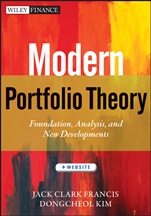
Modern Portfolio Theory: Foundations, Analysis, and New Developments + Website
ISBN 9781118370520
Autor: Jack Clark Francis, Dongcheol Kim
Wydawca: Wiley
Dostępność: 3-6 tygodni
Cena: 449,40 zł
Przed złożeniem zamówienia prosimy o kontakt mailowy celem potwierdzenia ceny.
ISBN13: |
9781118370520 |
ISBN10: |
111837052X |
Autor: |
Jack Clark Francis, Dongcheol Kim |
Oprawa: |
Hardback |
Rok Wydania: |
2013-02-15 |
Ilość stron: |
576 |
Wymiary: |
265x171 |
Tematy: |
KF |
Praise for Modern Portfolio Theory "Francis and Kim review the works of a generation of financial economists and pull these together under a single set of mathematical conventions. Their writing style is easy to read, and the chapters flow logically. The early chapters deal with the original material created by Markowitz, Tobin, and Sharpe whereas succeeding chapters deal with more recent developments. Readers who wish to avoid complex derivations and proofs may do so easily because the book is organized so this rigorous material is in the end-of-chapter appendices and footnotes. This work is comprehensive and accessible, and will reward either classroom or individual study." Harry Markowitz, Nobel Laureate, Professor of Economics and Finance "Professors Francis and Kim review the various models and research findings related to the original Markowitz portfolio theory. They compile many of the derivative works, drilling down on each topic, and, in the final analysis, pull together a unified portfolio theory using a single set of conventions. The Markowitz theory is central to portfolio management, and this book provides a thorough, up-to-date treatment of the topic." Roger Ibbotson, Professor of Finance, Yale University; founder, Ibbotson Associates "Building on the foundation of the original Markowitz portfolio theory and the key derivative works that span the decades since 1952, Professors Francis and Kim have written a unifying, one-of-a-kind book on portfolio analysis. This book is well organized and easy to read. Francis and Kim review the theoretical underpinnings of the seminal models, as well as provide rigorous analyses of real-world applications, advanced mathematics, and empirical tests. In the aftermath of the global financial crisis, finance and risk professionals must do a better job in understanding the theory, applications, and limitations of financial models. This book represents a major contribution in this endeavor." James Lam, author, Enterprise Risk Management; President, James Lam & Associates, Inc.; past Senior Vice President and Chief Risk Manager, Fidelity Investments Modern Portfolio Theory + Website puts an emphasis on practical application. To that end, this book provides readers with access to a companion website filled with supplementary materials, allowing you to continue to learn in a hands-on fashion long after closing the book.
Contents Preface xvii CHAPTER 1 Introduction 1 1.1 The Portfolio Management Process 1 1.2 The Security Analyst’s Job 1 1.3 Portfolio Analysis 2 1.4 Portfolio Selection 5 1.5 The Mathematics is Segregated 6 1.6 Topics to be Discussed 6 Appendix: Various Rates of Return 7 PART ONE Probability Foundations CHAPTER 2 Assessing Risk 13 2.1 Mathematical Expectation 13 2.2 What Is Risk? 15 2.3 Expected Return 16 2.4 Risk of a Security 17 2.5 Covariance of Returns 18 2.6 Correlation of Returns 19 2.7 Using Historical Returns 20 2.8 Data Input Requirements 22 2.9 Portfolio Weights 22 2.10 A Portfolio’s Expected Return 23 2.11 Portfolio Risk 23 2.12 Summary of Notations and Formulas 27 CHAPTER 3 Risk and Diversification 29 3.1 Reconsidering Risk 29 3.2 Utility Theory 32 3.3 Risk–Return Space 36 3.4 Diversification 38 3.5 Conclusions 41 PART TWO Utility Foundations CHAPTER 4 Single–Period Utility Analysis 45 4.1 Basic Utility Axioms 46 4.2 The Utility of Wealth Function 47 4.3 Utility of Wealth and Returns 47 4.4 Expected Utility of Returns 48 4.5 Risk Attitudes 52 4.6 Absolute Risk Aversion 59 4.7 Relative Risk Aversion 60 4.8 Measuring Risk Aversion 62 4.9 Portfolio Analysis 66 4.10 Indifference Curves 69 4.11 Summary and Conclusions 74 Appendix: Risk Aversion and Indifference Curves 75 PART THREE Mean–Variance Portfolio Analysis CHAPTER 5 Graphical Portfolio Analysis 85 5.1 Delineating Efficient Portfolios 85 5.2 Portfolio Analysis Inputs 86 5.3 Two–Asset Isomean Lines 87 5.4 Two–Asset Isovariance Ellipses 90 5.5 Three–Asset Portfolio Analysis 92 5.6 Legitimate Portfolios 102 5.7 ‘‘Unusual’’ Graphical Solutions Don’t Exist 103 5.8 Representing Constraints Graphically 103 5.9 The Interior Decorator Fallacy 103 5.10 Summary 104 Appendix: Quadratic Equations 105 CHAPTER 6 Efficient Portfolios 113 6.1 Risk and Return for Two–Asset Portfolios 113 6.2 The Opportunity Set 114 6.3 Markowitz Diversification 120 6.4 Efficient Frontier without the Risk–Free Asset 123 6.5 Introducing a Risk–Free Asset 126 6.6 Summary and Conclusions 131 Appendix: Equations for a Relationship between Erp) and σp CHAPTER 7 Advanced Mathematical Portfolio Analysis 135 7.1 Efficient Portfolios without a Risk–Free Asset 135 7.2 Efficient Portfolios with a Risk–Free Asset 146 7.3 Identifying the Tangency Portfolio 150 7.4 Summary and Conclusions 152 Appendix: Mathematical Derivation of the Efficient Frontier 152 CHAPTER 8 Index Models and Return–Generating Process 165 8.1 Single–Index Models 165 8.2 Efficient Frontier and the Single–Index Model 178 8.3 Two–Index Models 186 8.4 Multi–Index Models 189 8.5 Conclusions 190 Appendix: Index Models 191 PART FOUR Non–Mean–Variance Portfolios CHAPTER 9 Non–Normal Distributions of Returns 201 9.1 Stable Paretian Distributions 201 9.2 The Student’s t –Distribution 204 9.3 Mixtures of Normal Distributions 204 9.4 Poisson Jump–Diffusion Process 206 9.5 Lognormal Distributions 206 9.6 Conclusions 213 CHAPTER 10 Non–Mean–Variance Investment Decisions 215 10.1 Geometric Mean Return Criterion 215 10.2 The Safety–First Criterion 218 10.3 Semivariance Analysis 228 10.4 Stochastic Dominance Criterion 236 10.5 Mean–Variance–Skewness Analysis 246 10.6 Summary and Conclusions 254 Appendix A: Stochastic Dominance 254 Appendix B: Expected Utility as a Function of Three Moments 257 CHAPTER 11 Risk Management: Value at Risk 261 11.1 VaR of a Single Asset 261 11.2 Portfolio VaR 263 11.3 Decomposition of a Portfolio’s VaR 265 11.4 Other VaRs 269 11.5 Methods of Measuring VaR 270 11.6 Estimation of Volatilities 277 11.7 The Accuracy of VaR Models 282 11.8 Summary and Conclusions 285 Appendix: The Delta–Gamma Method 285 PART FIVE Asset Pricing Models CHAPTER 12 The Capital Asset Pricing Model 291 12.1 Underlying Assumptions 291 12.2 The Capital Market Line 292 12.3 The Capital Asset Pricing Model 295 12.4 Over– and Under–priced Securities 299 12.5 The Market Model and the CAPM 300 12.6 Summary and Conclusions 301 Appendix: Derivations of the CAPM 301 CHAPTER 13 Extensions of the Standard CAPM 311 13.1 Risk–Free Borrowing or Lending 311 13.2 Homogeneous Expectations 316 13.3 Perfect Markets 318 13.4 Unmarketable Assets 322 13.5 Summary and Conclusions 323 Appendix: Derivations of a Non–Standard CAPM 324 CHAPTER 14 Empirical Tests of the CAPM 333 14.1 Time–Series Tests of the CAPM 333 14.2 Cross–Sectional Tests of the CAPM 335 14.3 Empirical Misspecifications in Cross–Sectional Regression Tests 345 14.4 Multivariate Tests 353 14.5 Is the CAPM Testable? 356 14.6 Summary and Conclusions 357 CHAPTER 15 Continuous–Time Asset Pricing Models 361 15.1 Intertemporal CAPM (ICAPM) 361 15.2 The Consumption–Based CAPM (CCAPM) 363 15.3 Conclusions 366 Appendix: Lognormality and the Consumption–Based CAPM 367 CHAPTER 16 Arbitrage Pricing Theory 371 16.1 Arbitrage Concepts 371 16.2 Index Arbitrage 375 16.4 Asset Pricing on a Security Market Plane 383 16.5 Contrasting APT with CAPM 385 16.6 Empirical Evidence 386 16.7 Comparing the APT and CAPM Empirically 388 16.8 Conclusions 389 PART SIX Implementing the Theory CHAPTER 17 Portfolio Construction and Selection 395 17.1 Efficient Markets 395 17.2 Using Portfolio Theories to Construct and Select Portfolios 398 17.3 Security Analysis 400 17.4 Market Timing 401 17.5 Diversification 407 17.6 Constructing an Active Portfolio 415 17.7 Portfolio Revision 424 17.8 Summary and Conclusions 430 Appendix: Proofs for Some Ratios from Active Portfolios 431 CHAPTER 18 Portfolio Performance Evaluation 435 18.1 Mutual Fund Returns 435 18.2 Portfolio Performance Analysis in the Good Old Days 436 18.3 Capital Market Theory Assumptions 438 18.4 Single–Parameter Portfolio Performance Measures 438 18.5 Market Timing 449 18.6 Comparing Single–Parameter Portfolio Performance Measures 452 18.7 The Index of Total Portfolio Risk (ITPR) and the Portfolio Beta 454 18.8 Measurement Problems 457 18.9 Do Winners or Losers Repeat? 461 18.10 Summary about Investment Performance Evaluation 465 Appendix: Sharpe Ratio of an Active Portfolio 467 CHAPTER 19 Performance Attribution 473 19.1 Factor Model Analysis 474 19.2 Return–Based Style Analysis 475 19.3 Return Decomposition–Based Analysis 479 19.4 Conclusions 485 Appendix: Regression Coefficients Estimation with Constraints 486 CHAPTER 20 Stock Market Developments 489 20.1 Recent NYSE Consolidations 489 20.2 International Securities Exchange (ISE) 492 20.3 Nasdaq 492 20.4 Downward Pressures on Transactions Costs 494 20.5 The Venerable Limit Order 497 20.6 Market Microstructure 498 20.7 High–Frequency Trading 499 20.8 Alternative Trading Systems (ATSs) 500 20.9 Algorithmic Trading 501 20.10 Symbiotic Stock Market Developments 505 20.11 Detrimental Stock Market Developments 505 20.12 Summary and Conclusions 506 Mathematical Appendixes 509 Bibliography 519 About the Authors 539 Author Index 541 Subject Index 547
JACK CLARK FRANCIS is Professor of Economics and Finance at Bernard M. Baruch College in New York City. His research focuses on investments, banking, and monetary economics, and he has had dozens of articles published in many refereed academic, business, and government journals. Dr. Francis was an assistant professor of finance at the University of Pennsylvania's Wharton School of Finance for five years and was a Federal Reserve economist for two years. He received his bachelor's and MBA from Indiana University and earned his PhD in finance from the University of Washington in Seattle. Dongcheol Kim is a Professor of Finance at Korea University in Seoul. He served as president of the Korea Securities Association and editor-in-chief of the Asia-Pacific Journal of Financial Studies . Previously, he was a finance professor at Rutgers University. Kim has published articles in Financial Management, the Accounting Review, Journal of Financial and Quantitative Analysis, Journal of Economic Research, Journal of Finance, and Journal of the Futures Market .
Koszyk
Książek w koszyku: 0 szt.
Wartość zakupów: 0,00 zł
Informacje


Kontakt
Gambit
Centrum Oprogramowania
i Szkoleń Sp. z o.o.
Al. Pokoju 29b/22-24
31-564 Kraków
Siedziba Księgarni
ul. Kordylewskiego 1
31-542 Kraków
+48 12 410 5991
+48 12 410 5987
+48 12 410 5989
Subskrypcje
Administratorem danych osobowych jest firma Gambit COiS Sp. z o.o. Na podany adres będzie wysyłany wyłącznie biuletyn informacyjny.
Autoryzacja płatności

Informacje na temat autoryzacji płatności poprzez PayU.

© Copyright 2012: GAMBIT COiS Sp. z o.o. Wszelkie prawa zastrzeżone.
Projekt i wykonanie: Alchemia Studio Reklamy