


Wydawcy
Katalog tematyczny
- Archeologia (109)
- Ekonomia, finanse, business (13704)
- Filozofia (1445)
- Historia (3040)
- Języki i językoznawstwo (2356)
- Lifestyle, hobby i rozrywka (475)
- Medycyna (9704)
- Nauki humanistyczne (4)
- Nauki o Ziemi i środowisku (2638)
- Nauki ścisłe (20412)
- Nauki społeczne (8486)
- Nauki techniczne (13450)
- Prawo (1696)
- Publikacje informacyjne i interdyscyplinarne (1288)
- Religia i wierzenia (917)
- Technika komputerowa (4067)
- Zdrowie, relacje międzyludzkie i rozwój osobisty (657)





Informacje szczegółowe o książce
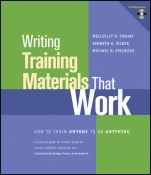
Writing Training Materials That Work: How to Train Anyone to Do Anything
ISBN 9781118351680
Autor: Wellesley R. Foshay, Kenneth H. Silber, Michael Stelnicki
Wydawca: Wiley
Dostępność: 3-6 tygodni
Cena: 372,75 zł
Przed złożeniem zamówienia prosimy o kontakt mailowy celem potwierdzenia ceny.
ISBN13: |
9781118351680 |
ISBN10: |
1118351681 |
Autor: |
Wellesley R. Foshay, Kenneth H. Silber, Michael Stelnicki |
Oprawa: |
Paperback |
Rok Wydania: |
2012-03-09 |
Ilość stron: |
274 |
Wymiary: |
244x188 |
Tematy: |
KM |
Going far beyond the latest instructional fads or merely theory, Writing Training Materials That Work offers an up–to–date synthesis and summary of "best practices" in instructional design. It provides specific how–to guidelines that are research–based, have been used by practitioners long enough to show they are acceptable and can be implemented in business settings, and— perhaps most importantly— produce consistently good instructional results. The book includes instructional strategies grounded in cognitive theory and covers a range of key areas, including Declarative Knowledge (facts, concepts, principles, and metal models), Procedural Knowledge (well–structured and ill–structured), Problem Solving— including a special chapter on teaching troubleshooting. The authors also provide a variety of illustrative examples, templates, and other useful job aids.
List of Figures. Contents of the CD–ROM. Acknowledgments. Preface. Introduction. PART I: INTRODUCTION TO THE COGNITIVE APPROACH. Chapter 1: The Cognitive Approach to Training Development. The Cognitive Approach to Instructional Design. The Cognitive Point of View on How Learning Occurs. Declarative and Procedural Knowledge and Their Subtypes. Summary. Chapter 2: A Cognitive Training Model. A New Cognitive Model. Learner Tasks and Lesson Elements. How to Read the Cognitive Training Model. Differentiating Our Model from Gagne′s. How to Use the Model. Summary. PART II: HOW TO DESIGN LESSONS USING THE COGNITIVE APPROACH. Chapter 3: How to Begin Any Lesson: The First Three Lesson Elements. About Using the Lesson Elements Attention, WIIFM, and YCDI to Begin a Lesson. Using the Lesson Elements Attention, WIIFM, and YCDI to Begin a Lesson. Summary. Chapter 4: How to Organize and Present Information: Message Design Principles. About Using the Lesson Elements to Help Learners Organize the Information. Summary. Chapter 5: Teaching Facts. About Facts. General Strategies for Teaching Facts. Using the Lesson Elements to Teach Facts. Summary. Chapter 6: Teaching Concepts. About Concepts. General Strategies for Teaching Concepts. Using the Lesson Elements to Teach Concepts. Summary. Chapter 7: Teaching Principles and Mental Models. About Principles and Mental Models. General Strategies for Teaching Principles and Mental Models. Using the Lesson Elements to Teach Principles and Mental Models. Summary. Chapter 8: Teaching Well–Structured Problem–Solving. About Well–Structured Problem–Solving. General Strategies for Teaching Well–Structured Problem–Solving. Using the Lesson Elements to Teach Well–Structured Problem–Solving. Summary. Chapter 9: Teaching Ill–Structured Problem–Solving. About Ill–Structured Problem–Solving. Problems Learning Ill–Structured Problem–Solving. General Strategies for Teaching Ill–Structured Problem–Solving. Using the Lesson Elements to Teach Ill–Structured Problem–Solving. Summary. Chapter 10: Teaching Troubleshooting. About Troubleshooting. General Strategies for Teaching Troubleshooting. Using the Lesson Elements to Teach Troubleshooting. Summary. Chapter 11: Teaching Complete Lessons. Combining Declarative and Procedural Teaching: Two Approaches. Two Key ID Issues. Template. An Example of the Recommended Approach to Combined Lessons. Summary. PART III: USING THE COGNITIVE APPROACH: THE RESEARCH ISSUES. Chapter 12: Issues Underlying the Cognitive Approach to Instructional Design. Purpose and Approach. How the Behavioral and Cognitive Approaches Differ. Summary. Chapter 13: Issues Underlying Teaching Declarative Knowledge. How Declarative and Procedural Knowledge Differ. Facts. Concepts. Principles and Mental Models. Common Errors in Teaching Declarative Knowledge. Summary. Chapter 14: Issues Underlying Teaching Procedural Knowledge. About Procedural Knowledge. Terminology. How Learners Solve Problems. Problem–Solving Strategies. Teaching Procedural Knowledge to Solve Problems. Issues in Teaching Ill–Structured Problem Solving. Issues in Teaching Troubleshooting. Summary. Further Reading. About the Authors. Index. How to Use the CD–ROM.
Dr. Wellesley (Rob) Foshay is vice president for instructional design and quality control for PLATO Learning, Inc. He formerly served on the Board of Directors of the International Society for Performance Improvement. Dr. Ken Silber is associate professor of instructional design at Northern Illinois University in DeKalb, Illinois. He is a performance consulting/ID/change management professional with 30 years of experience in consulting in corporate, nonprofit, and academic settings both in the U.S. and internationally. Dr. Michael B. Stelnicki is Professor and Chairman of the graduate Human performance and training program at Governors State University in University Park, Illinois. He is a thirty–five year veteran presenter in the field and has worked as a journalist, psychology instructor, instructional television producer/director and consultant to business and industry.
Koszyk
Książek w koszyku: 0 szt.
Wartość zakupów: 0,00 zł
Informacje


Kontakt
Gambit
Centrum Oprogramowania
i Szkoleń Sp. z o.o.
Al. Pokoju 29b/22-24
31-564 Kraków
Siedziba Księgarni
ul. Kordylewskiego 1
31-542 Kraków
+48 12 410 5991
+48 12 410 5987
+48 12 410 5989
Subskrypcje
Administratorem danych osobowych jest firma Gambit COiS Sp. z o.o. Na podany adres będzie wysyłany wyłącznie biuletyn informacyjny.
Autoryzacja płatności

Informacje na temat autoryzacji płatności poprzez PayU.

© Copyright 2012: GAMBIT COiS Sp. z o.o. Wszelkie prawa zastrzeżone.
Projekt i wykonanie: Alchemia Studio Reklamy