


Wydawcy
Katalog tematyczny
- Archeologia (109)
- Ekonomia, finanse, business (13704)
- Filozofia (1445)
- Historia (3040)
- Języki i językoznawstwo (2356)
- Lifestyle, hobby i rozrywka (475)
- Medycyna (9704)
- Nauki humanistyczne (4)
- Nauki o Ziemi i środowisku (2638)
- Nauki ścisłe (20412)
- Nauki społeczne (8486)
- Nauki techniczne (13450)
- Prawo (1696)
- Publikacje informacyjne i interdyscyplinarne (1288)
- Religia i wierzenia (917)
- Technika komputerowa (4067)
- Zdrowie, relacje międzyludzkie i rozwój osobisty (657)





Informacje szczegółowe o książce
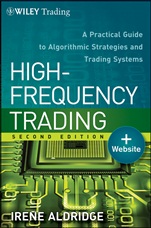
High–Frequency Trading: A Practical Guide to Algorithmic Strategies and Trading Systems
ISBN 9781118343500
Autor: Irene Aldridge
Wydawca: Wiley
Dostępność: 3-6 tygodni
Cena: 394,80 zł
Przed złożeniem zamówienia prosimy o kontakt mailowy celem potwierdzenia ceny.
ISBN13: |
9781118343500 |
ISBN10: |
1118343506 |
Autor: |
Irene Aldridge |
Oprawa: |
Hardback |
Rok Wydania: |
2013-05-17 |
Numer Wydania: |
2nd Edition |
Ilość stron: |
320 |
Wymiary: |
254x178 |
Tematy: |
KF |
Praise for High–Frequency Trading, Second Edition
"High–Frequency Trading, Second Edition tells the fascinating story of how computers came to dominate modern financial markets. Irene Aldridge guides the reader through the intellectual ideas that have allowed this revolution to occur, from the economic, technological, and regulatory points of view."
Sasha Stoikov, Senior Research Associate, ORIE, Cornell University
"High–frequency trading is a complex subject at the nexus of advances in market microstructure, computer science, and financial data analysis. This book handles the topic in a comprehensive manner, making it accessible to a lay reader, yet providing enough detail for sophisticated industry practitioners and scientists."
Charles S. Tapiero, Topfer Distinguished Professor of Financial Engineering and Technology Management; Chair, Department of Finance and Risk Engineering, New York University Polytechnic Institute; and Coeditor in Chief, Risk and Decision Analysis
While interest in high–frequency trading (HFT) continues to grow, there is still very little meaningful information available to help investors understand and implement HFT systems. That′s why industry expert Irene Aldridge has returned with the Second Edition of High–Frequency Trading.
Incorporating the latest research and questions that have come to light since the publication of the first edition, this reliable resource has everything you need to gain a firm grip on how HFT works and what it takes to apply this proven approach to your trading endeavors. Covering various aspects of HFT from trading strategies to risk management and regulation this book will put you in a better position to excel in today′s turbulent markets.
Website includes:
Customizable teaching slides Basic C/C++ code for estimating regression coefficients A sample of tick data Continuously updated resources, including research papers and newsPreface xi
Acknowledgments xiii
Chapter 1 How Modern Markets Differ from Those Past 1
Media, Modern Markets, and HFT 6
HFT as Evolution of Trading Methodology 7
What Is High–Frequency Trading? 13
What Do High–Frequency Traders Do? 15
How Many High–Frequency Traders Are There? 17
Major Players in the HFT Space 17
Organization of This Book 18
Summary 18
End–of–Chapter Questions 19
Chapter 2 Technological Innovations, Systems, and HFT 21
A Brief History of Hardware 21
Messaging 25
Software 33
Summary 35
End–of–Chapter Questions 35
Chapter 3 Market Microstructure, Orders, and Limit Order Books 37
Types of Markets 37
Limit Order Books 39
Aggressive versus Passive Execution 43
Complex Orders 44
Trading Hours 45
Modern Microstructure: Market Convergence and Divergence 46
Fragmentation in Equities 46
Fragmentation in Futures 50
Fragmentation in Options 51
Fragmentation in Forex 51
Fragmentation in Fixed Income 51
Fragmentation in Swaps 51
Summary 52
End–of–Chapter Questions 52
Chapter 4 High–Frequency Data 53
What Is High–Frequency Data? 53
How Is High–Frequency Data Recorded? 54
Properties of High–Frequency Data 56
High–Frequency Data Are Voluminous 57
High–Frequency Data Are Subject to the Bid–Ask Bounce 59
High–Frequency Data Are Not Normal or Lognormal 62
High–Frequency Data Are Irregularly Spaced in Time 62
Most High–Frequency Data Do Not Contain Buy–and–Sell Identifiers 70
Summary 73
End–of–Chapter Questions 74
Chapter 5 Trading Costs 75
Overview of Execution Costs 75
Transparent Execution Costs 76
Implicit Execution Costs 78
Background and Definitions 82
Estimation of Market Impact 85
Empirical Estimation of Permanent Market Impact 88
Summary 96
End–of–Chapter Questions 96
Chapter 6 Performance and Capacity of High–Frequency Trading Strategies 97
Principles of Performance Measurement 97
Basic Performance Measures 98
Comparative Ratios 106
Performance Attribution 110
Capacity Evaluation 112
Alpha Decay 116
Summary 116
End–of–Chapter Questions 116
Chapter 7 The Business of High–Frequency Trading 117
Key Processes of HFT 117
Financial Markets Suitable for HFT 121
Economics of HFT 122
Market Participants 129
Summary 130
End–of–Chapter Questions 130
Chapter 8 Statistical Arbitrage Strategies 131
Practical Applications of Statistical Arbitrage 133
Summary 144
End–of–Chapter Questions 144
Chapter 9 Directional Trading Around Events 147
Developing Directional Event–Based Strategies 148
What Constitutes an Event? 149
Forecasting Methodologies 150
Tradable News 153
Application of Event Arbitrage 155
Summary 163
End–of–Chapter Questions 163
Chapter 10 Automated Market Making Naïve Inventory Models 165
Introduction 165
Market Making: Key Principles 167
Simulating a Market–Making Strategy 167
Naïve Market–Making Strategies 168
Market Making as a Service 173
Profitable Market Making 176
Summary 178
End–of–Chapter Questions 178
Chapter 11 Automated Market Making II 179
What s in the Data? 179
Modeling Information in Order Flow 182
Summary 193
End–of–Chapter Questions 193
Chapter 12 Additional HFT Strategies, Market Manipulation, and Market Crashes 195
Latency Arbitrage 196
Spread Scalping 197
Rebate Capture 198
Quote Matching 199
Layering 200
Ignition 201
Pinging/Sniping/Sniffing/Phishing 201
Quote Stuffing 201
Spoofing 202
Pump–and–Dump 202
Machine Learning 207
Summary 208
End–of–Chapter Questions 208
Chapter 13 Regulation 209
Key Initiatives of Regulators Worldwide 209
Summary 222
End–of–Chapter Questions 223
Chapter 14 Risk Management of HFT225
Measuring HFT Risk 225
Summary 244
End–of–Chapter Questions 244
Chapter 15 Minimizing Market Impact 245
Why Execution Algorithms? 245
Order–Routing Algorithms 247
Issues with Basic Models 258
Advanced Models 262
Practical Implementation of Optimal Execution Strategies 269
Summary 269
End–of–Chapter Questions 270
Chapter 16 Implementation of HFT Systems 271
Model Development Life Cycle 271
System Implementation 273
Testing Trading Systems 283
Summary 286
End–of–Chapter Questions 287
About the Author 288
About the Web Site 290
References 291
Index 303
IRENE ALDRIDGE is an investment consultant, portfolio manager, a recognized expert on the subjects of quantitative investing and high–frequency trading, and a seasoned educator. She is currently Industry Professor at New York University, Department of Finance and Risk Engineering, Polytechnic Institute, as well as Managing Partner and Quantitative Portfolio Manager at Able Alpha Trading Ltd., an investment consulting firm and a proprietary trading vehicle specializing in quantitative and high–frequency trading strategies. Aldridge is also a founder of AbleMarkets.com, an online resource making the latest high–frequency research for institutional investors and broker–dealers. Aldridge holds an MBA from INSEAD, an MS in financial engineering from Columbia University, a BE in electric engineering from the Cooper Union in New York, and is in the process of completing her PhD at New York University. She is a frequent speaker at top industry events and a contributor to academic, practitioner, and mainstream media publications, including the Journal of Trading, Futures magazine, Reuters HedgeWorld, Advanced Trading, FX Week, FINalternatives, Dealing With Technology, and Huffington Post.
Koszyk
Książek w koszyku: 0 szt.
Wartość zakupów: 0,00 zł
Informacje


Kontakt
Gambit
Centrum Oprogramowania
i Szkoleń Sp. z o.o.
Al. Pokoju 29b/22-24
31-564 Kraków
Siedziba Księgarni
ul. Kordylewskiego 1
31-542 Kraków
+48 12 410 5991
+48 12 410 5987
+48 12 410 5989
Subskrypcje
Administratorem danych osobowych jest firma Gambit COiS Sp. z o.o. Na podany adres będzie wysyłany wyłącznie biuletyn informacyjny.
Autoryzacja płatności

Informacje na temat autoryzacji płatności poprzez PayU.

© Copyright 2012: GAMBIT COiS Sp. z o.o. Wszelkie prawa zastrzeżone.
Projekt i wykonanie: Alchemia Studio Reklamy