


Wydawcy
Katalog tematyczny
- Archeologia (109)
- Ekonomia, finanse, business (13704)
- Filozofia (1445)
- Historia (3040)
- Języki i językoznawstwo (2356)
- Lifestyle, hobby i rozrywka (475)
- Medycyna (9704)
- Nauki humanistyczne (4)
- Nauki o Ziemi i środowisku (2638)
- Nauki ścisłe (20412)
- Nauki społeczne (8486)
- Nauki techniczne (13450)
- Budownictwo lądowe (1045)
- Chemia przemysłowa (2258)
- Elektronika i telekomunikacja (3287)
- Energetyka (1122)
- Inne nauki stosowane (363)
- Inżynieria biochemiczna (507)
- Inżynieria transportu (232)
- Mechanika i materiały (3316)
- Nauka o środowisku (321)
- Rolnictwo (507)
- Technika, ogólnie (475)
- Prawo (1696)
- Publikacje informacyjne i interdyscyplinarne (1288)
- Religia i wierzenia (917)
- Technika komputerowa (4067)
- Zdrowie, relacje międzyludzkie i rozwój osobisty (657)





Informacje szczegółowe o książce
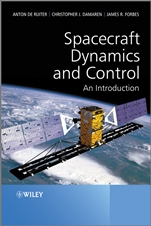
Spacecraft Dynamics and Control: An Introduction
ISBN 9781118342367
Autor: Anton H. de Ruiter, Christopher Damaren, James R. Forbes
Wydawca: Wiley
Dostępność: 3-6 tygodni
Cena: 443,10 zł
Przed złożeniem zamówienia prosimy o kontakt mailowy celem potwierdzenia ceny.
ISBN13: |
9781118342367 |
ISBN10: |
1118342364 |
Autor: |
Anton H. de Ruiter, Christopher Damaren, James R. Forbes |
Oprawa: |
Hardback |
Rok Wydania: |
2013-01-04 |
Ilość stron: |
588 |
Wymiary: |
244x170 |
Tematy: |
TG |
"This unique volume is unmatched in breadth and depth, providing detailed coverage of topics ranging from orbital dynamics to formation flight to attitude dynamics to control and navigation. The authors bring a fresh, unified perspective to the field with a groundbreaking textbook that is destined to become the favorite of students at all levels."— Dennis S. Bernstein, Aerospace Engineering Department, The University of Michigan, USA This textbook presents a rigorous, yet practical and accessible introduction to the fundamentals of spacecraft dynamics and control. Written for engineering students and practicing engineers with a basic background in mathematics and mechanics, it is suitable for both upper–year undergraduate courses and first graduate courses, as well as self study. The material covered is comprehensive; all the pertinent aspects of a spacecraft mission including orbital dynamics, attitude dynamics, and control are discussed. Additionally, advanced topics such as low–thrust trajectory analysis, nonlinear spacecraft attitude control, and navigation techniques are introduced. A unique feature of this textbook is the presentation of classical control systems design techniques using spacecraft attitude control as the motivating control design objective. Key features: A comprehensive reference on the fundamentals of orbital dynamics, attitude dynamics, and control Classical control systems design is explained and motivated by the control of a spacecraft′s attitude Practical aspects of spacecraft dynamics and control are discussed, included sensor and actuator operation, digital implementation of controllers, and the effects of unmodelled dynamics Numerous illustrations accompany the text, helping the reader to better understand the material
Preface xvii 1 Kinematics 1 1.1 Physical Vectors 1 1.2 Reference Frames and Physical Vector Coordinates 6 1.3 Rotation Matrices 11 1.4 Derivatives of Vectors 32 1.5 Velocity and Acceleration 41 1.6 More Rigorous Definition of Angular Velocity 42 Notes 44 References 45 2 Rigid Body Dynamics 47 2.1 Dynamics of a Single Particle 47 2.2 Dynamics of a System of Particles 49 2.3 Rigid Body Dynamics 52 2.4 The Inertia Matrix 56 2.5 Kinetic Energy of a Rigid Body 60 Notes 63 References 63 3 The Keplerian Two–Body Problem 65 3.1 Equations of Motion 65 3.2 Constants of the Motion 67 3.3 Shape of a Keplerian Orbit 69 3.4 Kepler’s Laws 80 3.5 Time of Flight 83 3.6 Orbital Elements 89 3.7 Orbital Elements given Position and Velocity 92 3.8 Position and Velocity given Orbital Elements 94 Notes 98 References 98 4 Preliminary Orbit Determination 99 4.1 Orbit Determination from Three Position Vectors 99 4.2 Orbit Determination from Three Line–of–Sight Vectors 103 4.3 Orbit Determination from Two Position Vectors and Time (Lambert’s Problem) 109 Notes 114 References 114 5 Orbital Maneuvers 115 5.1 Simple Impulsive Maneuvers 115 5.2 Coplanar Maneuvers 116 5.3 Plane Change Maneuvers 123 5.4 Combined Maneuvers 125 5.5 Rendezvous 127 Notes 128 Reference 128 6 Interplanetary Trajectories 129 6.1 Sphere of Influence 129 6.2 Interplanetary Hohmann Transfers 133 6.3 Patched Conics 137 6.4 Planetary Flyby 143 6.5 Planetary Capture 145 Notes 146 References 147 7 Orbital Perturbations 149 7.1 Special Perturbations 150 7.1.1 Cowell’s Method 151 7.2 General Perturbations 154 7.3 Gravitational Perturbations due to a Non–Spherical Primary Body 156 7.4 Effect of J2 on the Orbital Elements 164 7.5 Special Types of Orbits 168 7.6 Small Impulse Form of the Gauss Variational Equations 169 7.7 Derivation of the Remaining Gauss Variational Equations 171 Notes 180 References 181 8 Low Thrust Trajectory Analysis and Design 183 8.1 Problem Formulation 183 8.2 Coplanar Circle to Circle Transfers 184 8.3 Plane Change Maneuver 186 Notes 188 References 188 9 Spacecraft Formation Flying 189 9.1 Mathematical Description 190 9.2 Relative Motion Solutions 194 9.3 Special Types of Relative Orbits 203 Notes 207 Reference 207 10 The Restricted Three–Body Problem 209 10.1 Formulation 209 10.2 The Lagrangian Points 212 10.3 Stability of the Lagrangian Points 214 10.4 Jacobi’s Integral 215 Notes 218 References 218 11 Introduction to Spacecraft Attitude Stabilization 219 11.1 Introduction to Control Systems 220 11.2 Overview of Attitude Representation and Kinematics 222 11.3 Overview of Spacecraft Attitude Dynamics 223 12 Disturbance Torques on a Spacecraft 227 12.1 Magnetic Torque 227 12.2 Solar Radiation Pressure Torque 228 12.3 Aerodynamic Torque 230 12.4 Gravity–Gradient Torque 231 Notes 234 Reference 234 13 Torque–Free Attitude Motion 235 13.1 Solution for an Axisymmetric Body 235 13.2 Physical Interpretation of the Motion 242 Notes 245 References 245 14 Spin Stabilization 247 14.1 Stability 247 14.2 Spin Stability of Torque–Free Motion 249 14.3 Effect of Internal Energy Dissipation 252 Notes 253 References 253 15 Dual–Spin Stabilization 255 15.1 Equations of Motion 255 15.2 Stability of Dual–Spin Torque–Free Motion 257 15.3 Effect of Internal Energy Dissipation 259 Notes 266 References 266 16 Gravity–Gradient Stabilization 267 16.1 Equations of Motion 268 16.2 Stability Analysis 272 Notes 277 References 277 17 Active Spacecraft Attitude Control 279 17.1 Attitude Control for a Nominally Inertially Fixed Spacecraft 280 17.2 Transfer Function Representation of a System 281 17.3 System Response to an Impulsive Input 282 17.4 Block Diagrams 284 17.5 The Feedback Control Problem 286 17.6 Typical Control Laws 289 17.7 Time–Domain Specifications 292 17.8 Factors that Modify the Transient Behavior 308 17.9 Steady–State Specifications and System Type 311 JWST251–FM JWST251–De–Ruiter Printer: Yet to Come November 2, 2012 14:18 Trim: 244mm × 168mm viii Contents 2.4 The Inertia Matrix 56 2.4.1 A Parallel Axis Theorem 57 2.4.2 A Rotational Transformation Theorem 58 2.4.3 Principal Axes 59 2.5 Kinetic Energy of a Rigid Body 60 Notes 63 References 63 3 The Keplerian Two–Body Problem 65 3.1 Equations of Motion 65 3.2 Constants of the Motion 67 3.2.1 Orbital Angular Momentum 67 3.2.2 Orbital Energy 67 3.2.3 The Eccentricity Vector 68 3.3 Shape of a Keplerian Orbit 69 3.3.1 Perifocal Coordinate System 72 3.4 Kepler’s Laws 80 3.5 Time of Flight 83 3.5.1 Circular Orbits 83 3.5.2 Elliptical Orbits 84 3.5.3 Parabolic Orbits 88 3.5.4 Hyperbolic Orbits 89 3.6 Orbital Elements 89 3.6.1 Heliocentric–Ecliptic Coordinate System 89 3.6.2 Geocentric–Equatorial Coordinate System 90 3.7 Orbital Elements given Position and Velocity 92 3.8 Position and Velocity given Orbital Elements 94 Notes 98 References 98 4 Preliminary Orbit Determination 99 4.1 Orbit Determination from Three Position Vectors 99 4.2 Orbit Determination from Three Line–of–Sight Vectors 103 4.3 Orbit Determination from Two Position Vectors and Time (Lambert’s Problem) 109 4.3.1 The Lagrangian Coefficients 110 Notes 114 References 114 5 Orbital Maneuvers 115 5.1 Simple Impulsive Maneuvers 115 5.2 Coplanar Maneuvers 116 5.2.1 Hohmann Transfers 118 5.2.2 Bi–Elliptic Transfers 120 5.3 Plane Change Maneuvers 123 FOR SCREEN VIEWING IN DART ONLY JWST251–FM JWST251–De–Ruiter Printer: Yet to Come November 2, 2012 14:18 Trim: 244mm × 168mm Contents ix 5.4 Combined Maneuvers 125 5.5 Rendezvous 127 Notes 128 Reference 128 6 Interplanetary Trajectories 129 6.1 Sphere of Influence 129 6.2 Interplanetary Hohmann Transfers 133 6.3 Patched Conics 137 6.3.1 Departure Hyperbola 139 6.3.2 Arrival Hyperbola 141 6.4 Planetary Flyby 143 6.5 Planetary Capture 145 Notes 146 References 147 7 Orbital Perturbations 149 7.1 Special Perturbations 150 7.1.1 Cowell’s Method 151 7.1.2 Encke’s Method 151 7.2 General Perturbations 154 7.3 Gravitational Perturbations due to a Non–Spherical Primary Body 156 7.3.1 The Perturbative Force Per Unit Mass Due to J 2 163 7.4 Effect of J 2 on the Orbital Elements 164 7.5 Special Types of Orbits 168 7.5.1 Sun–Synchronous Orbits 168 7.5.2 Molniya Orbits 169 7.6 Small Impulse Form of the Gauss Variational Equations 169 7.7 Derivation of the Remaining Gauss Variational Equations 171 Notes 180 References 181 8 Low Thrust Trajectory Analysis and Design 183 8.1 Problem Formulation 183 8.2 Coplanar Circle to Circle Transfers 184 8.3 Plane Change Maneuver 186 Notes 188 References 188 9 Spacecraft Formation Flying 189 9.1 Mathematical Description 190 9.2 Relative Motion Solutions 194 9.2.1 Out–of–Plane Motion 195 9.2.2 In–Plane Motion 195 FOR SCREEN VIEWING IN DART ONLY JWST251–FM JWST251–De–Ruiter Printer: Yet to Come November 2, 2012 14:18 Trim: 244mm × 168mm x Contents 9.2.3 Alternative Description for In–Plane Relative Motion 198 9.2.4 Further Examination of In–Plane Motion 200 9.2.5 Out–of–Plane Motion – Revisited 202 9.3 Special Types of Relative Orbits 203 9.3.1 Along–Track Orbits 203 9.3.2 Projected Elliptical Orbits 204 9.3.3 Projected Circular Orbits 207 Notes 207 Reference 207 10 The Restricted Three–Body Problem 209 10.1 Formulation 209 10.1.1 Equations of Motion 211 10.2 The Lagrangian Points 212 10.2.1 Case (i) 212 10.2.2 Case (ii) 213 10.3 Stability of the Lagrangian Points 214 10.3.1 Comments 215 10.4 Jacobi’s Integral 215 10.4.1 Hill’s Curves 216 10.4.2 Comments on Figure 10.5 218 Notes 218 References 218 11 Introduction to Spacecraft Attitude Stabilization 219 11.1 Introduction to Control Systems 220 11.1.1 Open–loop versus Closed–loop 220 11.1.2 Typical Feedback Control Structure 221 11.2 Overview of Attitude Representation and Kinematics 222 11.3 Overview of Spacecraft Attitude Dynamics 223 11.3.1 Properties of the Inertia Matrix – A Summary 224 12 Disturbance Torques on a Spacecraft 227 12.1 Magnetic Torque 227 12.2 Solar Radiation Pressure Torque 228 12.3 Aerodynamic Torque 230 12.4 Gravity–Gradient Torque 231 Notes 234 Reference 234 13 Torque–Free Attitude Motion 235 13.1 Solution for an Axisymmetric Body 235 13.2 Physical Interpretation of the Motion 242 Notes 245 References 245 FOR SCREEN VIEWING IN DART ONLY JWST251–FM JWST251–De–Ruiter Printer: Yet to Come November 2, 2012 14:18 Trim: 244mm × 168mm Contents xi 14 Spin Stabilization 247 14.1 Stability 247 14.2 Spin Stability of Torque–Free Motion 249 14.3 Effect of Internal Energy Dissipation 252 14.3.1 Energy Sink Hypothesis 252 14.3.2 Major Axis Rule 253 Notes 253 References 253 15 Dual–Spin Stabilization 255 15.1 Equations of Motion 255 15.2 Stability of Dual–Spin Torque–Free Motion 257 15.3 Effect of Internal Energy Dissipation 259 Notes 266 References 266 16 Gravity–Gradient Stabilization 267 16.1 Equations of Motion 268 16.2 Stability Analysis 272 16.2.1 Pitch Motion 272 16.2.2 Roll–Yaw Motion 273 16.2.3 Combined Pitch and Roll/Yaw 277 Notes 277 References 277 17 Active Spacecraft Attitude Control 279 17.1 Attitude Control for a Nominally Inertially Fixed Spacecraft 280 17.2 Transfer Function Representation of a System 281 17.3 System Response to an Impulsive Input 282 17.4 Block Diagrams 284 17.5 The Feedback Control Problem 286 17.6 Typical Control Laws 289 17.7 Time–Domain Specifications 292 17.8 Factors that Modify the Transient Behavior 308 17.9 Steady–State Specifications and System Type 311 17.10 Effect of Disturbances 316 17.11 Actuator Limitations 319 Notes 320 References 320 18 Routh’s Stability Criterion 321 18.1 Proportional–Derivative Control with Actuator Dynamics 322 18.2 Active Dual–Spin Stabilization 325 Notes 330 References 330 19 The Root Locus 331 19.1 Rules for Constructing the Root Locus 332 19.2 PD Attitude Control with Actuator Dynamics – Revisited 341 19.3 Derivation of the Rules for Constructing the Root Locus 345 Notes 353 References 353 20 Control Design by the Root Locus Method 355 20.1 Typical Types of Controllers 357 20.2 PID Design for Spacecraft Attitude Control 361 Notes 369 References 369 21 Frequency Response 371 21.1 Frequency Response and Bode Plots 372 21.2 Low–Pass Filter Design 383 Notes 385 References 385 22 Relative Stability 387 22.1 Polar Plots 387 22.2 Nyquist Stability Criterion 390 22.3 Stability Margins 399 Notes 410 References 410 23 Control Design in the Frequency Domain 411 23.1 Feedback Control Problem – Revisited 416 23.2 Control Design 422 23.3 Example – PID Design for Spacecraft Attitude Control 430 Notes 435 References 435 24 Nonlinear Spacecraft Attitude Control 437 24.1 State–Space Representation of the Spacecraft Attitude Equations 437 24.2 Stability Definitions 440 24.3 Stability Analysis 442 24.4 LaSalle’s Theorem 448 24.5 Spacecraft Attitude Control with Quaternion and Angular Rate Feedback 451 Notes 456 References 457 25 Spacecraft Navigation 459 25.1 Review of Probability Theory 459 25.2 Batch Approaches for Spacecraft Attitude Estimation 467 25.3 The Kalman Filter 477 Notes 496 References 497 26 Practical Spacecraft Attitude Control Design Issues 499 26.1 Attitude Sensors 499 26.2 Attitude Actuators 506 26.3 Control Law Implementation 511 26.4 Unmodeled Dynamics 523 Notes 539 References Appendix A: Review of Complex Variables 541 Appendix B: Numerical Simulation of Spacecraft Motion 557 Notes 561 Reference 561 Index 563
“Overall, this book provides a good, comprehensive examination of the fundamentals of translational and rotational dynamics, determination, and control of spacecraft. Summing Up: Recommended. All academic and professional aerospace engineering collections.” ( Choice , 1 September 2013)
Koszyk
Książek w koszyku: 0 szt.
Wartość zakupów: 0,00 zł
Informacje


Kontakt
Gambit
Centrum Oprogramowania
i Szkoleń Sp. z o.o.
Al. Pokoju 29b/22-24
31-564 Kraków
Siedziba Księgarni
ul. Kordylewskiego 1
31-542 Kraków
+48 12 410 5991
+48 12 410 5987
+48 12 410 5989
Subskrypcje
Administratorem danych osobowych jest firma Gambit COiS Sp. z o.o. Na podany adres będzie wysyłany wyłącznie biuletyn informacyjny.
Autoryzacja płatności

Informacje na temat autoryzacji płatności poprzez PayU.

© Copyright 2012: GAMBIT COiS Sp. z o.o. Wszelkie prawa zastrzeżone.
Projekt i wykonanie: Alchemia Studio Reklamy