


Wydawcy
Katalog tematyczny
- Archeologia (109)
- Ekonomia, finanse, business (13704)
- Filozofia (1445)
- Historia (3040)
- Języki i językoznawstwo (2356)
- Lifestyle, hobby i rozrywka (475)
- Medycyna (9704)
- Nauki humanistyczne (4)
- Nauki o Ziemi i środowisku (2638)
- Nauki ścisłe (20412)
- Nauki społeczne (8486)
- Nauki techniczne (13450)
- Prawo (1696)
- Publikacje informacyjne i interdyscyplinarne (1288)
- Religia i wierzenia (917)
- Technika komputerowa (4067)
- Zdrowie, relacje międzyludzkie i rozwój osobisty (657)





Informacje szczegółowe o książce
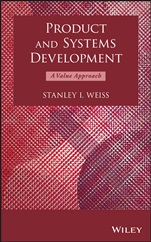
Product and Systems Development: A Value Approach
ISBN 9781118331545
Autor: Stanley I. Weiss
Wydawca: Wiley
Dostępność: 3-6 tygodni
Cena: 475,65 zł
Przed złożeniem zamówienia prosimy o kontakt mailowy celem potwierdzenia ceny.
ISBN13: |
9781118331545 |
ISBN10: |
1118331540 |
Autor: |
Stanley I. Weiss |
Oprawa: |
Hardback |
Rok Wydania: |
2013-06-21 |
Ilość stron: |
280 |
Wymiary: |
234x162 |
Tematy: |
KM |
A thorough treatment of product and systems development in terms of value to all stakeholders Product and Systems Development compiles more than twenty years of research and practice from a value perspective, from vision and marketing to design, manufacturing, delivery, operations, and maintenance. It defines stakeholder value and identifies specific stakeholders in the product and system development process; covers best practices in development; and examines systems engineering, current industry views, and the life cycle of a value stream. Featuring appendices written by professionals in the field on topics such as Design Structure Matrices, Lean Enablers for systems engineering, and MDAO and simulations, this indispensable guide: Explains why stakeholders' values can hold the key to fulfillment or defeat of the developer's vision Emphasizes the succession of value-contributing practices and tools that form a framework for development success Integrates the technical, productivity, and customer/end-user elements in product and system development Uses more than 100 tables and figures to illustrate the above processes, as well as corollary elements of risk, failure analysis, and fault-tolerant design Includes numerous case studies and links to online material Product and Systems Development is an excellent coursebook for senior and graduate students in aerospace, mechanical, civil, electrical, and material engineering, as well as management science and engineering. It is also a useful reference for practicing engineers in a variety of technology-based industries.
Preface xi Acknowledgments xv 1 Preview of Best Practices 1 Resource and Note 3 Review Checklist 4 2 Stakeholder Values 5 2.1. Value and Stakeholder Identities 6 2.2. The Stakeholder Connection 7 Resources and Notes 11 Review Checklist 11 3 Role of Systems Engineering 13 3.1. Definition of a System 13 3.2. Industry Views 16 3.3. Stakeholders and Systems 17 3.4. System Value Stream 18 Resources and Notes 19 Review Checklist 19 4 Stakeholder Value Drivers 21 4.1. Value Analysis in a Strategic Framework 22 4.2. The QFD Stakeholder Values Matrix Process 22 4.3. QFD Process Summary 24 Resources and Notes 27 Review Checklist 27 5 Value–Driven Requirements Development 29 5.1. Establishing the Parameters 29 5.2. Translating Values to Requirements 32 5.3. Changing Requirements 34 5.4. Quantifying Requirements 35 5.5. Requirements Process Summary 37 Resources and Notes 39 Review Checklist 40 6 Functional Analysis 41 6.1. Functional Flows 41 6.2. Functional Block Diagrams 43 Resources and Notes 46 Review Checklist 46 7 Interface Definition and Management 47 7.1. Interface Complexity 48 7.2. The N–Squared Matrix 50 7.3. Interface Control 53 Resources and Notes 54 Review Checklist 54 8 Concept Selection and Trades 55 8.1. Concept Options 55 8.2. Concept Creativity 57 8.3. Decision Processes 59 8.4. Multidiscipline Analysis and Optimization 66 Resources and Notes 67 Review Checklist 67 9 Architectures and “Architecting” 69 9.1. Selecting an Architecture 69 9.2. Architectural Design 71 9.3. Architectural Imperatives and Precautions 72 Resources and Notes 78 Review Checklist 79 10 Failure Modes and Fault Tolerance 81 10.1. Causes of Failure 81 10.2. Failure Modes and Effects 84 10.3. Fault Tolerance 87 10.4. Redundancy Concepts 88 10.5. Human Factors and Hazards 91 10.6. Programmatic Failures and Fault Tolerance 93 10.7. Summary 93 Resources and Notes 94 Review Checklist 94 11 Risk Analysis 95 11.1. Risk Philosophies 95 11.2. Risk Management 96 11.3. Risk Mitigation Practices 100 Resources and Notes 105 Review Checklist 105 12 Integration, Verification, and Validation 107 12.1. Definitions 107 12.2. Planning Issues 109 12.3. Design Verification and Validation 109 12.4. Quality Assurance 110 12.5. Test Considerations 113 Resources and Notes 115 Review Checklist 116 13 Integrated Product and Process Development 117 13.1. Definitions 117 13.2. Integrated Project Teams 119 13.3. IPPD Benefits 123 Resources and Notes 125 Review Checklist 125 14 Design for X 127 Resources and Notes 130 Review Checklist 130 15 Development Management 131 15.1. Key Integrations 131 15.2. Strategic Approaches 132 15.3. Measuring Progress 133 Resources and Notes 141 Review Checklist 142 16 Cost Estimating 143 16.1. Stakeholder Involvement 143 16.2. Costing Factors 144 16.3. Estimating Methods 144 16.4. Learning Curves 148 16.5. Cost–Estimating Problems 149 Resources and Notes 151 Review Checklist 151 17 Lean Principles and Practices 153 17.1. Thinking Lean Precepts 154 17.2. Dealing with Waste 156 17.3. Lean Models 159 Resources and Notes 161 Review Checklist 162 18 Value Stream Mapping 163 18.1. Streamlining the Process 163 18.2. Adapting to New Developments 167 Resources and Notes 170 Review Checklist 171 19 Case Studies 173 Case Study 1: Health Management System for a Next–Generation UAV 173 Case Study 2: Product and Systems Development for the Unique Identification Authority of India 189 Case Study 3: Software Development for a Photovoltaic System Construction Project 196 Review Checklist 208 20 Process Summary and Tools 209 Appendix I: Notes on the Design Structure Matrix 215 Tyson R. Browning Appendix II: Lean Systems Engineering and Lean Enablers for Systems Engineering 221 Bohdan W. Oppenheim Appendix III: Introduction to Modeling and Simulation 235 Heinz Stoewer Appendix IV: Introduction to Multidisciplinary Analysis and Optimization 241 Juan J. Alonso Bibliography 247 Index 251
STANLEY I. WEISS, PhD, has served as a Consulting Professor at Stanford University since 2000. He earned his PhD in theoretical and applied mechanics at the University of Illinois and is a graduate of the Advanced Management Program at Harvard Business School. Dr. Weiss developed much of his research and practice in the fields of product design and manufacturing at MIT and Stanford and during thirty years in industry and government. He is a past chairman and current advisory board member at the Rensselaer Polytechnic Institute's Department of Mechanical, Aerospace, and Nuclear Engineering.
Koszyk
Książek w koszyku: 0 szt.
Wartość zakupów: 0,00 zł
Informacje


Kontakt
Gambit
Centrum Oprogramowania
i Szkoleń Sp. z o.o.
Al. Pokoju 29b/22-24
31-564 Kraków
Siedziba Księgarni
ul. Kordylewskiego 1
31-542 Kraków
+48 12 410 5991
+48 12 410 5987
+48 12 410 5989
Subskrypcje
Administratorem danych osobowych jest firma Gambit COiS Sp. z o.o. Na podany adres będzie wysyłany wyłącznie biuletyn informacyjny.
Autoryzacja płatności

Informacje na temat autoryzacji płatności poprzez PayU.

© Copyright 2012: GAMBIT COiS Sp. z o.o. Wszelkie prawa zastrzeżone.
Projekt i wykonanie: Alchemia Studio Reklamy