


Wydawcy
Katalog tematyczny
- Archeologia (109)
- Ekonomia, finanse, business (13704)
- Filozofia (1445)
- Historia (3040)
- Języki i językoznawstwo (2356)
- Lifestyle, hobby i rozrywka (475)
- Medycyna (9704)
- Nauki humanistyczne (4)
- Nauki o Ziemi i środowisku (2638)
- Nauki ścisłe (20412)
- Nauki społeczne (8486)
- Nauki techniczne (13450)
- Prawo (1696)
- Publikacje informacyjne i interdyscyplinarne (1288)
- Religia i wierzenia (917)
- Technika komputerowa (4067)
- Zdrowie, relacje międzyludzkie i rozwój osobisty (657)





Informacje szczegółowe o książce
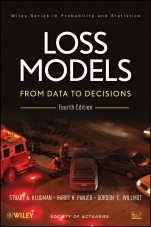
Loss Models: From Data to Decisions
ISBN 9781118315323
Autor: Stuart A. Klugman, Harry H. Panjer, Gordon E. Willmot
Wydawca: Wiley
Dostępność: 3-6 tygodni
Cena: 676,20 zł
Przed złożeniem zamówienia prosimy o kontakt mailowy celem potwierdzenia ceny.
ISBN13: |
9781118315323 |
ISBN10: |
1118315324 |
Autor: |
Stuart A. Klugman, Harry H. Panjer, Gordon E. Willmot |
Oprawa: |
Hardback |
Rok Wydania: |
2012-10-12 |
Numer Wydania: |
4th Edition |
Ilość stron: |
536 |
Wymiary: |
258x179 |
Tematy: |
KF |
Praise for the Third Edition
"This book provides in–depth coverage of modelling techniquesused throughout many branches of actuarial science. . . . Theexceptional high standard of this book has made it a pleasure toread." Annals of Actuarial Science
Newly organized to focus exclusively on material tested in theSociety of Actuaries′ Exam C and the Casualty Actuarial Society′sExam 4, Loss Models: From Data to Decisions, Fourth Editioncontinues to supply actuaries with a practical approach to the keyconcepts and techniques needed on the job. With updated materialand extensive examples, the book successfully provides theessential methods for using available data to construct models forthe frequency and severity of future adverse outcomes.
The book continues to equip readers with the tools needed forthe construction and analysis of mathematical models that describethe process by which funds flow into and out of an insurancesystem. Focusing on the loss process, the authors explore keyquantitative techniques including random variables, basicdistributional quantities, and the recursive method, and discusstechniques for classifying and creating distributions. Parametric,non–parametric, and Bayesian estimation methods are thoroughlycovered along with advice for choosing an appropriate model.
New features of this Fourth Edition include:
Expanded discussion of working with large data sets, nowincluding more practical elements of constructing decrementtables Added coverage of methods for simulating several specialsituations An updated presentation of Bayesian estimation, outliningconjugate prior distributions and the linear exponential family aswell as related computational issuesThroughout the book, numerous examples showcase the real–worldapplications of the presented concepts, with an emphasis oncalculations and spreadsheet implementation. A wealth of newexercises taken from previous Exam C/4 exams allows readers to testtheir comprehension of the material, and a related FTP sitefeatures the book′s data sets.
Loss Models, Fourth Edition is an indispensable resourcefor students and aspiring actuaries who are preparing to take theSOA and CAS examinations. The book is also a valuable reference forprofessional actuaries, actuarial students, and anyone who workswith loss and risk models.
Preface xiii
PART I INTRODUCTION
1 Modeling 3
1.1 The model–based approach 3
1.2 Organization of this book 5
2 Random variables 7
2.1 Introduction 7
2.2 Key functions and four models 9
3 Basic distributional quantities 19
3.1 Moments 19
3.2 Percentiles 27
3.3 Generating functions and sums of random variables 29
3.4 Tails of distributions 31
3.5 Measures of Risk 38
PART II ACTUARIAL MODELS
4 Characteristics of Actuarial Models 49
4.1 Introduction 49
4.2 The role of parameters 49
5 Continuous models 59
5.1 Introduction 59
5.2 Creating new distributions 59
5.3 Selected distributions and their relationships 72
5.4 The linear exponential family 75
6 Discrete distributions 79
6.1 Introduction 79
6.2 The Poisson distribution 80
6.3 The negative binomial distribution 83
6.4 The binomial distribution 85
6.5 The (a, b, 0) class 86
6.6 Truncation and modification at zero 89
7 Advanced discrete distributions 95
7.1 Compound frequency distributions 95
7.2 Further properties of the compound Poisson class 101
7.3 Mixed frequency distributions 107
7.4 Effect of exposure on frequency 114
7.5 An inventory of discrete distributions 114
8 Frequency and severity with coverage modifications117
8.1 Introduction 117
8.2 Deductibles 117
8.3 The loss elimination ratio and the effect of inflation forordinary deductibles 122
8.4 Policy limits 125
8.5 Coinsurance, deductibles, and limits 127
8.6 The impact of deductibles on claim frequency 131
9 Aggregate loss models 137
9.1 Introduction 137
9.2 Model choices 140
9.3 The compound model for aggregate claims 141
9.4 Analytic results 155
9.5 Computing the aggregate claims distribution 159
9.6 The recursive method 161
9.7 The impact of individual policy modifications on aggregatepayments 173
9.8 The individual risk model 176
PART III CONSTRUCTION OF EMPIRICAL MODELS
10 Review of mathematical statistics 187
10.1 Introduction 187
10.2 Point estimation 188
10.3 Interval estimation 196
10.4 Tests of hypotheses 198
11 Estimation for complete data 203
11.1 Introduction 203
11.2 The empirical distribution for complete, individual data207
11.3 Empirical distributions for grouped data 211
12 Estimation for modified data 217
12.1 Point estimation 217
12.2 Means, variances, and interval estimation 225
12.3 Kernel density models 236
12.4 Approximations for large data sets 240
PART IV PARAMETRIC STATISTICAL METHODS
13 Frequentist estimation 253
13.1 Method of moments and percentile matching 253
13.2 Maximum likelihood estimation 259
13.3 Variance and interval estimation 272
13.4 Non–normal confidence intervals 280
13.5 Maximum likelihood estimation of decrement probabilities282
14 Frequentist Estimation for discrete distributions285
14.1 Poisson 285
14.2 Negative binomial 289
14.3 Binomial 291
14.4 The (a, b, 1) class 293
14.5 Compound models 297
14.6 Effect of exposure on maximum likelihood estimation 299
14.7 Exercises 300
15 Bayesian estimation 305
15.1 Definitions and Bayes theorem 305
15.2 Inference and prediction 309
15.3 Conjugate prior distributions and the linear exponentialfamily 320
15.4 Computational issues 322
16 Model selection 323
16.1 Introduction 323
16.2 Representations of the data and model 324
16.3 Graphical comparison of the density and distributionfunctions 325
16.4 Hypothesis tests 330
16.5 Selecting a model 342
PART V CREDIBILITY
17 Introduction and Limited Fluctuation Credibility357
17.1 Introduction 357
17.2 Limited fluctuation credibility theory 359
17.3 Full credibility 360
17.4 Partial credibility 363
17.5 Problems with the approach 366
17.6 Notes and References 367
17.7 Exercises 367
18 Greatest accuracy credibility 371
18.1 Introduction 371
18.2 Conditional distributions and expectation 373
18.3 The Bayesian methodology 377
18.4 The credibility premium 385
18.5 The Buhlmann model 388
18.6 The Buhlmann–Straub model 392
18.7 Exact credibility 397
18.8 Notes and References 401
18.9 Exercises 402
19 Empirical Bayes parameter estimation 415
19.1 Introduction 415
19.2 Nonparametric estimation 418
19.3 Semiparametric estimation 428
19.4 Notes and References 430
19.5 Exercises 430
PART VI SIMULATION
20 Simulation 437
20.1 Basics of simulation 437
20.2 Simulation for specific distributions 442
20.3 Determining the sample size 448
20.4 Examples of simulation in actuarial modeling 450
Appendix A: An inventory of continuous distributions459
A.1 Introduction 459
A.2 Transformed beta family 463
A.3 Transformed gamma family 467
A.4 Distributions for large losses 470
A.5 Other distributions 471
A.6 Distributions with finite support 473
Appendix B: An inventory of discrete distributions475
B.1 Introduction 475
B.2 The (a, b, 0) class 476
B.3 The (a, b, 1) class 477
B.4 The compound class 480
B.5 A hierarchy of discrete distributions 482
Appendix C: Frequency and severity relationships 483
Appendix D: The recursive formula 485
Appendix E: Discretization of the severity distribution487
E.1 The method of rounding 487
E.2 Mean preserving 488
E.3 Undiscretization of a discretized distribution 488
Appendix F: Numerical optimization and solution of systems ofequations 491
F.1 Maximization using Solver 491
F.2 The simplex method 495
F.3 Using Excel® to solve equations 496
References 501
STUART A. KLUGMAN, PhD, FSA, CERA, is Staff Fellow(Education) at the Society of Actuaries (SOA) and PrincipalFinancial Group Distinguished Professor Emeritus of ActuarialScience at Drake University. He served as SOA vice–president from2001–2003.
HARRY H. PANJER, PhD, is Distinguished Professor Emeritusin the Department of Statistics and Actuarial Science at theUniversity of Waterloo, Canada. He is past president of theCanadian Institute of Actuaries and the Society of Actuaries.
GORDON E. WILLMOT, PhD, FSA, FCIA, is Munich Re Chair inInsurance and Professor in the Department of Statistics andActuarial Science at the University of Waterloo, Canada. Dr.Willmot currently focuses his research on the analysis of insurancelosses, with an emphasis on the theory and application of aggregateclaims models.
Koszyk
Książek w koszyku: 0 szt.
Wartość zakupów: 0,00 zł
Informacje


Kontakt
Gambit
Centrum Oprogramowania
i Szkoleń Sp. z o.o.
Al. Pokoju 29b/22-24
31-564 Kraków
Siedziba Księgarni
ul. Kordylewskiego 1
31-542 Kraków
+48 12 410 5991
+48 12 410 5987
+48 12 410 5989
Subskrypcje
Administratorem danych osobowych jest firma Gambit COiS Sp. z o.o. Na podany adres będzie wysyłany wyłącznie biuletyn informacyjny.
Autoryzacja płatności

Informacje na temat autoryzacji płatności poprzez PayU.

© Copyright 2012: GAMBIT COiS Sp. z o.o. Wszelkie prawa zastrzeżone.
Projekt i wykonanie: Alchemia Studio Reklamy