


Wydawcy
Katalog tematyczny
- Archeologia (109)
- Ekonomia, finanse, business (13704)
- Filozofia (1445)
- Historia (3040)
- Języki i językoznawstwo (2356)
- Lifestyle, hobby i rozrywka (475)
- Medycyna (9704)
- Nauki humanistyczne (4)
- Nauki o Ziemi i środowisku (2638)
- Nauki ścisłe (20412)
- Nauki społeczne (8486)
- Nauki techniczne (13450)
- Prawo (1696)
- Publikacje informacyjne i interdyscyplinarne (1288)
- Religia i wierzenia (917)
- Technika komputerowa (4067)
- Zdrowie, relacje międzyludzkie i rozwój osobisty (657)





Informacje szczegółowe o książce
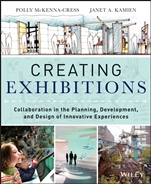
Creating Exhibitions: Collaboration in the Planning, Development, and Design of Innovative Experiences
ISBN 9781118306345
Autor: Polly McKenna–Cress, Janet Kamien
Wydawca: Wiley
Dostępność: 3-6 tygodni
Cena: 327,60 zł
Przed złożeniem zamówienia prosimy o kontakt mailowy celem potwierdzenia ceny.
ISBN13: |
9781118306345 |
ISBN10: |
1118306341 |
Autor: |
Polly McKenna–Cress, Janet Kamien |
Oprawa: |
Paperback |
Rok Wydania: |
2013-11-19 |
Ilość stron: |
320 |
Wymiary: |
236x194 |
Tematy: |
AC |
"A rich and detailed description of the team approach to creating museum exhibitions. Janet Kamien and Polly McKenna-Cress were pioneers in developing this successful approach, and their experience, wisdom, and humor shine through on every page. A must-read for anyone involved in museum exhibitions." Kathleen McLean, Principal, Independent Exhibitions "This book is like having a personal mentor by your side during every step of the exhibition process. The authors have written a book that is concise, insightful, practical, and friendlyjust what you need during a complex and often tense process." Elaine Heumann Gurian, Senior Consultant, The Museum Group Exhibition design involves numerous disciplines, variable physical and intellectual content, and the goal of enabling visitors to understand and enjoy complex topics more completely. It is a necessarily collaborative and multilayered process. Creating Exhibitions is the first guide of its kind: a one-stop resource that integrates the design process with content development to deliver a comprehensive program for conceiving, designing, and installing exhibitions. Structured around the key phases of the exhibition creation process, this team-oriented guide covers the entire project duration and offers problem-solving techniques supported by useful examples of how each solution was strategically applied. It offers this critical information in the context of a collaborative design process, speaks to a broad range of stakeholders in any exhibition project, and encourages innovation in every aspect of planning, development, and design. Both comprehensive and closely detailed, this one-stop manual: Delivers in-depth coverage of current thinking and research in exhibition design along with case studies that illustrate how the process was applied Includes exercises and experiments that provide hands-on experience with different concepts and approaches Features contributions from leading exhibition and museum professionals from all levels, offering multiple points of view for achieving collaboration and innovation Creating Exhibitions is an indispensable resource for professionals and students in architecture, graphic design, environmental graphic design, industrial design, digital media, lighting and theater, interior design, and landscape architecture. It is a valuable tool for anyone who wants to become not just a practitioner, but also an innovator in this fascinating and rewarding field.
Acknowledgments vi Foreword vii Introduction ix Chapter 1: Collaboration 1 Collaboration Unpacked 2 Why Collaborate? 4 Why Collaborate in Museums? 5 How to Collaborate 7 A Case Study: Science Gallery, Dublin 16 An Intrinsic Imperative 19 Chapter 2: Advocacies and Action Steps 21 Advocacy Positions as a Team Creation Strategy 21 Five Advocacies Needed for Every Team 22 Action Steps 34 Dangers and Pitfalls 35 Chapter 3: Advocacy for the Institution 39 Creating the Landscape for Exemplary Exhibitions 39 Laying the Foundation 40 Planning Major Change 43 Plan Ahead, Leslie Swartz 47 Reflecting Institutional Identity, Charlie Walter 50 Review, Critique, and Approval 60 Institutional Culture and Risk 64 Assessing Results and Learning from Them 65 Chapter 4: Advocacy for the Subject Matter 69 It’s about Something Too! 69 Approach and Philosophy 70 Object or Idea Driven 74 Dangers for the Subject Matter Expert 78 History through Objects, Jessica Neuwirth 80 An Art Historian’s Perspective, Rachel McGarry 83 Chapter 5: Advocacy for Visitor Experiences 89 Developing Exhibition Content for Visitors 89 Getting Started: Developing the Concepts 100 Strategies for Organizing Information 103 Synthesizing and Presenting Initial Concepts 107 Organizing the Concepts into a Cohesive Narrative 108 The Story on Storyelling, Leslie Bedford 113 Documentation and Presentation 115 Getting the Details Ironed Out: How Does This Thing Really Work? 119 Educator as Advocate, Shari Rosenstein Werb 120 Strategies for Ironing Out the Details 124 Chapter 6: Advocacy for Design 131 Advocating for the Physical and Sensory Experience 131 Design Advocacy: Working within the Collaboration 134 Primary Exhibition Design Principles 141 The Launch of Design 143 Spatial Planning and Visitor Flow 146 Gestalt—Sensory Perception Forming a Whole 153 The Impact of Lighting, Lauren Helpern and Traci Klainer Polimeni 154 The Medium Is the Message: Modes of Display 161 Wheel of Dependent Implementation, Jeff Hoke 162 Environmental Graphic Design, Richard Cress 165 Multimedia Integration, Richard Lewis 169 Magic and Illusion in Exhibition, Diane Perlov 172 Theater and Immersive Environments, Donna Lawrence 174 Object Theater, Paul Martin 174 Accessible and Universal Design 180 Accessible Design, Lath Carlson 181 Environmentally Sound Practice 184 Sustainable Exhibitions, Lath Carlson 186 Conclusion 189 Chapter 7: Advocacy for Project and Team 193 Managing the Project and Team 193 Creating a Schedule 195 Creating a Budget 201 Managing a Team 208 Chapter 8: Methods and Techniques 213 Getting the Most out of the Process 213 Process Documentation 214 Ways to Produce and Shape Ideas 215 Concept Organization and Visual Documentation 220 Sketching as Team visualization, Dottie Miles 222 Making Decisions and Conducting Evaluation 232 Evaluation, Jeff Hayward 236 Pilot Testing, Dana Schloss & Katherine Ziff 246 Prototyping to Test Ideas, Erika Kiessner 249 Visitors’ Bill of Rights, Judy Rand 254 Writing a Successful RFP, George Mayer 258 Chapter 9: Process and Phases 263 How Do We Set Up Our Process? 263 Process Outline 266 Process Phases 270 The Postpartum: Evaluating, Maintaining, Evolving, and Documenting 295 Exhibition Closing 300 Index 301
Polly McKenna-Cress is Department Chair and Program Director of Museum Exhibition Planning & Design at the University of the Arts, as well as Principal of Alusiv, Inc., a design firm in Philadelphia. She is a consultant, author, and educator who leads institutions, departments, and teams in master planning, development, design, and project management of exhibitions. Over her 25+ year career in both museums and design firms, she has led the creation of more than 60 exhibitions of varying sizes, budgets, and complexities. Janet A. Kamien was an executive consultant, author, and strategic planner. In her 40+ years in the museum field she worked on staff at four major museums and also worked as an independent consultant. She worked, consulted, and advised on more than 100 different interpretive projects and strategic master plans.
Koszyk
Książek w koszyku: 0 szt.
Wartość zakupów: 0,00 zł
Informacje


Kontakt
Gambit
Centrum Oprogramowania
i Szkoleń Sp. z o.o.
Al. Pokoju 29b/22-24
31-564 Kraków
Siedziba Księgarni
ul. Kordylewskiego 1
31-542 Kraków
+48 12 410 5991
+48 12 410 5987
+48 12 410 5989
Subskrypcje
Administratorem danych osobowych jest firma Gambit COiS Sp. z o.o. Na podany adres będzie wysyłany wyłącznie biuletyn informacyjny.
Autoryzacja płatności

Informacje na temat autoryzacji płatności poprzez PayU.

© Copyright 2012: GAMBIT COiS Sp. z o.o. Wszelkie prawa zastrzeżone.
Projekt i wykonanie: Alchemia Studio Reklamy