


Wydawcy
Katalog tematyczny
- Archeologia (109)
- Ekonomia, finanse, business (13704)
- Filozofia (1445)
- Historia (3040)
- Języki i językoznawstwo (2356)
- Lifestyle, hobby i rozrywka (475)
- Medycyna (9704)
- Nauki humanistyczne (4)
- Nauki o Ziemi i środowisku (2638)
- Nauki ścisłe (20412)
- Nauki społeczne (8486)
- Nauki techniczne (13450)
- Prawo (1696)
- Publikacje informacyjne i interdyscyplinarne (1288)
- Religia i wierzenia (917)
- Technika komputerowa (4067)
- Zdrowie, relacje międzyludzkie i rozwój osobisty (657)





Informacje szczegółowe o książce
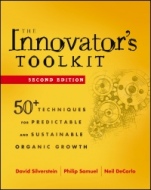
The Innovators Toolkit: 50+ Techniques for Predictable and Sustainable Organic Growth
ISBN 9781118298107
Autor: David Silverstein, Philip Samuel, Neil DeCarlo
Wydawca: Wiley
Dostępność: 3-6 tygodni
Cena: 170,10 zł
Przed złożeniem zamówienia prosimy o kontakt mailowy celem potwierdzenia ceny.
ISBN13: |
9781118298107 |
ISBN10: |
1118298101 |
Autor: |
David Silverstein, Philip Samuel, Neil DeCarlo |
Oprawa: |
Hardback |
Rok Wydania: |
2012-11-02 |
Numer Wydania: |
2nd Edition |
Ilość stron: |
432 |
Wymiary: |
242x192 |
Tematy: |
KM |
Praise for The Innovator′s Toolkit
"This book delivers the tools needed to unlock the creative potential of employees in any organization. It′s the missing link between making an organization great at what it does today (operational efficiencies) and also successful at what it will do tomorrow (revenue growth). Get ready to re–examine core assumptions about how you run your business."
JOHN BIEDRY, Global Director of Lean Enterprise, Nike
"This is not just a book to read and ponder. It′s an enormously practical framework that my team and I use to execute day–to–day product management activities. I have become a Jobs to be Done evangelist!"
GABI STRIJP, Executive Head of Business Mobility, Vodacom South Africa
"A business book that is also a practical guide! This book isn′t about new concepts; it′s about bringing innovation concepts together into one place and providing clear, concise, step–by–step mentoring. If you are serious about heading down the path of innovation, this book is a great reference."
F. ROBERT SALERNO, President and Chief Operating Officer, Avis Budget Group, Inc.
"A definitive and one–of–a–kind work, this book packs more innovation know–how under its hood than any other resource available. Silverstein and his coauthors have successfully connected the scattered dots of organic growth into an unbelievably cohesive, elegant, and actionable framework."
DENNIS CAREY, PhD, Senior Partner, Korn/Ferry International, and coauthor of How to Run a Company
"Driving organic growth is one thing. Driving it and realizing it on a large–scale and sustainable basis throughout a corporation is quite another. The system and techniques in this book enable many more, rather than fewer, to innovate and to repeatedly meet organic growth objectives."
GREG FRAZIER, Executive Vice President, Avnet, Inc.
"This book is truly the first and only of its kind. Its authors do an incredible job of showing how creativity and ideation techniques work hand–in–hand with Lean and Six Sigma tools to manifest the innovation agenda."
BERND WEBER, PhD, Director of Quality Management, ADVA Optical Networking, Munich, Germany
"The Innovator′s Toolkit provides a repeatable, reliable methodology that promises to be every bit as effective at driving innovation and organic growth as Lean Six Sigma has been for driving process improvement. The tools in this book are a valuable addition to any business excellence initiative."
ROBERT CRESCENZI, Vice President of Business Excellence, NewPage Corporation
"The Innovator′s Toolkit is a practical, well–thought–out work that is immediately usable for anyone or any company interested in enhancing innovation in an enterprise. Well done!"
TY R. SAGALOW, President, Innovation Insurance Group
DOWNLOADABLE EXHIBITS xiii
PREFACE xv
INTRODUCTION xvii
P A R T I Define the Opportunity 1
TECHNIQUE 1 Jobs to be Done 3
Highlight the human need you re trying to fulfill
TECHNIQUE 2 Job Mapping 13
Determine how customers are getting jobs done
TECHNIQUE 3 Outcome Expectations 20
Give customers more of what they desire
TECHNIQUE 4 Value Quotient 27
Identify opportunity gaps in the marketplace
TECHNIQUE 5 Ethnography 34
Observe your customers to uncover unarticulated needs
TECHNIQUE 6 Scenario Planning 41
Paint visions of possible change
TECHNIQUE 7 Heuristic Redefinition 49
Draw a picture of your system and its parts to focus ideation
TECHNIQUE 8 Nine Windows 57
Looking at your opportunity through nine different lenses
TECHNIQUE 9 Job Scoping 64
Broaden or narrow your innovation focus
TECHNIQUE 10 Stakeholder Management 68
Get key influencers involved and on your side
TECHNIQUE 11 Cognitive Style 74
Leverage the diversity of your exploiters and explorers
TECHNIQUE 12 Project Charter 82
Keep your innovation team focused and on track
TECHNIQUE 13 Innovation Financial Management 90
Constantly improve your assumption–to–knowledge ratio
P A R T II Discover the Ideas 99
TECHNIQUE 14 Resource Optimization 101
Make sure you use all available resources
TECHNIQUE 15 Functional Analysis 108
Scrutinize your system for innovation
TECHNIQUE 16 Trend Prediction 115
Learn from evolution s genetic code
TECHNIQUE 17 Creative Challenge 125
Sacrifice the sacred cows
TECHNIQUE 18 HIT Matrix 130
Compare existing solutions to spark new breakthroughs
TECHNIQUE 19 SCAMPER 133
Ask eight important questions
TECHNIQUE 20 Brainwriting 6–3–5 137
Encourage equal opportunity ideation
TECHNIQUE 21 Imaginary Brainstorming 140
Get silly for the sake of creativity
TECHNIQUE 22 Concept Tree 144
Leverage current ideas to generate many ideas
TECHNIQUE 23 Random Stimulus 147
Use an unrelated picture or word to spawn new ideas
TECHNIQUE 24 Provocation and Movement 153
Bust through the roadblocks in your thinking
TECHNIQUE 25 Forced Association 159
Hone in on solutions from other industries
TECHNIQUE 26 Structured Abstraction 164
Guide your innovation using 40 proven principles
TECHNIQUE 27 Separation Principles 173
Split your innovation problem in four ways
TECHNIQUE 28 Substance Field Analysis 179
Learn how substances interact with fields to form solutions
TECHNIQUE 29 Biomimicry 189
Seek nature s eons of experience to find answers
TECHNIQUE 30 KJ Method 195
Group and organize ideas by their natural affinities
TECHNIQUE 31 Idea Sorting and Refinement 199
Organize and shape ideas to improve their yield
TECHNIQUE 32 Six Thinking Modes 206
Evaluate your solution ideas in six different ways
P A R T III Develop the Designs 215
TECHNIQUE 33 Functional Requirements 217
Identify what customers want in your solution
TECHNIQUE 34 Axiomatic Design 223
Transform what customers want into the best products and services
TECHNIQUE 35 Function Structure 231
Identify how the solution functions in its whole and its parts
TECHNIQUE 36 Morphological Matrix 236
Generate solution concepts by combining design alternatives
TECHNIQUE 37 TILMAG 241
Pair ideal solution elements to create new design concepts
TECHNIQUE 38 Work Cell Design 245
Configure the workspace for flow and optimization
TECHNIQUE 39 Paired Comparison Analysis 253
Rank design concepts against each other in pairs
TECHNIQUE 40 Pugh Matrix 257
Evaluate all your design concepts to create the invincible solution
TECHNIQUE 41 Process Capability 262
Predict the performance of your new solution
TECHNIQUE 42 Robust Design 268
Make your design insensitive to uncontrollable influences
TECHNIQUE 43 Design Scorecards 273
Develop a dashboard to track your design and its underlying processes
TECHNIQUE 44 Design Failure Mode and Effects Analysis 285
Anticipate what can go wrong with your solution before it does
TECHNIQUE 45 Mistake Proofing 293
Install measures to prevent human and system error
TECHNIQUE 46 Discrete Event Simulation 301
Visualize and test your innovation through computer modeling
TECHNIQUE 47 Rapid Prototyping 308
Make a fast 3D model of your solution to explore its viability
P A R T IV Demonstrate the Innovation 315
TECHNIQUE 48 Prototyping 317
Make a fully functioning model of your new product to test and perfect it
TECHNIQUE 49 Piloting 322
Implement your solution on a limited basis to work out any problems
TECHNIQUE 50 SIPOC Map 328
Identify the key inputs and outputs of your process
TECHNIQUE 51 Process Map/Value Stream Map 333
Flesh out the details of your process
TECHNIQUE 52 Measurement Systems Analysis 340
Make sure you know your measurements are valid
TECHNIQUE 53 Design of Experiments 348
Analyze input and output variables to identify the critical few
TECHNIQUE 54 Conjoint Analysis 354
Compare solution attributes to cull out customer preferences
TECHNIQUE 55 Process Behavior Charts 360
Monitor process performance to keep the new solution in control
TECHNIQUE 56 Cause & Effect Diagram 367
Investigate the root causes of performance problems
TECHNIQUE 57 Cause & Effect Matrix 371
Identify the key input–output relationships in need of attention
TECHNIQUE 58 Control Plan 374
Ensure that your new solution becomes commercialized as planned
ACKNOWLEDGMENTS 381
INDEX 383
DAVID SILVERSTEIN is founder/CEO of BMGI, an international firm specializing in innovation, performance improvement, and strategy. A highly regarded public speaker and executive coach, Silverstein has been featured in the Wall Street Journal, Worth magazine, Investor′s Business Daily, ComputerWorld, Chief Learning Officer, Chief Executive, Forbes.com, and BusinessWeek.
Dr. PHILIP SAMUEL is Chief Innovation Officer of BMGI. A frequent public speaker and thought leader in the field of strategy and innovation, he has become a trusted advisor for executives in a variety of industries. Dr. Samuel is also coauthor of Design for Lean Six Sigma: A Holistic Approach to Design and Innovation (Wiley).
NEIL DeCARLO is a veteran author, editor, and publishing coach whose work has ranged from Lean Six Sigma to corporate finance to strategy partnering with such firms as BMGI, McKinsey & Company, and many others. DeCarlo is also coauthor of the bestselling Six Sigma For Dummies (Wiley).
Koszyk
Książek w koszyku: 0 szt.
Wartość zakupów: 0,00 zł
Informacje


Kontakt
Gambit
Centrum Oprogramowania
i Szkoleń Sp. z o.o.
Al. Pokoju 29b/22-24
31-564 Kraków
Siedziba Księgarni
ul. Kordylewskiego 1
31-542 Kraków
+48 12 410 5991
+48 12 410 5987
+48 12 410 5989
Subskrypcje
Administratorem danych osobowych jest firma Gambit COiS Sp. z o.o. Na podany adres będzie wysyłany wyłącznie biuletyn informacyjny.
Autoryzacja płatności

Informacje na temat autoryzacji płatności poprzez PayU.

© Copyright 2012: GAMBIT COiS Sp. z o.o. Wszelkie prawa zastrzeżone.
Projekt i wykonanie: Alchemia Studio Reklamy