


Wydawcy
Katalog tematyczny
- Archeologia (109)
- Ekonomia, finanse, business (13704)
- Filozofia (1445)
- Historia (3040)
- Języki i językoznawstwo (2356)
- Lifestyle, hobby i rozrywka (475)
- Medycyna (9704)
- Nauki humanistyczne (4)
- Nauki o Ziemi i środowisku (2638)
- Nauki ścisłe (20412)
- Nauki społeczne (8486)
- Nauki techniczne (13450)
- Prawo (1696)
- Publikacje informacyjne i interdyscyplinarne (1288)
- Religia i wierzenia (917)
- Technika komputerowa (4067)
- Zdrowie, relacje międzyludzkie i rozwój osobisty (657)





Informacje szczegółowe o książce
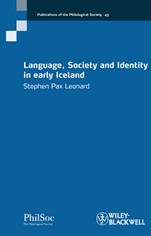
Language, Society and Identity in early Iceland
ISBN 9781118294963
Autor: Stephen Pax Leonard
Wydawca: Wiley
Dostępność: 3-6 tygodni
Cena: 168,00 zł
Przed złożeniem zamówienia prosimy o kontakt mailowy celem potwierdzenia ceny.
ISBN13: |
9781118294963 |
ISBN10: |
1118294963 |
Autor: |
Stephen Pax Leonard |
Oprawa: |
Paperback |
Rok Wydania: |
2012-05-25 |
Ilość stron: |
198 |
Wymiary: |
228x151 |
Tematy: |
CF |
The language of a speech community can only act as an identity marker for all of its speakers if a standard is widely shared and if a minimal number of language varieties are spoken. This book examines how one dialect came to serve the whole of Iceland. The language community that we can reconstruct for early Iceland should have led to the establishment and maintenance of dialects. But this didn′t happen. Iceland was instead characterized by long–term linguistic homogeneity. Using the most recent sociolinguistic theory, and drawing on history and archaeology, Stephen Pax Leonard explores some of the reasons for the unusual development of the Icelandic language, showing how the Icelandic identity developed through the establishment of social structures and their literary culture. With its rich literature, the language became the single most important factor for the identity of the Icelanders. Language, Society and Identity in early Iceland is a fascinating account of an under examined historical–linguistic story that will spur further research and discussion amongst researchers. In particular, it leaves a trail for those concerned with language and identity in Iceland today, where there is for the first time unequivocal evidence of sociolinguistic variation.
1 Introduction 1.1 Aims of the present study 1.2 Organisation of study 1.3 The settlement of Iceland 1.4 The establishment of social structures 1.5 The language of the Icelanders 1.6 Sources 1.6.1 Historical texts 1.6.2 Religious works 1.6.3 Law codes 1.6.4 Grammatical Treatises 1.6.5 Poetry 1.6.6 Saga material 2 Language and identity: theoretical considerations 2.1 Introduction 2.2 Socio–historical linguistics and sociolinguistic theory 2.3 Language change and norms 2.3.1 Intra–linguistic versus extra–linguistic explanations of language change 2.4 Language and dialect contact 2.4.1 Dialect levelling and koineisation 2.4.2 Markedness in tabula rasa dialect–formation 2.5 Language and dialect isolation 2.5.1 ‘ Drift ’ 2.6 Language development in tabula rasa societies 2.6.1 Language community types (and settlement patterns) 2.6.2 A deterministic model versus social factors 2.6.3 The Founder Principle and prestige 2.7 Identity: essentialism versus constructivism 2.7.1 Personal identity and group membership 2.7.2 Place and identity 2.8 Language and identity 2.8.1 Accommodation and networks 2.8.2 Accommodation Theory 2.8.3 Social network theory and language change 2.8.4 Deixis, pronouns and identity 2.9 Conclusion 3 Norm–establishment in Iceland 3.1 Introduction 3.2 Norse dialectal variation prior to the Settlement 3.2.1 The runic evidence 3.2.2 Runic evidence and the spoken language 3.3 The settlers: geographic origins and social mobility 3.3.1 The geographic origins of the settlers 3.3.2 Social background and mobility of the settlers 3.3.3 The status of Norse and Common Gaelic at the time of the Settlement 3.4 Dialect features in Iceland, the Faroe Islands and south–west Norway 3.5 Iceland as a ‘new society’ 3.5.1 Features of ‘new societies’ 3.6 Language development in early Iceland 3.6.1 The ‘mixture theory’ 3.6.2 Dialect levelling in early Iceland 3.6.3 The basis for koineisation 3.7 Establishment of a linguistic norm in Iceland 3.7.1 Pre– and post–Settlement linguistic norms 3.7.2 Spoken norms and ‘standardised’ written languages 3.7.3 The establishment of a norm: skaldic poetry (and the laws) 3.7.4 The establishment of a norm: the role of the sagas 3.8 The homogeneity of Icelandic 3.8.1 Background 3.8.2 Factors explaining the homogeneity of Icelandic 3.9 Conclusion 4 Social structures in the lexicon 4.1 Introduction 4.2 Social identity and Icelandic social structures 4.2.1 Emerging social structures and identities 4.2.2 Characteristics of Icelandic social structures: role of the law 4.2.3 The significance of assembly–attachment 4.3 Specific Icelandic social structures 4.3.1 hreppr (‘commune’) 4.3.2 bu´ar (‘neighbours’) 4.3.3 alþingi (‘General Assembly’) and lo¨gre´tta (‘Law Council’) 4.3.4 goðar (‘chieftains’) 4.4 Individual identity and Icelandic kinship structures 4.4.1 landna´m (‘Settlement’) and kinship structures 4.4.2 Kinship and land–transfer 4.4.3 Genealogies and identity 4.4.4 Icelandic kinship terminology: cousin terms 4.5 Conclusion 5 Perception and use of language as an identity marker 5.1 Introduction 5.2 Icelanders’ perceptions of foreign languages 5.2.1 References to a foreign language 5.2.2 References to Irish 5.3 A vernacular identity: do¨nsk tunga , norræna and its speakers 5.3.1 The do¨nsk tunga as an identity marker 5.3.2 norræna as an identity marker 5.3.3 Norse dialectical variation and Anglo–Norse intelligibility 5.4 Grammatical variables as identity markers 5.4.1 Agreeing possessive adjectives 5.4.2 Pronominal usage in the early Icelandic law codes 5.4.3 The ‘they’ 5.4.4 The ‘we’ 5.5 Spatial references: the issue of identity 5.5.1 Spatio–directional particles 5.5.2 Idiomatic use of spatial grammar 5.5.3 Semantics of orientation: the Norwegian system 5.5.4 Semantics of orientation: the Quarter–based system 5.6 Conclusion 6 Conclusion References Index
Stephen Pax Leonard is a Fellow of Trinity Hall, Cambridge and a Research Associate at the Scott Polar Research Institute. Educated at the University of Oxford, he studied modern and ancient languages before developing interests in linguistic and existential anthropology. He has carried out both linguistic and ethnographic fieldwork in Iceland and the Faroe Islands. More recently, he spent a year living with the Inugguit of north–west Greenland who live in the northern–most permanently inhabited settlement in the world, documenting their vulnerable minority language and spoken traditions.
Koszyk
Książek w koszyku: 0 szt.
Wartość zakupów: 0,00 zł
Informacje


Kontakt
Gambit
Centrum Oprogramowania
i Szkoleń Sp. z o.o.
Al. Pokoju 29b/22-24
31-564 Kraków
Siedziba Księgarni
ul. Kordylewskiego 1
31-542 Kraków
+48 12 410 5991
+48 12 410 5987
+48 12 410 5989
Subskrypcje
Administratorem danych osobowych jest firma Gambit COiS Sp. z o.o. Na podany adres będzie wysyłany wyłącznie biuletyn informacyjny.
Autoryzacja płatności

Informacje na temat autoryzacji płatności poprzez PayU.

© Copyright 2012: GAMBIT COiS Sp. z o.o. Wszelkie prawa zastrzeżone.
Projekt i wykonanie: Alchemia Studio Reklamy