


Wydawcy
Katalog tematyczny
- Archeologia (109)
- Ekonomia, finanse, business (13704)
- Filozofia (1445)
- Historia (3040)
- Języki i językoznawstwo (2356)
- Lifestyle, hobby i rozrywka (475)
- Medycyna (9704)
- Nauki humanistyczne (4)
- Nauki o Ziemi i środowisku (2638)
- Nauki ścisłe (20412)
- Nauki społeczne (8486)
- Nauki techniczne (13450)
- Prawo (1696)
- Publikacje informacyjne i interdyscyplinarne (1288)
- Religia i wierzenia (917)
- Technika komputerowa (4067)
- Zdrowie, relacje międzyludzkie i rozwój osobisty (657)





Informacje szczegółowe o książce
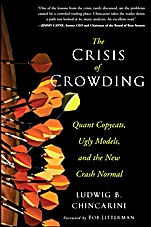
The Crisis of Crowding: Quant Copycats, Ugly Models, and the New Crash Normal
ISBN 9781118250020
Autor: Ludwig B. Chincarini
Wydawca: Wiley
Dostępność: 3-6 tygodni
Cena: 211,05 zł
Przed złożeniem zamówienia prosimy o kontakt mailowy celem potwierdzenia ceny.
ISBN13: |
9781118250020 |
ISBN10: |
1118250028 |
Autor: |
Ludwig B. Chincarini |
Oprawa: |
Hardback |
Rok Wydania: |
2012-08-21 |
Ilość stron: |
512 |
Wymiary: |
236x167 |
Tematy: |
KF |
"One of the lessons from the crisis, rarely discussed, are the problems caused by a crowded trading place. Chincarini takes the reader down a path not looked at by many analysts. An excellent read."
JIMMY CAYNE, former CEO and Chairman of the Board of Bear Stearns
"The Crisis of Crowding is an excellent account of the financial crisis of 2008. This book has everything: an analysis of the trades, interviews with key players, and, most importantly, a simple, entertaining explanation of how we got into this mess. It stretches from the LTCM crisis in 1998 to the Greek crisis of 2012. Anyone who wants to know how our financial system works and how we can improve it should read this book."
FRANK FABOZZI, Professor at EDHEC Business School and former Professor at the Yale School of Management
"Dr. Chincarini gives an engaging description of the various crises over the last decade and how they are connected. It′s as if Chincarini were in the trading room taking notes as the crisis unfolded."
KEN KRONER, Chief Investment Officer and head of the firm′s scientific active equity business, BlackRock
"Do we need yet another book on the financial crisis? Yes, we do. Some books are fun to read, but leave you confused about what the actors actually did. Others give you a great deal of technical information, but can be a hard slog. This book by Ludwig Chincarini fills the middle. It is fun to read, and it tells you exactly who did what and how. Read, enjoy, and learn."
OLIVIER BLANCHARD, Chief Economist at the IMF
"Chincarini′s book, which combines a narrative style with an overview of economic fundamentals, should be on the reading list of anyone interested in the roots of our financial meltdown."
AUSTAN GOOLSBEE, former Chairman of the Council of Economic Advisors to the President, Professor of Economics, University of Chicago
"Chincarini looks at the financial crises of the last fifteen years starting with a comprehensive analysis of the LTCM crisis in 1998 and ending with the Euro–debt crisis of 2012 and argues convincingly that the central risk in these crises was accentuated from within the financial system rather than from external economic forces (it includes the best analysis I have read on the LTCM crisis). This bold new theory has important implications for both industry practices as well as for new regulations. This book should be required reading for anyone who wants to understand and help prevent future financial crises."
ERIC ROSENFELD, cofounder of Long–Term Capital Management and JWMP
Foreword xv
Preface xix
Cast of Characters xxiii
CHAPTER 1 Introduction 1
PART I: THE 1998 LTCM CRISIS 5
CHAPTER 2 Meriwether s MagicMoney Tree 7
The Birth of Bond Arbitrage 7
The Dream Team 11
Early Success 14
CHAPTER 3 Risk Management 21
The General Idea 21
Leverage 22
Measuring Risk 23
The 24
Economics 24
Copycats, Puppies, and Counterparties 25
LTCM s Actual Risk Management Practices 27
Diversification 27
Operations 28
The Raw Evidence 29
CHAPTER 4 The Trades 37
The Short U.S. Swap Trade 41
The European Cross–Country Swap Trade
(Short UK and Long Europe) 44
Long U.S. Mortgage Securities Hedged 46
The Box Spread in Japan 48
The Italian Swap Spread 50
Fixed–Income Volatility Trades 52
The On–the–Run and Off–the–Run Trade 54
Short Longer–Term Equity Index Volatility 57
Risk Arbitrage Trades 60
Equity Relative–Value Trades 63
Emerging Market Trades 65
Other Trades 67
The Portfolio of Trades 68
CHAPTER 5 The Collapse 71
Early Summer 1998 71
The Salomon Shutdown 73
The Russian Default 75
The Phone Calls 77
The Meriwether Letter 79
Buffett s Hostile Alaskan Offer 81
The Consortium Bailout 82
Too Big To Fail 84
Why Did It Happen? 85
Appendix 5.1 The John Meriwether Letter 89
Appendix 5.2 The Warren Buffett Letter 93
CHAPTER 6 The Fate of LTCM Investors 95
CHAPTER 7 General Lessons from the Collapse 101
Interconnected Crowds 101
VaR 102
Leverage 105
Clearinghouses 108
Compensation 110
What s Size Got to Do with It? 110
Contingency Capital 113
The Fed Is a Coordinator of Last Resort 114
Counterparty Due Diligence 115
Spread the Love 115
Quantitative Theory Did Not Cause the LTCM Collapse 116
D´ej`a Vu 118
PART II: THE FINANCIAL CRISIS OF 2008 121
CHAPTER 8 The Quant Crisis 123
The Subprime Mortgage Market Collapse 127
What Was the Quant Crisis? 129
The Erratic Behavior of Quant Factors 130
Standard Factors 130
Quantitative Portfolio Factors 133
Causes of the Quant Crisis 134
The Shed Show 137
CHAPTER 9 The Bear Stearns Collapse 141
A Brief History of the Bear 141
Shadow Banking 143
Window Dressing 144
Repo Power 145
The Unexpected Hibernation 148
The Polar Spring 150
CHAPTER 10 Money for Nothing and Fannie and Freddie for Free 155
The Basic Business 157
Where s the Risk? 158
CDO and CDO2 159
The Gigantic Hedge Fund 162
Big–Time Profits 165
The U.S. Housing Bubble 168
The Circle of Greed 170
Real Estate Agents and Mortgage Lender Tricks 173
Home Owners 177
Profits and Politicians 177
The Media and Regulators 180
Grade Inflation 182
Commercial Banks 185
Freddie and Fannie s Foreclosure 186
Why Save Freddie and Fannie? 187
Did Anyone Know? 188
CHAPTER 11 The Lehman Bankruptcy 191
The Wall Street Club 191
Why Was Lehman Next? 193
Business Exposure 196
A Chronology of the Gorilla s Death 202
Double Down in Real Estate 203
Mildly Seeking Capital 207
The Final Days 213
A Classic Run on the Bank 217
Why Let Lehman Fail? 219
Who Was at Fault? 222
Lehman Brothers 222
The Counterparties 224
The Government and Market Structure 225
The Legal Opinion on the Lehman Bankruptcy 225
Who Would Have Been Next? 226
The Spoils of Having Friends in High Places 227
CHAPTER 12 The Absurdity of Imbalance 233
The Long–Dated Swap Imbalance 236
The Repo Imbalance 241
The 228 Wasted Resources and the Global Run on Banks 243
CHAPTER 13 Asleep in Basel 245
Basel I 246
The Concept 246
The Problems 247
Basel II 248
The Concept 248
The Problems 249
Basel and the Financial Crisis 250
CHAPTER 14 The LTCM Spinoffs 253
JWM Partners LLC 253
Platinum Grove Asset Management 258
The Others 259
The Copycat Funds 262
CHAPTER 15 The End of LTCM s Legacy 265
The Bear and the Gorilla Attack 265
November Rain 271
What Went Wrong? 274
Market Insanity 275
Bigger Shocks 281
Market Imbalance 282
Deleveraging 285
Coup de Grace 286
CHAPTER 16 New and Old Lessons from the Financial Crisis 289
Interconnectedness and Crowds 289
Leverage 291
Systemic Risk and Too Big to Fail 293
Derivatives: The Good, the Bad, and the Ugly 294
Conflicts of Interest 297
Policy Lessons 298
Risk Management 301
Counterparty Interaction 302
Hedge Funds 304
The Importance of Arbitrage 306
PART III: THE AFTERMATH 309
CHAPTER 17 The Flash Crash 311
Background 312
Flash Crash Theories 313
Fat Finger Theory 314
High–Frequency Trader Theory 314
Jittery Markets 315
The Real Cause of the Flash Crash 315
The Waddell–Reed Trade 316
The Computer Glitch 317
Gone Fishing 319
The Aftermath 321
CHAPTER 18 Getting Greeked 323
Members Only 324
The Conditions 324
The Benefits of Membership 328
The Drawbacks of Membership 328
The Club s Early Years 330
Getting Greeked 332
Greek Choices 333
Remain a Club Member and Order Finances 333
Ditch the Club and Keep the Debt 334
Ditch the Club and Ditch the Debt 334
The IMF and Euro Packages 335
The EU s Future 335
CHAPTER 19 The Fairy–Tale Decade 339
I Hate Wall Street 340
The Real Costs of the Financial Crisis 344
An Avatar s Life Force 346
Economic System Choices 349
The Crisis of Crowds 350
The Wine Arbitrage 351
APPENDIXES: 353
APPENDIX A The Mathematics of LTCM s Risk–Management Framework 355
A General Framework 355
A Numerical Example 357
Measuring Risk 357
APPENDIX B The Mechanics of the Swap Spread Trade 361
The Long Swap Spread Trade 361
The Short Swap Spread Trade 362
APPENDIX C Derivation of Approximate Swap Spread Returns 365
APPENDIX D Methodology to Compute Zero–Coupon Daily Returns 369
APPENDIX E Methodology to Compute Swap Spread Returns from Zero–Coupon Returns 373
APPENDIX F The Mechanics of the On–the–Run and Off–the–Run Trade 375
APPENDIX G The Correlations between LTCM Strategies Before and During the Crisis 377
APPENDIX H The Basics of CreativeMortgage Accounting 379
APPENDIX I The Business of an Investment Bank 381
Investment Banking 381
Capital Markets 382
Equities 382
Equity Cash 382
Equity Derivatives 383
Equity Finance 384
Arbitrage (Proprietary Trading) 384
Fixed Income 385
Government and Agency Obligations 385
Corporate Debt Securities and Loans 385
High–Yield Securities and Leveraged Bank Loans 386
Money Market Products 386
Mortgage– and Asset–Backed Securities 386
Municipal and Tax–Exempt Securities 387
Financing 387
Fixed–Income Derivatives 388
Lehman Brothers Bank 388
Foreign Exchange 388
Global Distribution (Global Sales) 389
Research 389
Client Services 389
Private Client Services (Private Wealth Management) 389
Private Equity 390
Technology 390
Corporate and Risk Management 390
Summary 391
APPENDIX J The Calculation of the BIS Capital Adequacy Ratio 393
The General Calculation 393
An Example 395
Notes 397
Glossary 443
Bibliography 451
About the Author 465
Index 467
Ludwig B. Chincarini, CFA, PhD, is an Associate Professor of Finance in the School of Management at the University of San Francisco and a member of the academic council of IndexIQ, with over fifteen years of experience in the financial industry specializing in portfolio management, quantitative equity management, and derivatives. He was Director of Research at Rydex Global Advisors, where he co–developed the S&P 500 equal–weight index and helped launch the Rydex ETF program. He helped build an internet brokerage firm, FOLIOfn, designing its innovative basket trading and portfolio management platform. He also worked at the Bank for International Settlements (BIS) and Schroders. He is the coauthor of Quantitative Equity Portfolio Management. He received a PhD from the Massachusetts Institute of Technology and a BA from the University of California at Berkeley.
Koszyk
Książek w koszyku: 0 szt.
Wartość zakupów: 0,00 zł
Informacje


Kontakt
Gambit
Centrum Oprogramowania
i Szkoleń Sp. z o.o.
Al. Pokoju 29b/22-24
31-564 Kraków
Siedziba Księgarni
ul. Kordylewskiego 1
31-542 Kraków
+48 12 410 5991
+48 12 410 5987
+48 12 410 5989
Subskrypcje
Administratorem danych osobowych jest firma Gambit COiS Sp. z o.o. Na podany adres będzie wysyłany wyłącznie biuletyn informacyjny.
Autoryzacja płatności

Informacje na temat autoryzacji płatności poprzez PayU.

© Copyright 2012: GAMBIT COiS Sp. z o.o. Wszelkie prawa zastrzeżone.
Projekt i wykonanie: Alchemia Studio Reklamy