


Wydawcy
Katalog tematyczny
- Archeologia (109)
- Ekonomia, finanse, business (13704)
- Filozofia (1445)
- Historia (3040)
- Języki i językoznawstwo (2356)
- Lifestyle, hobby i rozrywka (475)
- Medycyna (9704)
- Nauki humanistyczne (4)
- Nauki o Ziemi i środowisku (2638)
- Nauki ścisłe (20412)
- Nauki społeczne (8486)
- Nauki techniczne (13450)
- Budownictwo lądowe (1045)
- Chemia przemysłowa (2258)
- Elektronika i telekomunikacja (3287)
- Energetyka (1122)
- Inne nauki stosowane (363)
- Inżynieria biochemiczna (507)
- Inżynieria transportu (232)
- Mechanika i materiały (3316)
- Nauka o środowisku (321)
- Rolnictwo (507)
- Technika, ogólnie (475)
- Prawo (1696)
- Publikacje informacyjne i interdyscyplinarne (1288)
- Religia i wierzenia (917)
- Technika komputerowa (4067)
- Zdrowie, relacje międzyludzkie i rozwój osobisty (657)





Informacje szczegółowe o książce
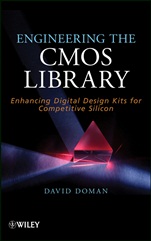
Engineering the CMOS Library: Enhancing Digital Design Kits for Competitive Silicon
ISBN 9781118243046
Autor: David Doman
Wydawca: Wiley
Dostępność: 3-6 tygodni
Cena: 573,30 zł
Przed złożeniem zamówienia prosimy o kontakt mailowy celem potwierdzenia ceny.
ISBN13: |
9781118243046 |
ISBN10: |
1118243048 |
Autor: |
David Doman |
Oprawa: |
Hardback |
Rok Wydania: |
2012-06-15 |
Ilość stron: |
342 |
Wymiary: |
238x166 |
Tematy: |
TJ |
Shows readers how to gain the competitive edge in the integratedcircuit marketplace
This book offers a wholly unique perspective on the digitaldesign kit. It points to hidden value in the safety margins ofstandard–cell libraries and shows design engineers and managers howto use this knowledge to beat the competition.
Engineering the CMOS Library reveals step by step how thegeneric, foundry–provided standard–cell library is built, and howto extract value from existing std–cells and EDA tools in order toproduce tighter–margined, smaller, faster, less power–hungry, andmore yield–producing integrated circuits. It explores all aspectsof the digital design kit, including the different views of CMOSstd–cell libraries along with coverage of IO libraries, memorycompilers, and small analog blocks. Readers will learn:
How to work with overdesigned std–cell libraries to improveprofitability while maintaining safety
How functions usually found in std–cell libraries cover thedesign environment, and how to add any missing functions
How to harness the characterization technique used by vendors toadd characterization without having to get it from the vendor
How to use verification and validation techniques to ensureproper descriptive views and even fix inconsistencies in vendorrelease views
How to correct for possible conflicts arising from multipleversions and different vendor sources in any given integratedcircuit design
Complete with real–world case studies, examples, and suggestionsfor further research, Engineering the CMOS Library will helpreaders become more astute designers.
PREFACE xi
ACKNOWLEDGMENTS xiii
1 INTRODUCTION 1
1.1 Adding Project–Specific Functions, Drive Strengths, Views,and Corners 4
1.2 What Is a DDK? 5
2 STDCELL LIBRARIES 9
2.1 Lesson from the Real World: Manager′s Perspective andEngineer′s Perspective 9
2.2 What Is a Stdcell? 11
2.3 Extended Library Offerings 32
2.4 Boutique Library Offerings 36
2.5 Concepts for Further Study 37
3 IO LIBRARIES 39
3.1 Lesson from the Real World: The Manager′s Perspective andthe Engineer′s Perspective 39
3.2 Extension Capable Architectures versus Function CompleteArchitectures 40
3.3 Electrostatic Discharge Considerations 43
3.4 Concepts for Further Study 50
4 MEMORY COMPILERS 52
4.1 Lesson from the Real World: The Manager′s Perspective andthe Engineer′s Perspective 52
4.2 Single Ports, Dual Ports, and ROM: The Compiler 55
4.3 Nonvolatile Memories: The Block 58
4.4 Special–Purpose Memories: The Custom 60
4.5 Concepts for Further Study 62
5 OTHER FUNCTIONS 63
5.1 Lesson from the Real World: The Manager′s Perspective andthe Engineer′s Perspective 63
5.2 Phase–Locked Loops, Power–On Resets, and Other Small–ScaleIntegration Analogs 66
5.3 Low–Power Support Structures 69
5.4 Stitching Structures 71
5.5 Hard, Firm, and Soft Boxes 75
5.6 Concepts for Further Study 78
6 PHYSICAL VIEWS 80
6.1 Lesson from the Real World: The Manager′s Perspective andthe Engineer′s Perspective 80
6.2 Picking an Architecture 82
6.3 Measuring Density 86
6.4 The Need and the Way to Work with Fabrication Houses 89
6.5 Concepts for Further Study 92
7 SPICE 95
7.1 Lesson from the Real World: The Manager′s Perspective andthe Engineer′s Perspective 95
7.2 Why a Tool More Than 40 Years Old Is Still Useful 99
7.3 Accuracy, Reality, and Why SPICE Results Must be Viewed witha Wary Eye 102
7.4 Sufficient Parasitics 106
7.5 Concepts for Further Study 107
8 TIMING VIEWS 109
8.1 Lesson from the Real World: The Manager′s Perspective andthe Engineer′s Perspective 109
8.2 Performance Limits and Measurement 110
8.3 Default Versus Conditional Arcs 110
8.4 Break–Point Optimization 112
8.5 A Word on Setup and Hold 115
8.6 Failure Mechanisms and Roll–Off 122
8.7 Supporting Efficient Synthesis 124
8.8 Supporting Efficient Timing Closure 131
8.9 Design Corner Specific Timing Views 134
8.10 Nonlinear Timing Views are so "Old Hat" . . . 140
8.11 Concepts for Further Study 142
9 POWER VIEWS 145
9.1 Lesson from the Real World: The Manager′s Perspective andthe Engineer′s Perspective 145
9.2 Timing Arcs Versus Power Arcs 147
9.3 Static Power 148
9.4 Real Versus Measured Dynamic Power 150
9.5 Should Power Be Built as a Monotonic Array? 153
9.6 Best–Case and Worst–case Power Views Versus Best–Case andWorst–Case Timing Views 155
9.7 Efficiently Measuring Power 156
9.8 Concepts for Further Study 158
10 NOISE VIEWS 160
10.1 Lesson from the Real World: The Manager′s Perspective andthe Engineer′s Perspective 160
10.2 Noise Arcs Versus Timing and Power Arcs 162
10.3 The Easy Part 165
10.4 The Not–So–Easy Part 166
10.5 Concepts for Further Study 168
11 LOGICAL VIEWS 170
11.1 Lesson from the Real World: The Manager′s Perspective andthe Engineer′s Perspective 170
11.2 Consistency Across Simulators 171
11.2.1 Efficient Testing 175
11.3 Consistency with Timing, Power & Noise Views 177
11.4 Concepts for Further Study 180
12 TEST VIEWS 181
12.1 Lesson from the Real World: The Manager′s Perspective andthe Engineer′s Perspective 181
12.2 Supporting Reachability 184
12.3 Supporting Observability 189
12.4 Concepts for Further Study 191
13 CONSISTENCY 193
13.1 Lesson from the Real World: The Manager′s Perspective andthe Engineer′s Perspective 193
13.2 Validating Views across a Library 195
13.3 Validating Stdcells Across a Technology Node 199
13.4 Validating Libraries Across Multiple Technology Nodes204
13.5 Concepts for Further Study 208
14 DESIGN FOR MANUFACTURABILITY 209
14.1 Lesson from the Real World: The Manager′s Perspective andthe Engineer′s Perspective 209
14.2 What is DFM? 211
14.3 Concepts for Further Study 224
15 VALIDATION 226
15.1 Lesson from the Real World: The Manager′s Perspective andthe Engineer′s Perspective 226
15.2 Quality Levels 229
15.3 Concepts for Further Study 236
16 PLAYING WITH THE PHYSICAL DESIGN KIT: USUALLY "AT YOUR OWNRISK" 237
16.1 Lesson from the Real World: The Manager′s Perspective andthe Engineer′s Perspective 237
16.2 Manipulating Models 240
16.3 Added Unsupported Devices 243
16.4 Concepts for Further Study 245
17 TAGGING AND REVISIONING 247
17.1 Lesson from the Real World: The Manager′s Perspective andthe Engineer′s Perspective 247
17.2 Tagging and Time Stamps 248
17.3 Metadata, Directory Structures, and Pointers 254
17.4 Concepts for Further Study 258
18 RELEASING AND SUPPORTING 260
18.1 Lesson from the Real World: The Manager′s Perspective andthe Engineer′s Perspective 260
18.2 When Is Test Silicon Needed for Verification? 263
18.3 Sending the Baby Out the Door 265
18.4 Multiple Quality Levels on the Same Design 269
18.5 Supporting "Bug Fixes" 271
18.6 Concepts for Further Study 274
19 OTHER TOPICS 276
19.1 Lesson from the Real World: The Manager′s Perspective andthe Engineer′s Perspective 276
19.2 Supporting High–Speed Design 279
19.3 Supporting Low–Power Design 283
19.4 Supporting Third–Party Libraries 286
19.5 Supporting Black Box Third–Party IP (Intellectual Property)Design 289
19.6 Supporting Multiple Library Design 292
19.7 Concepts for Further Study 293
20 COMMUNICATIONS 295
20.1 Manager′s Perspective 295
20.2 Customer′s Perspective 298
20.3 Vendor′s Perspective 300
20.4 Engineer′s Perspective 301
20.5 Concepts for Further Study 302
20.6 Conclusions 302
APPENDIX I MINIMUM LIBRARY SYNTHESIS VERSUS FULL–LIBRARYSYNTHESIS OF A FOUR–BIT FLASH ADDER 305
APPENDIX II PERTINENT CMOS BSIM SPICE PARAMETERS WITH UNITS ANDDEFAULT LEVELS 311
APPENDIX III DEFINITION OF TERMS 313
APPENDIX IV ONE POSSIBLE MEANS OF FORMALIZED
MONTHLY REPORTING 317
INDEX 319
David Doman is Circuit Manager at GlobalFoundries in Austin, Texas. He has more than thirty years of experience in semiconductor intellectual property design and development.
Koszyk
Książek w koszyku: 0 szt.
Wartość zakupów: 0,00 zł
Informacje


Kontakt
Gambit
Centrum Oprogramowania
i Szkoleń Sp. z o.o.
Al. Pokoju 29b/22-24
31-564 Kraków
Siedziba Księgarni
ul. Kordylewskiego 1
31-542 Kraków
+48 12 410 5991
+48 12 410 5987
+48 12 410 5989
Subskrypcje
Administratorem danych osobowych jest firma Gambit COiS Sp. z o.o. Na podany adres będzie wysyłany wyłącznie biuletyn informacyjny.
Autoryzacja płatności

Informacje na temat autoryzacji płatności poprzez PayU.

© Copyright 2012: GAMBIT COiS Sp. z o.o. Wszelkie prawa zastrzeżone.
Projekt i wykonanie: Alchemia Studio Reklamy