


Wydawcy
Katalog tematyczny
- Archeologia (109)
- Ekonomia, finanse, business (13704)
- Filozofia (1445)
- Historia (3040)
- Języki i językoznawstwo (2356)
- Lifestyle, hobby i rozrywka (475)
- Medycyna (9704)
- Nauki humanistyczne (4)
- Nauki o Ziemi i środowisku (2638)
- Nauki ścisłe (20412)
- Astronomia (294)
- Biologia (5119)
- Chemia (6540)
- Fizyka (3309)
- Elektryczność i magnetyzm (90)
- Fizyka atomowa i molekularna (110)
- Fizyka cząstek elementarnych (36)
- Fizyka jądra atomowego (36)
- Fizyka kwantowa (210)
- Fizyka matematyczna (121)
- Fizyka relatywistyczna (36)
- Fizyka statystyczna (51)
- Fizyka stosowana (498)
- Mechanika klasyczna (186)
- Optyka i światło (133)
- Stany materii (202)
- Matematyka (4574)
- Nauki ścisłe, ogólnie (503)
- Nauki społeczne (8486)
- Nauki techniczne (13450)
- Prawo (1696)
- Publikacje informacyjne i interdyscyplinarne (1288)
- Religia i wierzenia (917)
- Technika komputerowa (4067)
- Zdrowie, relacje międzyludzkie i rozwój osobisty (657)





Informacje szczegółowe o książce
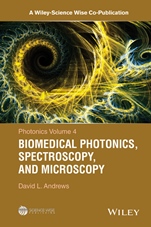
Photonics, Volume 4: Biomedical Photonics, Spectroscopy, and Microscopy
ISBN 9781118225554
Autor: David L. Andrews
Wydawca: Wiley
Dostępność: 3-6 tygodni
Cena: 665,70 zł
Przed złożeniem zamówienia prosimy o kontakt mailowy celem potwierdzenia ceny.
ISBN13: |
9781118225554 |
ISBN10: |
1118225554 |
Autor: |
David L. Andrews |
Oprawa: |
Hardback |
Rok Wydania: |
2015-05-19 |
Ilość stron: |
576 |
Wymiary: |
241x157 |
Tematy: |
PH |
Discusses the basic physical principles underlying Biomedical Photonics, spectroscopy and microscopy
This volume discusses biomedical photonics, spectroscopy and microscopy, the basic physical principles underlying the technology and its applications. The topics discussed in this volume are: Biophotonics; Fluorescence and Phosphorescence; Medical Photonics; Microscopy; Nonlinear Optics; Ophthalmic Technology; Optical Tomography; Optofluidics; Photodynamic Therapy; Image Processing; Imaging Systems; Sensors; Single Molecule Detection; Futurology in Photonics.Comprehensive and accessible coverage of the whole of modern photonics Emphasizes processes and applications that specifically exploit photon attributes of light Deals with the rapidly advancing area of modern optics Chapters are written by top scientists in their field
Written for the graduate level student in physical sciences; Industrial and academic researchers in photonics, graduate students in the area; College lecturers, educators, policymakers, consultants, Scientific and technical libraries, government laboratories, NIH.
David L. Andrews leads research on fundamental molecular photonics and energy transport, optomechanical forces and nonlinear optical phenomena. He has over 160 research papers and also eight books to his name – including the widely adopted textbook Lasers in Chemistry. The current focus of his research group is on novel mechanisms for optical nanomanipulation and switching, and light–harvesting in nanostructured molecular systems. The group enjoys strong international links, particularly with groups in Canada, Lithuania, New Zealand and the United States. Andrews is a Fellow of the Royal Society of Chemistry, and a Fellow of the Institute of Physics, and he is the inaugural Chair of the SPIE Nanotechnology Technical Group.
1 Fluorescence
David Birch, Yu Chen, Olaf J. Rolinski
1.1 Introduction
1. 2 Spectra
1.3 Quantum yield
1.4 Lifetime
1.5 Quenching
1.6 Anisotropy
1.7 Microscopy
1.8 Conclusions
Acknowledgements
References
2 Single–Molecule Detection and Spectroscopy
Michel Orrit
2.1 Introduction
2.2 Experimental Setups
2.3 Fluorescence spectroscopy
2.4 Fluorescence correlation spectroscopy
2.5 Fluorescence excitation spectroscopy
2.6 Other Detection Methods
2.7 Conclusion
Acknowledgements
References
3 Resonance Energy Transfer
David Andrews, David Bradshaw, Rayomond Dinshaw, and Gregory Scholes
3.1 Introduction
3.2 History of RET
3.3 The photophysics of RET
3.4 Investigative applications of RET in molecular biology
3.5 The role of RET in light–harvesting complexes
Acknowledgements
References
4 Biophotonics of Photosynthesis
Ryszard Jankowiak and Valter Zazubovits
4.1 Introduction.
4.2 Structure of pigment–protein complexes and structure–function relationships
4.3 Key concepts in physics of pigment–protein complexes
4.4 Experimental techniques.
4.5 Examples
4.5 Conclusions
Acknowledgments
References
5 Optical Sectioning Microscopy and Biological Imaging
John Girkin
5.1 Introduction and Background
5.2 Confocal Imaging
5.3 Non–Linear Microscopy
5.4 Practical Implementation of Non–Linear Microscopy
5.5 Recent Advances in Non–linear Microscopy
5.6 Widefield Optical Sectioning by Specialised Illumination Methods
5.7 Summary
References
6 Cell Handling, Sorting and Viability
Thomas Aabo, Andrew Bañas, Jesper Glückstad, and Darwin Palima
6.1 Handling cells with light
6.2 Optical Sorting
6.3 Cell Viability
References
7 Tissue Polarimetry
Antonello De Martino, Nirmalya Ghosh, and Alex Vitkin
7.1 Introduction
7. 2 Polarized Light Fundamentals
7.3 Instrumentation
7.4 Forward Modeling and Testing in Phantoms
7.5 Applications
7.6 Conclusions and Outlook
References
8 Optical waveguide biosensors
Daphne Duval and Laura Lechuga
8.1 Introduction
8.2 Fundamentals of label–free optical waveguide biosensing
8.3 Surface biofunctionalization
8.4 Evaluation of optical biosensors
8.5 Integrated optical waveguide–based biosensors
8.6 VI Optical fiber–based biosensors
8.7 Lab–on–a–chip integration
8.8 Summary
References
9 Light Propagation in Highly–scattering Turbid Media: Concepts, Techniques,
and Biomedical Applications
R.R. Alfano, S.K. Gayen, W.B. Wang, and L. Wang
9.1 Introduction
9.2 Physics behind optical imaging through a highly scattering turbid medium
9.3 Study of ballistic and diffuse light components
9.4 Photon sorting gates
9.5 Transition from ballistic to diffuse light in turbid media
9.6 Conclusion
Acknowledgement
References
10 Photodynamic Therapy
Pinar Avci, Rakkiyappan Chandran, Michael Hamblin, Magesh Sadasivam, Tyler G. St. Denis, and Daniela Vecchio
10.1 Historical overview of PDT
10.2 Introduction to PDT
10.3 Photosensitizer structure and photophysical properties
10.4 Light dosimetry and photodynamic therapy light sources
10.5 Light–based strategies to enhance PDT
10.6 PDT targeting and nanotechnology
10.7 PDT for dermatology
10.8 PDT for oncology
10.9 PDT for infectious disease
10.10 PDT in ophthalmology
10.11 PDT and the immune system
10.12 Conclusion
Acknowledgements
References
11 Imaging and Probing Cells beyond the Optical Diffraction Limit
Thomas Huser and Mark Schüttpelz
11.1 The quest for achieving optical resolution beyond Abbe s limit
11.2 Stimulated emission depletion (STED) microscopy
11.3 Photoactivated Localization Microscopy (PALM) and Stochastic Optical Reconstruction
Microscopy (STORM)
11.4 Structured Illumination Microscopy (SIM)
11.5 Super–resolution Optical Fluctuation Imaging and Other Approaches
11.6 Outlook
Acknowledgments
References
12 Ophthalmic Technology
Christopher A. Clark and Ann E. Elsner
12.1 Basic Ocular Anatomy and Physiology
12.2 Measurement techniques
12.3 Anterior Segment Diagnostics, Refractive Measurements, and Treatment
12.4 Diagnostic Applications and Treatment of Posterior Segment
References
David L. Andrews leads research on fundamental molecular photonics and energy transport, optomechanical forces and nonlinear optical phenomena. He has over 160 research papers and also eight books to his name – including the widely adopted textbook Lasers in Chemistry. The current focus of his research group is on novel mechanisms for optical nanomanipulation and switching, and light–harvesting in nanostructured molecular systems. The group enjoys strong international links, particularly with groups in Canada, Lithuania, New Zealand and the United States. Andrews is a Fellow of the Royal Society of Chemistry, and a Fellow of the Institute of Physics, and he is the inaugural Chair of the SPIE Nanotechnology Technical Group.
Koszyk
Książek w koszyku: 0 szt.
Wartość zakupów: 0,00 zł
Informacje


Kontakt
Gambit
Centrum Oprogramowania
i Szkoleń Sp. z o.o.
Al. Pokoju 29b/22-24
31-564 Kraków
Siedziba Księgarni
ul. Kordylewskiego 1
31-542 Kraków
+48 12 410 5991
+48 12 410 5987
+48 12 410 5989
Subskrypcje
Administratorem danych osobowych jest firma Gambit COiS Sp. z o.o. Na podany adres będzie wysyłany wyłącznie biuletyn informacyjny.
Autoryzacja płatności

Informacje na temat autoryzacji płatności poprzez PayU.

© Copyright 2012: GAMBIT COiS Sp. z o.o. Wszelkie prawa zastrzeżone.
Projekt i wykonanie: Alchemia Studio Reklamy