


Wydawcy
Katalog tematyczny
- Archeologia (109)
- Ekonomia, finanse, business (13704)
- Filozofia (1445)
- Historia (3040)
- Języki i językoznawstwo (2356)
- Lifestyle, hobby i rozrywka (475)
- Medycyna (9704)
- Nauki humanistyczne (4)
- Nauki o Ziemi i środowisku (2638)
- Nauki ścisłe (20412)
- Astronomia (294)
- Biologia (5119)
- Chemia (6540)
- Fizyka (3309)
- Elektryczność i magnetyzm (90)
- Fizyka atomowa i molekularna (110)
- Fizyka cząstek elementarnych (36)
- Fizyka jądra atomowego (36)
- Fizyka kwantowa (210)
- Fizyka matematyczna (121)
- Fizyka relatywistyczna (36)
- Fizyka statystyczna (51)
- Fizyka stosowana (498)
- Mechanika klasyczna (186)
- Optyka i światło (133)
- Stany materii (202)
- Matematyka (4574)
- Nauki ścisłe, ogólnie (503)
- Nauki społeczne (8486)
- Nauki techniczne (13450)
- Prawo (1696)
- Publikacje informacyjne i interdyscyplinarne (1288)
- Religia i wierzenia (917)
- Technika komputerowa (4067)
- Zdrowie, relacje międzyludzkie i rozwój osobisty (657)






Informacje szczegółowe o książce
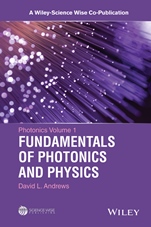
Photonics, Volume 1: Fundamentals of Photonics and Physics
ISBN 9781118225530
Autor: David L. Andrews
Wydawca: Wiley
Dostępność: 3-6 tygodni
Cena: 715,05 zł
Przed złożeniem zamówienia prosimy o kontakt mailowy celem potwierdzenia ceny.
ISBN13: |
9781118225530 |
ISBN10: |
1118225538 |
Autor: |
David L. Andrews |
Oprawa: |
Hardback |
Rok Wydania: |
2015-04-07 |
Ilość stron: |
472 |
Wymiary: |
246x160 |
Tematy: |
PH |
This book covers modern photonics accessibly and discusses the basic physical principles underlying all the applications and technology of photonics
This volume covers the basic physical principles underlying the technology and all applications of photonics from statistical optics to quantum optics. The topics discussed in this volume are: Photons in perspective; Coherence and Statistical Optics; Complex Light and Singular Optics; Electrodynamics of Dielectric Media; Fast and slow Light; Holography; Multiphoton Processes; Optical Angular Momentum; Optical Forces, Trapping and Manipulation; Polarization States; Quantum Electrodynamics; Quantum Information and Computing; Quantum Optics; Resonance Energy Transfer; Surface Optics; Ultrafast Pulse Phenomena.
Written for the graduate level student in physical sciences; Industrial and academic researchers in photonics, graduate students in the area; College lecturers, educators, policymakers, consultants, Scientific and technical libraries, government laboratories, NIH.
David L. Andrews leads research on fundamental molecular photonics and energy transport, optomechanical forces and nonlinear optical phenomena. He has over 160 research papers and also eight books to his name – including the widely adopted textbook Lasers in Chemistry. The current focus of his research group is on novel mechanisms for optical nanomanipulation and switching, and light–harvesting in nanostructured molecular systems. The group enjoys strong international links, particularly with groups in Canada, Lithuania, New Zealand and the United States. Andrews is a Fellow of the Royal Society of Chemistry, and a Fellow of the Institute of Physics, and he is the inaugural Chair of the SPIE Nanotechnology Technical Group.
I. A Photon in Perspective
David Andrews
1. Introduction
2. Foundations
3. Medium Issues
4. Photon Localization and Wavefunction
5. The Quantum Vacuum and Virtual Photons
6. Structured Light
7. Photon Number Fluctuations and Phase
8. The Reality of Photonics
9. Acknowledgements
10. References
II. Coherence and Statistical Optics
Mayukh Lahiri
1. Introduction
2. Classical Theory of Optical Coherence in the Space–time Domain
3. Classical Theory of Optical Coherence in the Space–frequency Domain
4. Cross–spectrally Pure Optical Fields
5. Polarization Properties of Stochastic Beams
6. Remark on Partially Coherent and Partially Polarized Beams
7. Basics of Quantum Theory of Optical Coherence
8. Concluding Remarks
9. Acknowledgements
10. References
III. Light Beams and Spatially–Variable Polarization
Kiko Galvez
1. Introduction
2. Poincaré Modes of Beams
3. Experimental Approaches
4. Polarization Singularities
5. Conclusion
6. Acknowledgements
7. References
IV. Quantum Optics
Howard Carmichael
1. Introduction
2. Fundamentals
3. Open Systems: Inputs and Outputs
4. Photon Counting
5. Cavity and Circuit QED
6. References
V. Squeezed Light
Alex Lvovsky
1. What is Squeezed Light?
2. Salient Features of Squeezed States
3. Detection
4. Preparation
5. Applications in Quantum Information
6. Applications in Quantum Metrology
7. Conclusion and Outlook
8. References
VI. Electromagnetic Theory of Materials
Tom Mackay
1. Preamble
2. Macroscopic Viewpoint
3. Constitutive Dyadics
4. Linear Materials
5. Nonlinear Materials
6. Closing Remarks
7. References
VII. Surface and Cavity Nanophotonics
Mohamed Babiker
1. Introduction
2. Basic Formalism
3. Dipole Emitter Near Edge
4. Quantum Correlations
5. Entanglement
6. Wedge Cavities
7. Conclusions
8. Acknowledgements
9. References
VIII. Quantum Electrodynamics
Akbar Salam
1. Introduction
2. Molecular Quantum Electrodynamics: Principle of Minimal Electromagnetic Coupling
3. Multipolar Hamiltonian
4. One–photon Absorption
5. Emission of Light: Spontaneous and Stimulated Processes
6. Linear Light–Scattering: The Kramers–Heisenberg Dispersion Formula
7. Chiroptical Effects
8. Two–Photon Absorption
9. Nonlinear Light–Scattering: Sum–Frequency and Harmonic Generation
10. Resonance Energy Transfer
11. Van der Waals Dispersion Energy
12. Radiation–Induced Inter–Particle Forces
13. Summary and Outlook
14. References
15. Figure Captions
IX. Multiphoton Processes
Angus Bain and Katarzyna Matczyszyn
1. Introduction
2. Molecular Two–Photon Absorption: Basic Principles
3. Molecular Two–Photon Fluorescence
4. Two– And Multiphoton Absorption in Free Rotors
5. Applications And Future Prospects
6. Conclusions
7. Acknowledgements
8. References
X. Orbital Angular Momentum
Miles Padgett
1. Historical Introduction
2. Creating Beam with OAM
3. Micro–Manipulation Through the Use of OAM
4. Beam Transformations
5. Measuring Beams with OAM
6. Orbital Angular Momentum in Classical Imaging
7. OAM in Nonlinear and Quantum Optics
8. Conclusions
9. References
XI. Introduction to Helicity and Electromagnetic Duality Transformations in Optics
Ivan Fernandez–Corbaton and Gabriel Molina–Terriza
1. Introduction
2. Symmetries and Operators
3. Electromagnetic Duality
4. Optical Helicity and Electromagnetic Duality Symmetry
5. Duality Symmetry in Piecewise Homogeneous and Isotropic Media
6. Spin to Orbit Angular Momentum Transfer
7. Conclusions
8. Bibliography
XII. Slow and Fast Light
Robert Boyd
1. Introduction
2. Mechanism of Slow Light
3. Physics with Slow and Fast Light
4. Some Applications of Slow and Fast Light
5. Fundamental Limits on Slow Light
6. References
XIII. Attosecond Physics: Attosecond Streaking Spectroscopy of Atoms and Solids
Matthias Kling, Reinhard Kienberger, and Uwe Thumm
1. Introduction
2. Time–resolved Photoemission from Atoms
3. Streaked Photoemission from Solids
4. Attosecond Streaking from Nanostructures
5. Conclusions
6. Acknowledgements
7. References
David L. Andrews leads research on fundamental molecular photonics and energy transport, optomechanical forces and nonlinear optical phenomena. He has over 160 research papers and also eight books to his name – including the widely adopted textbook Lasers in Chemistry. The current focus of his research group is on novel mechanisms for optical nanomanipulation and switching, and light–harvesting in nanostructured molecular systems. The group enjoys strong international links, particularly with groups in Canada, Lithuania, New Zealand and the United States. Andrews is a Fellow of the Royal Society of Chemistry, and a Fellow of the Institute of Physics, and he is the inaugural Chair of the SPIE Nanotechnology Technical Group.
Koszyk
Książek w koszyku: 0 szt.
Wartość zakupów: 0,00 zł
Informacje


Kontakt
Gambit
Centrum Oprogramowania
i Szkoleń Sp. z o.o.
Al. Pokoju 29b/22-24
31-564 Kraków
Siedziba Księgarni
ul. Kordylewskiego 1
31-542 Kraków
+48 12 410 5991
+48 12 410 5987
+48 12 410 5989
Subskrypcje
Administratorem danych osobowych jest firma Gambit COiS Sp. z o.o. Na podany adres będzie wysyłany wyłącznie biuletyn informacyjny.
Autoryzacja płatności

Informacje na temat autoryzacji płatności poprzez PayU.

© Copyright 2012: GAMBIT COiS Sp. z o.o. Wszelkie prawa zastrzeżone.
Projekt i wykonanie: Alchemia Studio Reklamy