


Wydawcy
Katalog tematyczny
- Archeologia (109)
- Ekonomia, finanse, business (13704)
- Filozofia (1445)
- Historia (3040)
- Języki i językoznawstwo (2356)
- Lifestyle, hobby i rozrywka (475)
- Medycyna (9704)
- Nauki humanistyczne (4)
- Nauki o Ziemi i środowisku (2638)
- Nauki ścisłe (20412)
- Nauki społeczne (8486)
- Nauki techniczne (13450)
- Prawo (1696)
- Publikacje informacyjne i interdyscyplinarne (1288)
- Religia i wierzenia (917)
- Technika komputerowa (4067)
- Zdrowie, relacje międzyludzkie i rozwój osobisty (657)





Informacje szczegółowe o książce
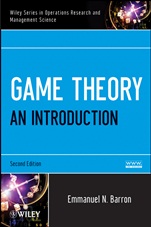
Game Theory: An Introduction
ISBN 9781118216934
Autor: E. N. Barron
Wydawca: Wiley
Dostępność: 3-6 tygodni
Cena: 549,15 zł
Przed złożeniem zamówienia prosimy o kontakt mailowy celem potwierdzenia ceny.
ISBN13: |
9781118216934 |
ISBN10: |
1118216938 |
Autor: |
E. N. Barron |
Oprawa: |
Hardback |
Rok Wydania: |
2013-05-17 |
Numer Wydania: |
2nd Edition |
Ilość stron: |
574 |
Wymiary: |
263x177 |
Tematy: |
KC |
An exciting new edition of the popular introduction to gametheory and its applications
The thoroughly expanded Second Edition presents a unique,hands–on approach to game theory. While most books on the subjectare too abstract or too basic for mathematicians, Game Theory:An Introduction, Second Edition offers a blend of theory andapplications, allowing readers to use theory and software to createand analyze real–world decision–making models.
With a rigorous, yet accessible, treatment of mathematics, thebook focuses on results that can be used to determine optimal gamestrategies. Game Theory: An Introduction, Second Editiondemonstrates how to use modern software, such as Maple ,Mathematica®, and Gambit, to create, analyze, and implementeffective decision–making models. Coverage includes the mainaspects of game theory including the fundamentals of two–personzero–sum games, cooperative games, and population games as well asa large number of examples from various fields, such as economics,transportation, warfare, asset distribution, political science, andbiology. The Second Edition features:
A new chapter on extensive games, which greatly expands theimplementation of available models New sections on correlated equilibria and exact formulas forthree–player cooperative games Many updated topics including threats in bargaining games andevolutionary stable strategies Solutions and methods used to solve all odd–numberedproblems A companion website containing the related Maple andMathematica data sets and codeA trusted and proven guide for students of mathematics andeconomics, Game Theory: An Introduction, Second Edition isalso an excellent resource for researchers and practitioners ineconomics, finance, engineering, operations research, statistics,and computer science.
Preface for the Second Edition xi
Preface for the First Edition xv
Acknowledgments xvii
Introduction 1
1 Matrix Two–Person Games 5
1.1 The Basics 5
Problems 16
1.2 The von Neumann Minimax Theorem 18
1.2.1 Proof of von Neumann s Minimax Theorem (Optional)21
Problems 24
1.3 Mixed Strategies 25
1.3.1 Properties of Optimal Strategies 35
1.3.2 Dominated Strategies 38
1.4 Solving 2 × 2 Games Graphically 41
Problems 43
1.5 Graphical Solution of 2 × m and n × 2 Games 44
Problems 50
1.6 Best Response Strategies 53
Problems 57
1.6.1 MapleTM/Mathematica R 58
Bibliographic Notes 59
2 Solution Methods for Matrix Games 60
2.1 Solution of Some Special Games 60
2.1.1 2 × 2 Games Revisited 60
Problems 64
2.2 Invertible Matrix Games 65
2.2.1 Completely Mixed Games 68
Problems 74
2.3 Symmetric Games 76
Problems 81
2.4 Matrix Games and Linear Programming 82
2.4.1 Setting Up the Linear Program: Method 1 83
2.4.2 A Direct Formulation Without Transforming: Method 2 89
Problems 94
2.5 Appendix: Linear Programming and the Simplex Method 98
2.5.1 The Simplex Method Step by Step 101
Problems 108
2.6 Review Problems 108
2.7 Maple/Mathematica 109
2.7.1 Invertible Matrices 109
2.7.2 Linear Programming: Method 1 110
2.7.3 Linear Programming: Method 2 111
Bibliographic Notes 113
3 Two–Person Nonzero Sum Games 115
3.1 The Basics 115
Problems 123
3.2 2 × 2 Bimatrix Games, Best Response, Equality ofPayoffs 125
3.2.1 Calculation of the Rational Reaction Sets for 2 × 2Games 125
Problems 132
3.3 Interior Mixed Nash Points by Calculus 135
3.3.1 Calculus Method for Interior Nash 135
Problems 143
3.3.2 Proof that There is a Nash Equilibrium for Bimatrix Games(Optional) 146
3.4 Nonlinear Programming Method for Nonzero Sum Two–PersonGames 148
3.4.1 Summary of Methods for Finding Mixed Nash Equilibria156
Problems 158
3.5 Correlated Equilibria 159
3.5.1 LP Problem for a Correlated Equilibrium 165
Problems 166
3.6 Choosing Among Several Nash Equilibria (Optional) 167
Problems 172
3.6.1 Maple/Mathematica 173
3.6.2 Mathematica for Lemke Howson Algorithm 173
Bibliographic Notes 175
4 Games in Extensive Form: Sequential Decision Making176
4.1 Introduction to Game Trees Gambit 176
Problems 189
4.2 Backward Induction and Subgame Perfect Equilibrium 190
Problems 193
4.2.1 Subgame Perfect Equilibrium 194
4.2.2 Examples of Extensive Games Using Gambit 200
Problems 209
Bibliographic Notes 212
5 n–Person Nonzero Sum Games and Games with a Continuum ofStrategies 213
5.1 The Basics 213
Problems 235
5.2 Economics Applications of Nash Equilibria 242
5.2.1 Cournot Duopoly 243
5.2.2 A Slight Generalization of Cournot 245
5.2.3 Cournot Model with Uncertain Costs 247
5.2.4 The Bertrand Model 250
5.2.5 The Stackelberg Model 252
5.2.6 Entry Deterrence 254
Problems 256
5.3 Duels (Optional) 259
5.3.1 Silent Duel on [0,1] (Optional) 262
Problem 266
5.4 Auctions (Optional) 266
5.4.1 Complete Information 271
Problems 272
5.4.2 Incomplete Information 272
5.4.3 Symmetric Independent Private Value Auctions 275
Problem 286
Bibliographic Notes 287
6 Cooperative Games 288
6.1 Coalitions and Characteristic Functions 288
Problems 307
6.1.1 More on the Core and Least Core 310
Problems 317
6.2 The Nucleolus 319
6.2.1 An Exact Nucleolus for Three–Player Games 327
Problems 333
6.3 The Shapley Value 335
Problems 347
6.4 Bargaining 352
6.4.1 The Nash Model with Security Point 358
6.4.2 Threats 365
6.4.3 The Kalai Smorodinsky Bargaining Solution 377
6.4.4 Sequential Bargaining 379
Problems 384
Review Problems 386
6.5 Maple/Mathematica 386
6.5.1 Finding the Nucleolus One Step at a Time 386
6.5.2 Mathematica Code for Three–Person Nucleolus 391
6.5.3 The Shapley Value with Maple 393
6.5.4 Maple and Bargaining 393
Bibliographic Notes 394
7 Evolutionary Stable Strategies and Population Games395
7.1 Evolution 395
7.1.1 Properties of an ESS 402
Problems 408
7.2 Population Games 409
Problems 428
Bibliographic Notes 430
Appendix A: The Essentials of Matrix Analysis 432
Appendix B: The Essentials of Probability 436
Appendix C: The Essentials of Maple 442
Appendix D: The Mathematica Commands 448
Appendix E: Biographies 463
Problem Solutions 465
References 549
Index 551
E. N. BARRON, PhD, is Professor of Mathematics andStatistics in the Department of Mathematics and Statistics atLoyola University Chicago and the author of more than sixty journalarticles on optimal control, differential games, nonlinear partialdifferential equations, and mathematical finance.
I highly recommend the superb and very practical textbook GameTheory: An Introduction, Second Edition by E.N. Barron,Ph.D., along with its very useful learning companion book SolutionsManual to Accompany Game Theory: An Introduction, SecondEdition also by E.N. Barron, Ph.D., to any academicinstructors of game theory, especially those who teach a wide rangeof students from many different disciplines. This textbook providesthe foundational aspects of game theory in an approachable andhands on format that will appeal to both professors and studentsalike. ( B log Business World , 21September 2013)
Koszyk
Książek w koszyku: 0 szt.
Wartość zakupów: 0,00 zł
Informacje


Kontakt
Gambit
Centrum Oprogramowania
i Szkoleń Sp. z o.o.
Al. Pokoju 29b/22-24
31-564 Kraków
Siedziba Księgarni
ul. Kordylewskiego 1
31-542 Kraków
+48 12 410 5991
+48 12 410 5987
+48 12 410 5989
Subskrypcje
Administratorem danych osobowych jest firma Gambit COiS Sp. z o.o. Na podany adres będzie wysyłany wyłącznie biuletyn informacyjny.
Autoryzacja płatności

Informacje na temat autoryzacji płatności poprzez PayU.

© Copyright 2012: GAMBIT COiS Sp. z o.o. Wszelkie prawa zastrzeżone.
Projekt i wykonanie: Alchemia Studio Reklamy