


Wydawcy
Katalog tematyczny
- Archeologia (109)
- Ekonomia, finanse, business (13704)
- Filozofia (1445)
- Historia (3040)
- Języki i językoznawstwo (2356)
- Lifestyle, hobby i rozrywka (475)
- Medycyna (9704)
- Nauki humanistyczne (4)
- Nauki o Ziemi i środowisku (2638)
- Nauki ścisłe (20412)
- Nauki społeczne (8486)
- Nauki techniczne (13450)
- Prawo (1696)
- Publikacje informacyjne i interdyscyplinarne (1288)
- Religia i wierzenia (917)
- Technika komputerowa (4067)
- Zdrowie, relacje międzyludzkie i rozwój osobisty (657)





Informacje szczegółowe o książce
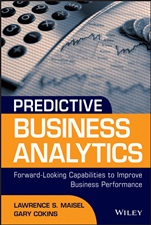
Predictive Business Analytics: Forward Looking Capabilities to Improve Business Performance
ISBN 9781118175569
Autor: Lawrence Maisel, Gary Cokins
Wydawca: Wiley
Dostępność: 3-6 tygodni
Cena: 248,85 zł
Przed złożeniem zamówienia prosimy o kontakt mailowy celem potwierdzenia ceny.
ISBN13: |
9781118175569 |
ISBN10: |
1118175565 |
Autor: |
Lawrence Maisel, Gary Cokins |
Oprawa: |
Hardback |
Rok Wydania: |
2013-11-19 |
Ilość stron: |
272 |
Wymiary: |
229x164 |
Tematy: |
KM |
Praise for Predictive Business Analytics "Maisel and Cokins have provided a highly readable account of the feasibility and power of predictive analytics. Implementing the book's ideas will definitely help companies make better data-driven decisions." Robert S. Kaplan, co-developer of Balanced Scorecard and Activity-Based Costing and Professor Emeritus, Harvard Business School "A simple how-to guide supported by practical case studies to implement a powerful process. In the dynamic economic environment we find ourselves in, having actionable analytics, based on facts and data supporting our decisions, increases our chances of making the best decisions." Jeffrey Nachowitz, VP Global Technology & Operations, MetLife "Finally a book that 'connects the dots' on predictive analytics as a necessary and useful tool for CFOs interested in having a competitive advantage. Kudos to Maisel and Cokins for superbly addressing a topic long overdue." C. S. "Bud" Kulesza, CMA, CFM, leadership expert, Dean Emeritus, IMA Leadership Academy "Cokins and Maisel paint a rich picture of the potential uses and pitfalls of predictive business analytics and provide a practical framework for implementing an analytics program. Both current and aspiring analytical practitioners will gain much insight and confidence by reading Predictive Business Analytics. " Wayne Eckerson, President, BI Leader Consulting, and author of Secrets of Analytical Leaders: Insights from Information Insiders "Larry and Gary are right on target in their evaluation of the power of predictive modeling in business analytics as the new wave that will sweep through businesses to drive and inform the decision-making process. This is a must-read for decision makers who will ride this wave into the future." Mitchell Blaser, Chief Operating Officer, Ironshore Inc. "Larry and Gary have laid out a set of business principles for applying predictive analytics, with an emphasis on how to integrate predictive analytics with the accounting and budgeting functions so central to any large organization. This emphasis, combined with their focus on the need to make better decisions and on using analytics to change a business not just monitor it, makes Predictive Business Analytics a great read." James Taylor, CEO, Decision Management Solutions, and author of Decision Management Systems: A Practical Guide to Using Business Rules and Predictive Analytics
Preface xv Part One “Why” 1 Chapter 1 Why Analytics Will Be the Next Competitive Edge 3 Analytics: Just a Skill, or a Profession? 4 Business Intelligence versus Analytics versus Decisions 5 How Do Executives and Managers Mature in Applying Accepted Methods? 6 Fill in the Blanks: Which X Is Most Likely to Y? 6 Predictive Business Analytics and Decision Management 7 Predictive Business Analytics: The Next “New” Wave 9 Game–Changer Wave: Automated Decision–Based Management 10 Preconception Bias 11 Analysts’ Imagination Sparks Creativity and Produces Confidence 12 Being Wrong versus Being Confused 12 Ambiguity and Uncertainty Are Your Friends 14 Do the Important Stuff First—Predictive Business Analytics 16 What If . . . You Can 17 Notes 19 Chapter 2 The Predictive Business Analytics Model 21 Building the Business Case for Predictive Business Analytics 27 Business Partner Role and Contributions 28 Summary 29 Notes 29 Part Two Principles and Practices 31 Chapter 3 Guiding Principles in Developing Predictive Business Analytics 33 Defining a Relevant Set of Principles 34 PRINCIPLE 1: Demonstrate a Strong Cause–and–Effect Relationship 34 PRINCIPLE 2: Incorporate a Balanced Set of Financial and Nonfinancial, Internal and External Measures 36 PRINCIPLE 3: Be Relevant, Reliable, and Timely for Decision Makers 37 PRINCIPLE 4: Ensure Data Integrity 38 PRINCIPLE 5: Be Accessible, Understandable, and Well Organized 39 PRINCIPLE 6: Integrate into the Management Process 39 PRINCIPLE 7: Drive Behaviors and Results 40 Summary 41 CHAPTER 4 Developing a Predictive Business Analytics Function 43 Getting Started 44 Selecting a Desired Target State 46 Adopting a PBA Framework 49 Developing the Framework 49 Summary 60 Notes 60 CHAPTER 5 Deploying the Predictive Business Analytics Function 61 Integrating Performance Management with Analytics 63 Performance Management System 64 Implementing a Performance Scorecard 67 Management Review Process 76 Implementation Approaches 78 Change Management 80 Summary 81 Notes 82 Part Three Case Studies 83 CHAPTER 6 MetLife Case Study in Predictive Business Analytics 85 The Performance Management Program 88 Implementing the MOR Program 93 Benefi ts and Lessons Learned 108 Summary 108 Notes 108 CHAPTER 7 Predictive Performance Analytics in the Biopharmaceutical Industry 109 Case Studies 113 Summary 127 Note 127 Part Four Integrating Business Methods and Techniques 129 CHAPTER 8 Why Do Companies Fail (Because of Irrational Decisions)? 131 Irrational Decision Making 131 Why Do Large, Successful Companies Fail? 132 From Data to Insights 134 Increasing the Return on Investment from Information Assets 135 Emerging Need for Analytics 136 Summary 137 Notes 138 CHAPTER 9 Integration of Business Intelligence, Business Analytics, and Enterprise Performance Management 139 Relationship among Business Intelligence, Business Analytics, and Enterprise Performance Management 140 Overcoming Barriers 143 Summary 144 Notes 145 CHAPTER 10 Predictive Accounting and Marginal Expense Analytics 147 Logic Diagrams Distinguish Business from Cost Drivers 148 Confusion about Accounting Methods 150 Historical Evolution of Managerial Accounting 152 An Accounting Framework and Taxonomy 153 What? So What? Then What? 156 Coexisting Cost Accounting Methods 159 Predictive Accounting with Marginal Expense Analysis 160 What Is the Purpose of Management Accounting? 160 What Types of Decisions Are Made with Managerial Accounting Information? 161 Activity–Based Cost/Management as a Foundation for Predictive Business Accounting 164 Major Clue: Capacity Exists Only as a Resource 165 Predictive Accounting Involves Marginal Expense Calculations 166 Decomposing the Information Flows Figure 169 Framework to Compare and Contrast Expense Estimating Methods 172 Predictive Costing Is Modeling 173 Debates about Costing Methods 174 Summary 175 Notes 175 CHAPTER 11 Driver–Based Budget and Rolling Forecasts 177 Evolutionary History of Budgets 180 A Sea Change in Accounting and Finance 182 Financial Management Integrated Information Delivery Portal 183 Put Your Money Where Your Strategy Is 185 Problem with Budgeting 185 Value Is Created from Projects and Initiatives, Not the Strategic Objectives 187 Driver–Based Resource Capacity and Spending Planning 189 Including Risk Mitigation with a Risk Assessment Grid 190 Four Types of Budget Spending: Operational, Capital, Strategic, and Risk 192 From a Static Annual Budget to Rolling Financial Forecasts 194 Managing Strategy Is Learnable 195 Summary 195 Notes 196 Part Five Trends and Organizational Challenges 197 CHAPTER 12 CFO Trends 199 Resistance to Change and Presumptions of Existing Capabilities 199 Evidence of Defi cient Use of Business Analytics in Finance and Accounting 201 Sobering Indication of the Advances Yet Needed by the CFO Function 202 Moving from Aspirations to Practice with Analytics 203 Approaching Nirvana 210 CFO Function Needs to Push the Envelope 210 Summary 215 Notes 216 CHAPTER 13 Organizational Challenges 217 What Is the Primary Barrier Slowing the Adoption Rate of Analytics? 219 A Blissful Romance with Analytics 220 Why Does Shaken Confidence Reinforce One’s Advocacy? 221 Early Adopters and Laggards 222 How Can One Overcome Resistance to Change? 224 The Time to Create a Culture for Analytics Is Now 226 Predictive Business Analytics: Nonsense or Prudence? 227 Two Types of Employees 227 Inequality of Decision Rights 228 What Factors Contribute to Organizational Improvement? 229 Analytics: The Skeptics versus the Enthusiasts 229 Maximizing Predictive Business Analytics: Top–Down or Bottom–Up Leadership? 234 Analysts Pursue Perceived Unachievable Accomplishments 235 Analysts Can Be Leaders 236 Summary 237 Notes 237 About the Authors 239 Index 243
LAWRENCE S. Maisel, President of DecisionVu, specializes in corporate performance management, financial management, and IT value management. He has extensive industry experiences with numerous Global 1000 companies including MetLife, TIAA-CREF, Citigroup, GE, Bristol-Myers, Pfizer, and News Corp/Fox Entertainment. Larry co-created with Drs. Kaplan and Norton the Balanced Scorecard Approach, and co-authored with Drs. Kaplan and Cooper Implementing Activity-Based Cost Management . He is a CPA, holds a BA from NYU and an MBA from Pace University, and was an adjunct professor at Columbia University's Graduate Business School. Contact him at LMaisel@DecisionVu.com. GARY COKINS is the founder of Analytics-Based Performance Management, LLC. He is an internationally recognized expert, speaker, and author in advanced cost management and performance improvement systems. He served fifteen years as a consultant with Deloitte Consulting, KPMG, and Electronic Data Systems (EDS, now part of HP). From 1997 until recently, Gary was in business development with SAS, a leading provider of enterprise performance management and business analytics and intelligence software. He has a degree in operations research from Cornell University and an MBA from Northwestern University Kellogg School of Management. Contact him at gcokins@garycokins.com.
Koszyk
Książek w koszyku: 0 szt.
Wartość zakupów: 0,00 zł
Informacje


Kontakt
Gambit
Centrum Oprogramowania
i Szkoleń Sp. z o.o.
Al. Pokoju 29b/22-24
31-564 Kraków
Siedziba Księgarni
ul. Kordylewskiego 1
31-542 Kraków
+48 12 410 5991
+48 12 410 5987
+48 12 410 5989
Subskrypcje
Administratorem danych osobowych jest firma Gambit COiS Sp. z o.o. Na podany adres będzie wysyłany wyłącznie biuletyn informacyjny.
Autoryzacja płatności

Informacje na temat autoryzacji płatności poprzez PayU.

© Copyright 2012: GAMBIT COiS Sp. z o.o. Wszelkie prawa zastrzeżone.
Projekt i wykonanie: Alchemia Studio Reklamy