


Wydawcy
Katalog tematyczny
- Archeologia (109)
- Ekonomia, finanse, business (13704)
- Filozofia (1445)
- Historia (3040)
- Języki i językoznawstwo (2356)
- Lifestyle, hobby i rozrywka (475)
- Medycyna (9704)
- Nauki humanistyczne (4)
- Nauki o Ziemi i środowisku (2638)
- Nauki ścisłe (20412)
- Astronomia (294)
- Biologia (5119)
- Chemia (6540)
- Chemia analityczna (361)
- Chemia fizyczna (346)
- Chemia nieorganiczna (137)
- Chemia organiczna (535)
- Krystalografia (27)
- Minerologia (46)
- Fizyka (3309)
- Matematyka (4574)
- Nauki ścisłe, ogólnie (503)
- Nauki społeczne (8486)
- Nauki techniczne (13450)
- Prawo (1696)
- Publikacje informacyjne i interdyscyplinarne (1288)
- Religia i wierzenia (917)
- Technika komputerowa (4067)
- Zdrowie, relacje międzyludzkie i rozwój osobisty (657)





Informacje szczegółowe o książce
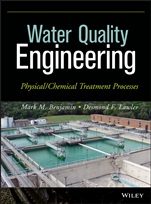
Water Quality Engineering: Physical / Chemical Treatment Processes
ISBN 9781118169650
Autor: Mark M. Benjamin, Desmond F. Lawler
Wydawca: Wiley
Dostępność: 3-6 tygodni
Cena: 801,15 zł
Przed złożeniem zamówienia prosimy o kontakt mailowy celem potwierdzenia ceny.
ISBN13: |
9781118169650 |
ISBN10: |
1118169654 |
Autor: |
Mark M. Benjamin, Desmond F. Lawler |
Oprawa: |
Hardback |
Rok Wydania: |
2013-08-09 |
Ilość stron: |
912 |
Wymiary: |
286x222 |
Tematy: |
PN |
Explains the fundamental theory and mathematics of water and wastewater treatment processes By carefully explaining both the underlying theory and the underlying mathematics, this text enables readers to fully grasp the fundamentals of physical and chemical treatment processes for water and wastewater. Throughout the book, the authors use detailed examples to illustrate real–world challenges and their solutions, including step–by–step mathematical calculations. Each chapter ends with a set of problems that enable readers to put their knowledge into practice by developing and analyzing complex processes for the removal of soluble and particulate materials in order to ensure the safety of our water supplies. Designed to give readers a deep understanding of how water treatment processes actually work, Water Quality Engineering explores: Application of mass balances in continuous flow systems, enabling readers to understand and predict changes in water quality Processes for removing soluble contaminants from water, including treatment of municipal and industrial wastes Processes for removing particulate materials from water Membrane processes to remove both soluble and particulate materials Following the discussion of mass balances in continuous flow systems in the first part of the book, the authors explain and analyze water treatment processes in subsequent chapters by setting forth the relevant mass balance for the process, reactor geometry, and flow pattern under consideration. With its many examples and problem sets, Water Quality Engineering is recommended as a textbook for graduate courses in physical and chemical treatment processes for water and wastewater. By drawing together the most recent research findings and industry practices, this text is also recommended for professional environmental engineers in search of a contemporary perspective on water and wastewater treatment processes.
PREFACE xxi ACKNOWLEDGMENTS xxv PART I REACTORS AND REACTIONS INWATER QUALITY ENGINEERING 1 Mass Balances 3 1.1 Introduction: The Mass Balance Concept, 3 1.2 The Mass Balance for a System with Unidirectional Flow and Concentration Gradient, 7 1.3 The Mass Balance for a System with Flow and Concentration Gradients in Arbitrary Directions, 20 1.4 The Differential Form of the Three–Dimensional Mass Balance, 24 1.5 Summary, 25 2 Continuous Flow Reactors: Hydraulic Characteristics 29 2.1 Introduction, 29 2.2 Residence Time Distributions, 30 2.3 Ideal Reactors, 42 2.4 Nonideal Reactors, 48 2.5 Equalization, 62 2.6 Summary, 70 3 Reaction Kinetics 81 3.1 Introduction, 81 3.2 Fundamentals, 82 3.3 Kinetics of Irreversible Reactions, 88 3.4 Kinetics of Reversible Reactions, 99 3.5 Kinetics of Sequential Reactions, 107 3.6 The Temperature Dependence of the Rates of Nonelementary Reactions, 114 3.7 Summary, 115 4 Continuous Flow Reactors: Performance Characteristics with Reaction 121 4.1 Introduction, 121 4.2 Extent of Reaction in Single Ideal Reactors at Steady State, 121 4.3 Extent of Reaction in Systems Composed of Multiple Ideal Reactors at Steady State, 130 4.4 Extent of Reaction in Reactors with Nonideal Flow, 135 4.5 Extent of Reaction Under Non–Steady–Conditions in Continuous Flow Reactors, 141 4.6 Summary, 146 PART II REMOVAL OF DISSOLVED CONSTITUENTS FROM WATER 5 Gas Transfer Fundamentals 155 5.1 Introduction, 155 5.2 Types of Engineered Gas Transfer Systems, 159 5.3 Henry’s Law and Gas/Liquid Equilibrium, 162 5.4 Relating Changes in the Gas and Liquid Phases, 170 5.5 Mechanistic Models for Gas Transfer, 170 5.6 The Overall Gas Transfer Rate Coefficient, KL, 179 5.7 Evaluating kL, kG, KL, and a: Effects of Hydrodynamic and Other Operating Conditions, 187 5.8 Summary, 196 6 Gas Transfer: Reactor Design and Analysis 207 6.1 Introduction, 207 6.2 Case I: Gas Transfer in Systems with a Well–Mixed Liquid Phase, 207 6.3 Case II: Gas Transfer in Systems with Spatial Variations in the Concentrations of Both Solution and Gas, 226 6.4 Summary, 241 7 Adsorption Processes: Fundamentals 257 7.1 Introduction, 257 7.2 Examples of Adsorption in Natural and Engineered Aquatic Systems, 262 7.3 Conceptual, Molecular–Scale Models for Adsorption, 266 7.4 Quantifying the Activity of Adsorbed Species and Adsorption Equilibrium Constants, 268 7.5 Quantitative Representations of Adsorption Equilibrium: The Adsorption Isotherm, 269 7.6 Modeling Adsorption Using Surface Pressure to Describe the Activity of Adsorbed Species, 296 7.7 The Polanyi Adsorption Model and the Polanyi Isotherm, 306 7.8 Modeling Other Interactions and Reactions at Surfaces, 314 7.9 Summary, 320 8 Adsorption Processes: Reactor Design and Analysis 327 8.1 Introduction, 327 8.2 Systems with Rapid Attainment of Equilibrium, 328 8.3 Systems with a Slow Approach to Equilibrium, 340 8.4 The Movement of the Mass Transfer Zone Through Fixed Bed Adsorbers, 354 8.5 Chemical Reactions in Fixed Bed Adsorption Systems, 356 8.6 Estimating Long–Term, Full–Scale Performance of Fixed Beds from Short–Term, Bench–Scale Experimental Data, 357 8.7 Competitive Adsorption in Column Operations: The Chromatographic Effect, 359 8.8 Adsorbent Regeneration, 365 8.9 Design Options and Operating Strategies for Fixed Bed Reactors, 366 8.10 Summary, 369 References, 371 Problems, 371 9 Precipitation and Dissolution Processes 379 9.1 Introduction, 379 9.2 Fundamentals of Precipitation Processes, 380 9.3 Precipitation Dynamics: Particle Nucleation and Growth, 384 9.4 Modeling Solution Composition in Precipitation Reactions, 394 9.5 Stoichiometric and Equilibrium Models for Precipitation Reactions, 397 9.6 Solid Dissolution Reactions, 422 9.7 Reactors for Precipitation Reactions, 426 9.8 Summary, 428 10 Redox Processes and Disinfection 435 10.1 Introduction, 435 10.2 Basic Principles and Overview, 435 10.3 Oxidative Processes Involving Common Oxidants, 441 10.4 Advanced Oxidation Processes, 469 10.5 Reductive Processes, 486 10.6 Electrochemical Processes, 488 10.7 Disinfection, 488 10.8 Summary, 502 PART III REMOVAL OF PARTICLES FROM WATER 11 Particle Treatment Processes: Common Elements 519 11.1 Introduction, 519 11.2 Particle Stability, 521 11.3 Chemicals Commonly Used for Destabilization, 532 11.4 Particle Destabilization, 535 11.5 Interactions of Destabilizing Chemicals with Soluble Materials, 542 11.6 Mixing of Chemicals into the Water Stream, 544 11.7 Particle Size Distributions, 546 11.8 Particle Shape, 551 11.9 Particle Density, 552 11.10 Fractal Nature of Flocs, 552 11.11 Summary, 553 12 Flocculation 563 12.1 Introduction, 563 12.2 Changes in Particle Size Distributions by Flocculation, 564 12.3 Flocculation Modeling, 565 12.4 Collision Frequency: Long–Range Force Model, 572 12.5 Collision Efficiency: Short–Range Force Model, 581 12.6 Turbulence and Turbulent Flocculation, 589 12.7 Floc Breakup, 592 12.8 Modeling of Flocculation with Fractal Dimensions, 594 12.9 Summary, 596 13 Gravity Separations 603 13.1 Introduction, 603 13.2 Engineered Systems for Gravity Separations, 605 13.3 Sedimentation of Individual Particles, 607 13.4 Batch Sedimentation: Type I, 612 13.5 Batch Sedimentation: Type II, 618 13.6 Continuous Flow Ideal Settling, 622 13.7 Effects of Nonideal Flow on Sedimentation Reactor Performance, 639 13.8 Thickening, 644 13.9 Flotation, 655 13.10 Summary, 669 14 Granular Media Filtration 677 14.1 Introduction, 677 14.2 ATypical Filter Run, 680 14.3 General Mathematical Description of Particle Removal: Iwasaki’s Model, 683 14.4 Clean Bed Removal, 684 14.5 Predicted Clean Bed Removal in Standard Water and Wastewater Treatment Filters, 694 14.6 Head Loss in a Clean Filter Bed, 698 14.7 Filtration Dynamics: Experimental Findings of Changes with Time, 700 14.8 Models of Filtration Dynamics, 709 14.9 Filter Cleaning, 714 14.10 Summary, 717 PART IV MEMBRANE–BASED WATER AND WASTEWATER TREATMENT 15 Membrane Processes 731 15.1 Introduction, 731 15.2 Overview of Membrane System Operation, 732 15.3 Membranes, Modules, and the Mechanics of Membrane Treatment, 734 15.4 Parameters Used to Describe Membrane Systems, 742 15.5 Overview of Pressure–Driven Membrane Systems, 749 15.6 Quantifying Driving Forces in Membrane Systems, 752 15.7 Quantitative Modeling of Pressure–Driven Membrane Systems, 759 15.8 Modeling Transport of Water and Contaminants From Bulk Solution to the Surface of Pressure–Driven Membranes, 773 15.9 Effects of Crossflow on Permeation and Fouling, 792 15.10 Electrodialysis, 816 15.11 Modeling Dense Membrane Systems Using Irreversible Thermodynamics, 834 15.12 Summary, 838 INDEX 847
MARK M. BENJAMIN, PhD, is Professor of Environmental Engineering at the University of Washington. A Fulbright Fellow, Dr. Benjamin is an expert in physical and chemical treatment processes. His research examines the behavior of natural organic matter and its removal from potable water sources. Moreover, he has developed adsorption-based processes for the removal of metals, natural organic matter, and other contaminants from solutions. A major focus of his current research has been the membrane treatment of drinking water. DESMOND F. LAWLER, PhD, holds the Nasser I. Al-Rashid Chair in Civil Engineering at the University of Texas and is a member of the University's Distinguished Teaching Academy. Throughout his career, his research and teaching have focused on physical-chemical treatment processes. The research has emphasized particle removal in drinking water and wastewater but has also involved gas transfer, precipitation, oxidation, and desalination. Fourteen of his Ph.D. advisees hold academic positions, while his numerous M.S. research graduates work in consulting firms and government agencies.
Koszyk
Książek w koszyku: 0 szt.
Wartość zakupów: 0,00 zł
Informacje


Kontakt
Gambit
Centrum Oprogramowania
i Szkoleń Sp. z o.o.
Al. Pokoju 29b/22-24
31-564 Kraków
Siedziba Księgarni
ul. Kordylewskiego 1
31-542 Kraków
+48 12 410 5991
+48 12 410 5987
+48 12 410 5989
Subskrypcje
Administratorem danych osobowych jest firma Gambit COiS Sp. z o.o. Na podany adres będzie wysyłany wyłącznie biuletyn informacyjny.
Autoryzacja płatności

Informacje na temat autoryzacji płatności poprzez PayU.

© Copyright 2012: GAMBIT COiS Sp. z o.o. Wszelkie prawa zastrzeżone.
Projekt i wykonanie: Alchemia Studio Reklamy