


Wydawcy
Katalog tematyczny
- Archeologia (109)
- Ekonomia, finanse, business (13704)
- Filozofia (1445)
- Historia (3040)
- Języki i językoznawstwo (2356)
- Lifestyle, hobby i rozrywka (475)
- Medycyna (9704)
- Nauki humanistyczne (4)
- Nauki o Ziemi i środowisku (2638)
- Nauki ścisłe (20412)
- Nauki społeczne (8486)
- Nauki techniczne (13450)
- Prawo (1696)
- Publikacje informacyjne i interdyscyplinarne (1288)
- Religia i wierzenia (917)
- Technika komputerowa (4067)
- Zdrowie, relacje międzyludzkie i rozwój osobisty (657)





Informacje szczegółowe o książce
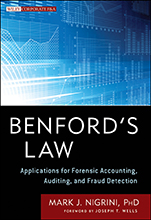
Benfords Law: Applications for Forensic Accounting, Auditing, and Fraud Detection
ISBN 9781118152850
Autor: Mark J. Nigrini, Joseph T. Wells
Wydawca: Wiley
Dostępność: 3-6 tygodni
Cena: 394,80 zł
Przed złożeniem zamówienia prosimy o kontakt mailowy celem potwierdzenia ceny.
ISBN13: |
9781118152850 |
ISBN10: |
1118152859 |
Autor: |
Mark J. Nigrini, Joseph T. Wells |
Oprawa: |
Hardback |
Rok Wydania: |
2012-04-27 |
Ilość stron: |
352 |
Wymiary: |
254x178 |
Tematy: |
KM |
Praise for Benford′s Law Applications for Forensic Accounting, Auditing, and Fraud Detection "Mark Nigrini . . . took Benford′s original data and developed it into solid analytical methods to detect a variety of white–collar misdeeds: vendor, payroll, and sales tax frauds; fraudulent medical and insurance claims; check fraud and tax evasion among others. In other words, Dr. Nigrini has put Benford′s Law on the map. With the passage of time, he and others will find additional useful applications for this powerful tool." — From the Foreword by Dr. Joseph T. Wells, CFE, CPA Apply Benford′s Law to detect fraud and to test the integrity of your data Numbers play an important part in our lives from weather forecasts to the stock market, and from street addresses and phone numbers to baseball statistics and casino games. It would be impossible to take numbers out of our daily lives. The secret is out that there are patterns to the numbers that we come across every day, and more importantly, that deviations from these patterns are red flags for fraud, errors, and biases. Author Mark Nigrini, a pioneer in forensic accounting, describes the mathematical foundations of Benford′s Law in a way that is easily understood by accounting and other business–related professionals. He then shows many examples of authentic and accurate data that conformed to Benford′s Law—and the fraudulent and invented numbers that did not. Nigrini goes way beyond the first digits test and outlines a series of digit– and number–based tests called the Nigrini Cycle. With a companion website with data sets and Excel templates, these tests are based on the state–of–the–art tools, thinking, and research related to Benford′s Law. The applications include: The Madoff numbers GM and Chrysler bankruptcy data Numbers reported by Enron and AIG Bill and Hillary Clinton′s tax returns U.S. census population numbers Corporate payments data The Fibonacci numbers Taxpayer interest and dividend income Benford′s Law "gives Professor Nigrini a tool worthy of Sherlock Holmes," said Robert Burton, chief financial investigator for the district attorney′s office in Brooklyn, New York. In Benford′s Law , Nigrini shares his insights and passion for the topic in a way that is sure to cause fraudsters to have many sleepless nights in the years ahead.
Foreword xi Preface xiii About the Author xix Chapter 1: Introduction and Mathematical Foundations 1 Benford′s Expected Digit Frequencies 5 Defining the First and First–Two Digits 6 Digit Patterns of U.S. Census Data 8 Logging on to Benford′s Law 10 General Significant Digit Law 13 Log and Behold, the Census Data 13 Love at First Sight 15 Mantissa Test and Census Data 19 Number of Records and Benford′s Law Tests 20 When Should Data Conform to Benford′s Law? 21 Conclusions 23 Chapter 2: Theorems, Truisms, and a Little Trivia 25 Digits of Corporate Payments Data 26 Digits of Lake Data 28 Scale Invariance Theorem 31 Mean Absolute Deviation 34 Scale Invariance and Census Data 34 Scale Invariance and Corporate Payments 35 Scale Invariance and Lake Data 36 A Level Playing Field Becomes Benford 38 Multiplication by 1/X 42 All Distributions Lead to Benford 43 Getting a Gripf on Benford and Zipf 46 Conclusions 50 Chapter 3: More Formulas and Facts, and a Little Fibonacci 51 Fibonacci Numbers 51 Lucas Numbers 53 Back to Square One 55 3nþ1 Problem 58 Ultimate Uniform Distribution 60 Benford Embraces Other Bases 62 Nigrini′s Second Last Theorem 65 Conclusions 69 Chapter 4: Primary Benford’s Law Tests 71 Corporate Payments Data 72 Data Profile 72 First Come, First Served 74 Playing Second Fiddle 75 First–Two Digits Test 78 Running the Digit Tests in Excel 80 Running the Digit Tests in Access 83 Conclusions 87 Chapter 5: Advanced Benford’s Law Tests 89 Summation Test 90 Running the Summation Test in Excel 94 Running the Summation Test in Access 95 Second–Order Test 97 An Analysis of Payments Data 102 An Analysis of Journal Entry Data 104 An Analysis of Census Data 107 Running the Second–Order Test in Excel 108 Excel, Thanks a Million(s) 110 Scale Invariance and the Second–Order Test 113 Conclusions 114 Chapter 6: Associated Benford’s Law Tests 117 Number Duplication Test 117 An Analysis of Payments Data 119 An Analysis of Census Data 121 Running the Number Duplication Test in Excel 122 Running the Number Duplication Test in Access 126 Last–Two Digits Test 129 An Analysis of Payments Data 130 An Analysis of Census Data 131 An Analysis of Election Results 132 Running the Last–Two Digits Test in Excel 135 Running the Last–Two Digits Test in Access 136 Distortion Factor Model 138 Distortion and the Census Data 145 Conclusions 146 Chapter 7: Assessing Conformity to Benford′s Law 149 Z–Statistic 150 Chi–Square Test 153 Kolmogorov–Smirnoff Test 157 Mean Absolute Deviation Test 158 The Logarithmic Basis of Benford′s Law 160 Creating a Perfect Synthetic Benford Set 163 Mantissa Arc Test 165 Conclusions 169 Chapter 8: Examples of Fraudulent Data 171 The Inside Story 172 The Vendor Who Never Was 174 Not Paying Attention 175 Funny Money 177 The Heart of the Matter 181 Going the Extra Mile 182 Laugh All the Way to the Bank 184 Culture Shock 187 Having a Bad Hair Day 189 An Unclean Bill of Health 191 Turning the Table on Tax Evasion 193 Conclusions 196 Chapter 9: Fraudulent Financial Statements, Part I 199 Number Crunching 200 Wrong Numbers 205 A Look at Enron′s and AIG’s Numbers 207 Figuring Out the Controllers 210 Conclusions 213 Chapter 10: Fraudulent Financial Statements, Part II 215 Digital Yoga by Absaroka 216 Can’t See the Forest for the Trees 218 Digit a Little Deeper into Papua New Guinea 221 The Good, the Bad, and the Ugly 227 Dig a Little Deeper 233 There Are More Questions than Answers 237 Conclusions 244 Chapter 11: Madoff and Other Ponzi Schemes 247 The Madoff Claims 248 Don′t Bank on Kaupthing 249 The Whole Ball of Waxenberg 252 General Motors Demoted to Private 253 Chrysler Unable to Dodge Bankruptcy 255 Discussion of the Claims Results 258 A Review of the Madoff Returns 259 Apple, Dell, Berkshire, and Benford 262 Discussion of the Returns Results 265 Chapter 12: Earth Science and Income Tax Applications 267 Still Waters Run Deep 268 The Lay of the Lake 274 For a Few Dollars Less 281 A Clean Bill of Clinton 286 Conclusions 290 Chapter 13: Future Directions and Conclusions 293 My Law 295 Insights into Number Invention 300 Lehman′s Charitable Gifts 306 The Bottom Line 310 Glossary of Selected Terms 315 References 323 Index 327
MARK J. NIGRINI , PhD, is a professor at The College of New Jersey where he teaches forensic accounting courses. His research involves advanced theoretical work on Benford′s Law and the legal process surrounding fraud convictions. Nigrini is also the author of Forensic Analytics (Wiley), which describes tests to detect fraud, errors, estimates, and biases in financial data. He has been published in national media including the Wall Street Journal and has published papers on Benford′s Law and accounting in academic and professional journals. Nigrini regularly presents professional seminars for accountants and auditors in North America, Europe, and Asia with recent events in Singapore, Switzerland, and New Zealand.
Koszyk
Książek w koszyku: 0 szt.
Wartość zakupów: 0,00 zł
Informacje


Kontakt
Gambit
Centrum Oprogramowania
i Szkoleń Sp. z o.o.
Al. Pokoju 29b/22-24
31-564 Kraków
Siedziba Księgarni
ul. Kordylewskiego 1
31-542 Kraków
+48 12 410 5991
+48 12 410 5987
+48 12 410 5989
Subskrypcje
Administratorem danych osobowych jest firma Gambit COiS Sp. z o.o. Na podany adres będzie wysyłany wyłącznie biuletyn informacyjny.
Autoryzacja płatności

Informacje na temat autoryzacji płatności poprzez PayU.

© Copyright 2012: GAMBIT COiS Sp. z o.o. Wszelkie prawa zastrzeżone.
Projekt i wykonanie: Alchemia Studio Reklamy