


Wydawcy
Katalog tematyczny
- Archeologia (109)
- Ekonomia, finanse, business (13704)
- Filozofia (1445)
- Historia (3040)
- Języki i językoznawstwo (2356)
- Lifestyle, hobby i rozrywka (475)
- Medycyna (9704)
- Nauki humanistyczne (4)
- Nauki o Ziemi i środowisku (2638)
- Nauki ścisłe (20412)
- Astronomia (294)
- Biologia (5119)
- Chemia (6540)
- Chemia analityczna (361)
- Chemia fizyczna (346)
- Chemia nieorganiczna (137)
- Chemia organiczna (535)
- Krystalografia (27)
- Minerologia (46)
- Fizyka (3309)
- Matematyka (4574)
- Nauki ścisłe, ogólnie (503)
- Nauki społeczne (8486)
- Nauki techniczne (13450)
- Prawo (1696)
- Publikacje informacyjne i interdyscyplinarne (1288)
- Religia i wierzenia (917)
- Technika komputerowa (4067)
- Zdrowie, relacje międzyludzkie i rozwój osobisty (657)





Informacje szczegółowe o książce
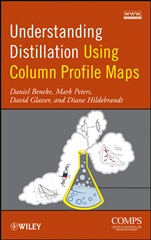
Understanding Distillation Using Column Profile Maps
ISBN 9781118145401
Autor: Daniel Beneke, Mark Peters, David Glasser, Diane Hildebrandt
Wydawca: Wiley
Dostępność: 3-6 tygodni
Cena: 757,05 zł
Przed złożeniem zamówienia prosimy o kontakt mailowy celem potwierdzenia ceny.
ISBN13: |
9781118145401 |
ISBN10: |
1118145402 |
Autor: |
Daniel Beneke, Mark Peters, David Glasser, Diane Hildebrandt |
Oprawa: |
Hardback |
Rok Wydania: |
2013-01-08 |
Ilość stron: |
384 |
Wymiary: |
242x162 |
Tematy: |
PN |
Researchers share their pioneering graphical method for designing almost any distillation structure
Developed by the authors in collaboration with other researchers at the Centre of Material and Process Synthesis, column profile maps (CPMs) enable chemical engineers to design almost any distillation structure using novel graphical techniques. The CPM method offers tremendous advantages over other design methods because it is generalized and not constrained to a particular piece of equipment.
Understanding Distillation Using Column Profile Maps enables readers to understand, analyze, and design distillation structures to solve common distillation problems, including distillation by simple columns, side rectifiers and strippers, multiple feed columns, and fully thermally coupled columns. In addition, the book presents advanced topics such as reactive distillation, membrane permeation, and validation of thermodynamic models. For all these processes, the authors set forth easy–to–follow design techniques, solution strategies, and insights gained using CPMs.
This book offers everything needed to fully understand and use CPMs as a design tool:
Figures help readers understand how to use CPMs as design and optimization tools Examples clearly illustrate how to solve specific problems using CPMs Tutorials allow readers to explore key concepts through experimentation Design and Optimization of Distillation Systems software package, developed for this book, enables readers to reproduce the examples in the book, follow the tutorials, and begin designing their own distillation systemsWith its many examples and step–by–step tutorials, Understanding Distillation Using Column Profile Maps is recommended for students in chemical engineering in advanced undergraduate and graduate courses. The book also provides new practical techniques that can be immediately applied by chemical engineering professionals in industry.
PREFACE xiii
NOMENCLATURE AND ABBREVIATIONS xix
ABOUT THE AUTHORS xxiii
1 INTRODUCTION 1
1.1 Context and Significance 1
1.2 Important Distillation Concepts 4
1.3 Summary 12
2 FUNDAMENTALS OF RESIDUE CURVE MAPS 15
2.1 Introduction 15
2.2 Batch Boiling 16
2.3 The Mass Balance Triangle (MBT) 17
2.4 The Residue Curve Equation 19
2.5 Residue Curve Maps 21
2.6 Properties of Residue Curve Maps 25
2.7 Applicability of RCMs to Continuous Processes 30
2.8 Limitations of RCMs 39
2.9 Residue Curve Maps: The Bigger Picture 40
2.10 Summary 46
3 DERIVATION AND PROPERTIES OF COLUMN PROFILE MAPS 48
3.1 Introduction 48
3.2 The Column Section (CS) 49
3.3 The Difference Point Equation (DPE) 51
3.4 Column Profile Maps 54
3.5 The Effect of CPM Parameters 61
3.6 Properties of Column Profile Maps 67
3.7 Pinch Point Loci 75
3.8 Some Mathematical Aspects of CPMs 80
3.9 Some Insights and Applications of CPMs 84
3.10 Summary 89
4 EXPERIMENTAL MEASUREMENT OF COLUMN PROFILES 91
4.1 Introduction 91
4.2 The Rectifying Column Section 92
4.3 The Stripping Column Section 98
4.4 Validation of Thermodynamic Models 103
4.5 Continuous Column Sections 105
4.6 Summary 114
5 DESIGN OF SIMPLE COLUMNS USING COLUMN PROFILE MAPS 116
5.1 Introduction 116
5.2 Absorbers and Strippers 117
5.3 Simple Column Design 128
5.4 Azeotropic Systems 141
5.5 Constant Relative Volatility Systems 145
5.6 Summary 154
6 DESIGN OF COMPLEX COLUMNS USING COLUMN PROFILE MAPS 157
6.1 Introduction 157
6.2 Distributed Feed Addition 158
6.3 Sidestream Withdrawal 175
6.4 Thermally Coupled Columns: Side Rectifiers and Strippers 184
6.5 Summary 205
7 DESIGN OF FULLY THERMALLY COUPLED COMPLEX COLUMNS USING COLUMN PROFILE MAPS 206
7.1 Introduction 206
7.2 A Simplified Infinite Reflux Case 208
7.3 General Petlyuk Design 216
7.4 Sharp Split Petlyuk Design Using TTs 240
7.5 Insights into Kaibel Column Design 250
7.6 Summary 258
8 REACTIVE DISTILLATION DESIGN USING COLUMN PROFILE MAPS 261
8.1 Introduction 261
8.2 Simple Reactive Distillation 262
8.3 Reactive Column Sections 275
8.4 Summary 293
9 APPLICATION OF COLUMN PROFILE MAPS TO ALTERNATIVE SEPARATION PROCESSES: MEMBRANE PERMEATION 296
9.1 Introduction 296
9.2 Membrane Permeation 297
9.3 Generalized Membrane Column Sections 299
9.4 Theory 299
9.5 MCS Profiles: Total Reflux 304
9.6 Column Section Profiles: Finite Reflux 306
9.7 Conclusions 314
9.8 Example: Design of Hybrid Systems Using Distillation–Membrane Processes 315
10 CONCLUDING REMARKS 328
10.1 Overall Conclusions 328
10.2 Limitations 329
10.3 Extensions and the Way Forward 330
References 330
APPENDIX A: DODS SOFTWARE PACKAGE 331
APPENDIX B: NRTL PARAMETERS AND ANTOINE COEFFICIENTS 345
INDEX 349
DANIEL BENEKE, PhD, is a Process Engineering Consultantfor the Centre of Material and Process Synthesis at the Universityof the Witwatersrand, where he works on process design for liquidfuel processes and separations research.
MARK PETERS, PhD, is a Separations Consultant andResearch Engineer for the Centre of Material and Process Synthesisat the University of the Witwatersrand. He is actively involved inseparations research as well as innovative waste–to–energyprocesses.
DAVID GLASSER, PhD, is Professor of Chemical Engineeringand Director of the Centre of Material and Process Synthesis at theUniversity of the Witwatersrand.
DIANE HILDEBRANDT, PhD, is the SARChI Professor ofSustainable Process Engineering and a Co–Director of the Centre ofMaterial and Process Synthesis at the University of theWitwatersrand.
Koszyk
Książek w koszyku: 0 szt.
Wartość zakupów: 0,00 zł
Informacje


Kontakt
Gambit
Centrum Oprogramowania
i Szkoleń Sp. z o.o.
Al. Pokoju 29b/22-24
31-564 Kraków
Siedziba Księgarni
ul. Kordylewskiego 1
31-542 Kraków
+48 12 410 5991
+48 12 410 5987
+48 12 410 5989
Subskrypcje
Administratorem danych osobowych jest firma Gambit COiS Sp. z o.o. Na podany adres będzie wysyłany wyłącznie biuletyn informacyjny.
Autoryzacja płatności

Informacje na temat autoryzacji płatności poprzez PayU.

© Copyright 2012: GAMBIT COiS Sp. z o.o. Wszelkie prawa zastrzeżone.
Projekt i wykonanie: Alchemia Studio Reklamy