


Wydawcy
Katalog tematyczny
- Archeologia (109)
- Ekonomia, finanse, business (13704)
- Filozofia (1445)
- Historia (3040)
- Języki i językoznawstwo (2356)
- Lifestyle, hobby i rozrywka (475)
- Medycyna (9704)
- Nauki humanistyczne (4)
- Nauki o Ziemi i środowisku (2638)
- Nauki ścisłe (20412)
- Nauki społeczne (8486)
- Nauki techniczne (13450)
- Budownictwo lądowe (1045)
- Chemia przemysłowa (2258)
- Elektronika i telekomunikacja (3287)
- Energetyka (1122)
- Inne nauki stosowane (363)
- Inżynieria biochemiczna (507)
- Inżynieria transportu (232)
- Mechanika i materiały (3316)
- Nauka o środowisku (321)
- Rolnictwo (507)
- Technika, ogólnie (475)
- Prawo (1696)
- Publikacje informacyjne i interdyscyplinarne (1288)
- Religia i wierzenia (917)
- Technika komputerowa (4067)
- Zdrowie, relacje międzyludzkie i rozwój osobisty (657)





Informacje szczegółowe o książce
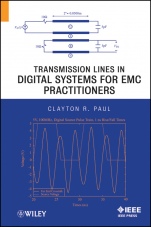
Transmission Lines in Digital Systems for EMC Practitioners
ISBN 9781118143995
Autor: Clayton R. Paul
Wydawca: Wiley
Dostępność: 3-6 tygodni
Cena: 463,05 zł
Przed złożeniem zamówienia prosimy o kontakt mailowy celem potwierdzenia ceny.
ISBN13: |
9781118143995 |
ISBN10: |
111814399X |
Autor: |
Clayton R. Paul |
Oprawa: |
Hardback |
Rok Wydania: |
2011-12-23 |
Ilość stron: |
288 |
Wymiary: |
239x167 |
Tematy: |
TJ |
Learn the new skills needed to work with today′s high–speeddigital electronic systems
Following this text′s clear explanations and examples, EMCpractitioners will quickly master the new transmission lineconcepts and skills needed to analyze and design today′s high–speeddigital electronic systems. The author focuses on moderntransmission lines in which the conductors that interconnect theelectronic modules are "electrically long" (i.e., longer thanone–tenth of a wavelength). Moreover, throughout the text, theauthor explores the increasingly important issues of crosstalk andsystem integrity, helping readers avoid many common pitfalls in theanalysis and design of electronic systems.
Transmission Lines in Digital Systems for EMCPractitioners begins with a discussion of the fundamentalconcepts of waves, wavelength, time delay, and electricaldimensions, and then examines the effect of electrically longconductors on signal integrity. Next, the book explores:
Time domain analysis of two–conductor lines
Frequency domain analysis of two–conductor lines
Crosstalk in three–conductor lines
Approximate inductive–capacitive crosstalk model forelectrically short lines
Exact crosstalk prediction model
Throughout the text, the PSpice program is used as acomputational aid to simulate digital systems and determinecrosstalk and system integrity. A quick PSpice tutorial is providedfor readers who are unfamiliar with the program. The text alsooffers numerous illustrations to help readers visualize complexconcepts and design methods. In addition, experimental results areset forth to verify mathematical results.
Transmission Lines in Digital Systems for EMCPractitioners is an essential guide for students and engineerswho need to keep pace with the growing demand for ever fasterdigital electronic systems.
Preface xi
1 Transmission Lines: Physical Dimensions vs. ElectricDimensions 1
1.1 Waves, Time Delay, Phase Shift, Wavelength, and ElectricalDimensions, 4
1.2 Spectral (Frequency) Content of Digital Waveforms and TheirBandwidths, 10
1.3 The Basic Transmission–Line Problem, 22
2 Time–Domain Analysis of Two–Conductor Lines 31
2.1 The Transverse Electromagnetic Mode of Propagation and theTransmission–Line Equations, 32
2.2 The Per–Unit–Length Parameters, 37
2.2.1 Wire–Type Lines, 37
2.2.2 Lines of Rectangular Cross Section, 47
2.3 The General Solutions for the Line Voltage and Current,50
2.4 Wave Tracing and Reflection Coefficients, 54
2.5 A Simple Alternative to Wave Tracing in the Solution ofTransmission Lines, 60
2.6 The SPICE (PSPICE) Exact Transmission–Line Model, 70
2.7 Lumped–Circuit Approximate Models of the Line, 75
2.8 Effects of Reactive Terminations on Terminal Waveforms,84
2.8.1 Effect of Capacitive Terminations, 85
2.8.2 Effect of Inductive Terminations, 87
2.9 Matching Schemes for Signal Integrity, 89
2.10 Effect of Line Discontinuities, 96
2.11 Driving Multiple Lines, 101
3 Frequency–Domain Analysis of Two–Conductor Lines103
3.1 The Transmission–Line Equations for Sinusoidal Steady–State(Phasor) Excitation of the Line, 104
3.2 The General Solution for the Line Voltages and Currents,105
3.3 The Voltage Reflection Coefficient and Input Impedance ofthe Line, 106
3.4 The Solution for the Terminal Voltages and Currents, 108
3.5 The SPICE Solution, 111
3.6 Voltage and Current as a Function of Position on the Line,112
3.7 Matching and VSWR, 115
3.8 Power Flow on the Line, 117
3.9 Alternative Forms of the Results, 120
3.10 Construction of Microwave Circuit Components UsingTransmission Lines, 120
4 Crosstalk in Three–Conductor Lines 125
4.1 The Multiconductor Transmission–Line Equations, 125
4.2 The MTL Per–Unit–Length Parameters of Inductance andCapacitance, 131
4.2.1 Wide–Separation Approximations for Wires, 135
4.2.2 Numerical Methods, 145
5 The Approximate Inductive Capacitive Crosstalk Model155
5.1 The Inductive Capacitive Coupling Approximate Model,159
5.2 Separation of the Crosstalk into Inductive and CapacitiveCoupling Components, 166
5.3 Common–Impedance Coupling, 172
5.4 Effect of Shielded Wires in Reducing Crosstalk, 173
5.4.1 Experimental Results, 182
5.5 Effect of Shield Pigtails, 183
5.5.1 Experimental Results, 187
5.6 Effect of Multiple Shields, 188
5.6.1 Experimental Results, 188
5.7 Effect of Twisted Pairs of Wires in Reducing Crosstalk,197
5.7.1 Experimental Results, 203
5.8 The Shielded Twisted–Pair Wire: The Best of Both Worlds,209
6 The Exact Crosstalk Prediction Model 211
6.1 Decoupling the Transmission–Line Equations with ModeTransformations, 212
6.2 The SPICE Subcircuit Model, 215
6.3 Lumped–Circuit Approximate Models of the Line, 231
6.4 A Practical Crosstalk Problem, 237
Appendix A Brief Tutorial on Using PSPICE 245
Index 267
CLAYTON R. PAUL, PhD, is Professor and Sam Nunn Eminent Chair in Aerospace Engineering in the Department of Electrical and Computer Engineering at Mercer University. The author of twelve electrical engineering textbooks, he has also published more than 200 technical papers primarily on the electromagnetic compatibility of electronic systems. Dr. Paul is a Fellow of the IEEE and a member of Tau Beta Pi and Eta Kappa Nu.
Koszyk
Książek w koszyku: 0 szt.
Wartość zakupów: 0,00 zł
Informacje


Kontakt
Gambit
Centrum Oprogramowania
i Szkoleń Sp. z o.o.
Al. Pokoju 29b/22-24
31-564 Kraków
Siedziba Księgarni
ul. Kordylewskiego 1
31-542 Kraków
+48 12 410 5991
+48 12 410 5987
+48 12 410 5989
Subskrypcje
Administratorem danych osobowych jest firma Gambit COiS Sp. z o.o. Na podany adres będzie wysyłany wyłącznie biuletyn informacyjny.
Autoryzacja płatności

Informacje na temat autoryzacji płatności poprzez PayU.

© Copyright 2012: GAMBIT COiS Sp. z o.o. Wszelkie prawa zastrzeżone.
Projekt i wykonanie: Alchemia Studio Reklamy