


Wydawcy
Katalog tematyczny
- Archeologia (109)
- Ekonomia, finanse, business (13704)
- Filozofia (1445)
- Historia (3040)
- Języki i językoznawstwo (2356)
- Lifestyle, hobby i rozrywka (475)
- Medycyna (9704)
- Nauki humanistyczne (4)
- Nauki o Ziemi i środowisku (2638)
- Nauki ścisłe (20412)
- Nauki społeczne (8486)
- Nauki techniczne (13450)
- Budownictwo lądowe (1045)
- Chemia przemysłowa (2258)
- Elektronika i telekomunikacja (3287)
- Energetyka (1122)
- Inne nauki stosowane (363)
- Inżynieria biochemiczna (507)
- Inżynieria transportu (232)
- Mechanika i materiały (3316)
- Nauka o środowisku (321)
- Rolnictwo (507)
- Technika, ogólnie (475)
- Prawo (1696)
- Publikacje informacyjne i interdyscyplinarne (1288)
- Religia i wierzenia (917)
- Technika komputerowa (4067)
- Zdrowie, relacje międzyludzkie i rozwój osobisty (657)





Informacje szczegółowe o książce
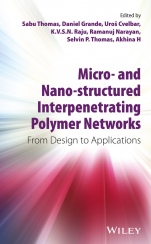
Micro– and Nano–Structured Interpenetrating Polymer Networks: From Design to Applications
ISBN 9781118138175
Autor: Sabu Thomas, Daniel Grande, Uros Cvelbar, K. V. S. N. Raju, Ramanuj Narayan, Selvin P. Thomas, Akhin
Wydawca: Wiley
Dostępność: 3-6 tygodni
Cena: 876,75 zł
Przed złożeniem zamówienia prosimy o kontakt mailowy celem potwierdzenia ceny.
ISBN13: |
9781118138175 |
ISBN10: |
1118138171 |
Autor: |
Sabu Thomas, Daniel Grande, Uros Cvelbar, K. V. S. N. Raju, Ramanuj Narayan, Selvin P. Thomas, Akhin |
Oprawa: |
Hardback |
Rok Wydania: |
2016-05-24 |
Ilość stron: |
432 |
Wymiary: |
235x163 |
Tematy: |
TG |
Among the various multiphase systems, Interpenetrating Polymer Networks (IPNs) have a unique position since the different polymer chains of the components interpenetrate on different length scales, i.e., micro– or nanoscales. Because of this molecular level interpenetration of the different polymer chains, very often IPNs exhibit outstanding properties and stable morphologies. Polymer scientists have shown strong interest in developing nanostructured functional materials, which have enhanced properties as compared to conventional polymeric systems. IPNs, therefore, have garnered much attention due to their unique morphology and physical properties.
Responding to the resulting need for information on IPNs; this book examines their challenges, opportunities and applications. It focuses on the preparation, characterization and properties of IPN systems and emphasizes nano–structured IPN materials. The book carefully examines the preparation of semi–IPNs, full IPNs, porous networks, and various manufacturing techniques.
Micro– and Nano–structured Interpenetrating Polymer Networks covers all types of IPNs including those based on exclusively natural polymers (eco–friendly green IPNs), IPNs based on natural and synthetic polymers, and IPNs based on fully synthetic polymers. The book reviews techniques for characterizing IPNs, including microscopy, spectroscopy, and scattering. There is a separate section on the preparation of micro–, meso– and nano–porous networks from IPN systems and the applications of IPNs are discussed in detail.
With contributions from experts across the globe, this survey is an outstanding resource reference for anyone involved in the field of polymer materials design for advanced technologies.
1 Micro– and Nano–Structured Interpenetrating Polymer Networks: State of the Art, New Challenges and Opportunities
Jose James, George V. Thomas, Akhina H and Sabu Thomas
1.1 Introduction
1.2 Types of IPNs
1.3 Synthesis of IPN
1.3.1. Sequential IPNs
1.3.2. Simultaneous Interpenetrating Networks
1.4 Characterization of IPN
1.4.1. Morphology
1.4.2. Thermal properties
1.4.3 .Mechanical properties
1.4.4. Kinetic properties
1.4.5. Spectroscopic techniques
1.4.6. Visco–elastic measurements of IPN
1.5 Applications of IPNs
1.6 Future trends
References
2 Miscibility, morphology and phase behavior of IPNs
Gaohong He, Xuemei Wu, Xiaoming Yan, Xiangcun Li, Wu Xiao and Xiaobin Jiang
2.1 Introduction
2.2 Miscibility of IPNs
2.1.1 Thermodynamics immiscibility of IPNs
2.1.2 Kinetically forced compatibility of IPNs
2.3 Phase diagram
2.3.1 Types of phase diagrams
2.3.2 Temperature–composition phase diagram
2.3.3 Monomer–polymer phase diagram
2.3.4 Phase continuity diagram
2.4 Morphology of IPNs
2.4.1 Phase separation mechanism
2.4.2 Typical morphologies of IPNs
2.5 Acknowledgments
References
3 Synthetic rubber–based IPNs
Qihua Wang and Shoubing Chen
3.1 Introduction
3.2 Synthetic rubber–based IPNs
3.2.1 The synthesis methods of synthetic rubber–based IPNs
3.2.2 General purpose rubber–based IPNs
3.2.3 Specialty rubber–based IPNs
3.3 Summary and conclusions
3.4 Acknowledgments
References
4 Micro– and nano–structured ipns based on thermosetting resins
Sanja Marinovi , Ivanka Popovic and Branko Dunjic
4.1 Introduction
4.2 Experimental details
4.2.1. Materials
4.2.2. Synthesis of ipns components and sample preparation
4.2.3. Ipns characterization techniques
4.3 Influence of HBP(A) contents in ipns on ipns mechanical properties
4.3.1 Dynamic mechanical analysis (DMA)
4.3.2 Thermogravimetric analysis
4.4 Influence of the reactive diluent in ipns on ipns properties
4.5 Conclusions
References
5 Micro– meso– and nano–porous systems designed from IPNs
Daniel Grande
5.1 Introduction
5.2 Porous Systems Derived from Semi–IPNs
5.2.1 Porous Networks by Selective Degradation of Un–Cross–Linked Chains
5.2.2 Porous Networks by Solvent Extraction of Un–Cross–Linked Chains
5.3 (Nano–)Porous Systems Derived from IPNs
5.3.1 Pioneering studies
5.3.2 Porous Networks by Selective Electron Beam Degradation
5.3.3 Nano–Porous Networks by Selective Hydrolysis
5.4 Conclusions
5.5 Acknowledgements
References
6 Natural rubber–based micro– and nano–structured IPNs
Sa–Ad Riyajan
6.1 Introduction
6.2 Natural rubber
6.2.1 Basic information of NR
6.2.2 Properties
6.2.3 Applications Synthesis of polymer IPN
6.3 Synthesis of polymer IPN
6.4 Preparation of Semi–IPN ENR and PVA
6.5 Properties of IPN made from NR and plastics
6.5.1Swelling behavior and solvent resistance
6.5.2 Mechanical strength
6.5.3 Creep properties
6.5.4 Thermal properties
6.6 Biodegradation
6.7 Possible application
6.8 Conclusion
6.9 Acknowledgement
References
7 Synthesis and applications of IPNs based on smart polymers
Guillermina Burillo, Emilio Bucio and Lorena Garcia–Uriostegui
7.1 Introduction
7.2 Stimuli–responsive polymers
7.3 IPNs and SIPNs
7.4 The synthesis and the applications of SIPNs and IPNs
7.4.1 Sequential SIPNs
7.4.2 The simultaneous method for the synthesis of SIPNs
7.4.3 A comparison of the properties between sequential and simultaneous SIPN films
7.4.4 The SIPNs of sensitive star polymers
7.5 IPNs
7.5.1 IPNs synthesized in one step by the simultaneous method
7.5.2 IPNs synthesized in two steps
7.6 IPNs and SIPNs synthesized by ionizing radiation
7.7 S–IPN and IPNs in the heavy ions immobilization
7.8 The novel architectures of IPNs developed by ionizing radiation polymerization
7.8.1 Polymer–g–IPNs synthesized via irradiation and the addition of a chemical initiator in three steps
7.8.2 Polymer–g– IPNs synthesized only by radiation in three steps
7.9 Conclusions
7.10 Acknowledgments
References
8 Microscopy of IPNs
Rameshwar Adhikari
8.1 Introduction and Overview
8.2 Sample Preparation for Microscopic Analysis
8.2.1 Microtomy and Ultramicrotomy
8.2.2 Staining of Thin Sections
8.2.3 Etching of Surfaces
8.2.4 Fracture Surface Preparation
8.3 Microscopy of Interpenetrating Polymer Networks (IPNs): An Overview
8.4 Morphological Characterization of Polymer Networks
8.4.1 Biomaterials and Biomedical Materials
8.4.2 Porous Networks
8.4.3 Elastomer and Latex Based Networks
8.4.4 Micro– and Nanostructured Materials and Hybrids
8.4.5 IPN–like Systems
8.5 Concluding Notes
Acknowledgements
9. Viscoelastic Properties of Interpenetrating Polymer Networks
Sudipta Goswami
9.1 Introduction
9.2 Viscoelastic properties of Simultaneous IPNS
9.3 Viscoelastic properties of Sequential IPNs
9.4 Overall Summary and future scope
9.5 Conclusion
References
10. Interpenetrating and Semi–Interpenetrating Networks of Polyurethane
Chepuri R.K. Rao, Ramanuj Narayan and K.V.S.N. Raju
10.1 Introduction
10.1.1 Polyurethane–acrylic, epoxy, polyester IPN systems
10.1.2 PU–other polymers
10.1.3 PU–conducting polymers
10.1.4 Applications and concluding remarks
References
11. Solid state NMR and ESR studies of IPNs
Sre ko Vali , M. Andreis and D. Klepac
11.1 Introduction
11.2 Theoretical background
11.2.1 Solid state NMR spectroscopy
11.2.2 ESR spectroscopy
11.3 NMR of IPNs and semi IPNs
11.3.1 Characterization
11.3.2 Structure and Dynamics
11.4 ESR studies of IPNs and semi–IPNs
11.4.1 Nitroxyl radicals in studying IPNs and semi–IPNs
11.4.2 Radicals induced by high energy radiation
11.4.3 Copper(II) ions
11.5 Conclusion
References
12. Diffusion, transport and barrier properties of IPNs
Runcy Wilson, Anil Kumar S, Miran Mozetic, Uro Cvelbar and Sabu Thomas
12.1 Introduction
12.2 Back ground of IPNs
12.3 Transport properties: theoretical and practical aspects
12.4 Transport mechanism
12.5 Sorption and diffusion of solvents
12.6 Gas barrier properties of IPNs
12.7 Pervaporation characteristics of IPNs
12.8 Principles of pervaporation
12.9 Vapour sorption behaviour of IPNs
12.10 Conclusion
12.11 Applications, Challenges, Difficulties and Future Directions
References
13. Ageing of Interpenetrating Polymer Networks
Selvin P. Thomas and Mohammed N Alghamdi
13.1 Introduction
13.2 Ageing of IPNs
13.2.1 Thermal ageing
13.2.2 UV–radiation ageing
13.2.3 Water ageing
13.2.4 Aging by other sources
13.3 Conclusion
References
13. Theoretical modeling and simulation of IPNs
Pratab Bhaskar
14.1 Introduction
14.2. Theoretical Simulations
14.2.1 Quantum Mechanics
14.2.2 Classical Mechanics
14.3. Molecular Dynamics Methods and Theory
14.3.1. Potential Energy Functions
14.3.2. Molecular Mechanics
14.3.3. Integration of Equation of Motion
14.3.4 Statistical Ensembles
14.3.5. Simulation Environment
14.3.6. Amorphous Cells
14.4. Molecular Dynamic Study of Surface/Interface properties of Thermoplastic AIPNs and Organic–Inorganic composite IPNs
14.4.1. Surface Energy of Thermoplastic–AIPNS
14.4.2. Organic– Inorganic Composite IPNs Materials
14.5. Conclusions
References
15. Applications of Interpenetrating Polymer Networks
Chandra P.Sharma and Radhika Raveendran
15.1 Introduction
15.2 What are IPNs?
15.3 Properties of IPNs
15.4 Applications of IPNs
15.4.1 Selective transportation of liquids and gases
15.4.2 Ion exchange membranes
15.4.3 Removal of metal ions
15.4.4 Sound and vibration damping
15.4.5 Other general applications
15.4.6 Biomedical Applications of IPNs
15.5 Conclusion
References
Index
Prof. Dr. Sabu Thomas teaches at Mahatma Gandhi University′s School of Chemical Sciences & Centre for Nanoscience and Nanotechnology.
Dr. Daniel Grande is a CNRS researcher based at the Institut de Chimie et des Matériaux Paris–Est, CNRS–Université Paris XII.
Dr. Uros Cvelbar is a researcher at Slovenia′s Jozef Stefan Institute.
Dr. K.V.S.N. Raju and Dr. Ramanuj Narayan are scientists working with the Indian Institute of Chemical Technology′s Organic Coatings & Polymer Division.
Dr. Selvin Thomas is a professor at King Fahd University of Pteroleum and Minerals in the Department of Chemical Engineering.
Akhina H is
Koszyk
Książek w koszyku: 0 szt.
Wartość zakupów: 0,00 zł
Informacje


Kontakt
Gambit
Centrum Oprogramowania
i Szkoleń Sp. z o.o.
Al. Pokoju 29b/22-24
31-564 Kraków
Siedziba Księgarni
ul. Kordylewskiego 1
31-542 Kraków
+48 12 410 5991
+48 12 410 5987
+48 12 410 5989
Subskrypcje
Administratorem danych osobowych jest firma Gambit COiS Sp. z o.o. Na podany adres będzie wysyłany wyłącznie biuletyn informacyjny.
Autoryzacja płatności

Informacje na temat autoryzacji płatności poprzez PayU.

© Copyright 2012: GAMBIT COiS Sp. z o.o. Wszelkie prawa zastrzeżone.
Projekt i wykonanie: Alchemia Studio Reklamy