


Wydawcy
Katalog tematyczny
- Archeologia (109)
- Ekonomia, finanse, business (13704)
- Filozofia (1445)
- Historia (3040)
- Języki i językoznawstwo (2356)
- Lifestyle, hobby i rozrywka (475)
- Medycyna (9704)
- Nauki humanistyczne (4)
- Nauki o Ziemi i środowisku (2638)
- Nauki ścisłe (20412)
- Nauki społeczne (8486)
- Nauki techniczne (13450)
- Prawo (1696)
- Publikacje informacyjne i interdyscyplinarne (1288)
- Religia i wierzenia (917)
- Technika komputerowa (4067)
- Zdrowie, relacje międzyludzkie i rozwój osobisty (657)





Informacje szczegółowe o książce
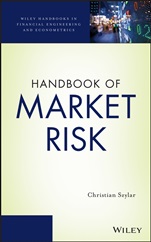
Handbook of Market Risk
ISBN 9781118127186
Autor: Christian Szylar
Wydawca: Wiley
Dostępność: 3-6 tygodni
Cena: 730,80 zł
Przed złożeniem zamówienia prosimy o kontakt mailowy celem potwierdzenia ceny.
ISBN13: |
9781118127186 |
ISBN10: |
1118127188 |
Autor: |
Christian Szylar |
Oprawa: |
Hardback |
Rok Wydania: |
2014-01-21 |
Ilość stron: |
432 |
Wymiary: |
243x156 |
Tematy: |
KF |
Authored by an acknowledged expert in the quantification of market risk, this one–stop guide conveniently and systematically displays all of the financial engineering topics, theories, applications, and current statistical methodologies that are intrinsic to the subject matter. A valuable resource for financial engineers, quantitative analysts, regulators, risk managers, large–scale consultancy groups, insurers, and academics, Handbook of Market Risk is a must–have comprehensive treatment for understanding the market and avoiding financial crises. An editor–maintained web site includes data sets, Excel spreadsheets, and text commentaries on a chapter–by–chapter basis.
PREFACE ACKNOWLEDGEMENTS ABOUT THE AUTHOR INTRODUCTION Chapter 1 Introduction to financial markets 1.1. The money market 1.2. The capital market 1.3. The futures and options market 1.4. The foreign exchange market 1.5. The commodity market Chapter 2 The efficient markets theory 2.1. Assumptions behind a perfectly competitive market 2.2. The efficient market hypothesis 2.3. Critics of efficient markets theory 2.4. Development of behavioural finance 2.5. Beating the market: fundamental versus technical Chapter 3 Return and volatility estimates 3.1. Standard deviation 3.2. Standard deviation with a moving observation window 3.3. Exponentially Weighted Moving Average 3.4. Double (Holt) Exponential Smoothing Model 3.5. Principal Component Analysis (PCA) models 3.6. The VIX 3.7. Geometric Brownian motion process 3.8. GARCH 3.9. Estimator using the highest and lowest Chapter 4 Diversification, portfolio of risky assets and efficient frontier, correlation estimates 4.1. Variance and covariance 4.2. Two asset portfolio: expected return and risk 4.3. Correlation coefficient 4.4. The efficient frontier 4.5. Correlation regime shifts and correlation estimates 4.6. Correlation estimates Chapter 5 The Capital Asset Pricing Model and the Arbitrage Pricing Theory 5.1. Implications of the CAPM assumptions 5.3. The separation theorem 5.4. Relationships defined by the CAPM 5.5. Interpretation of Beta 5.6. Determining the level of diversification of a portfolio 5.7. Investment implications of the CAPM 5.8. Introduction to the Arbitrage Pricing Theory Chapter 6 Market risk and fundamental multi–factors model 6.1. Why a multi–factors model 6.2. The returns model 6.3. Estimation universe 6.4. Model factors 6.5. The risk model Chapter 7 Market Risk: an historical perspective from market events and diverse mathematics to the value–at–risk 7.1. A brief history of market events 7.2. Towards the development of the value–at–risk 7.3. The definition of value–at–risk 7.4. VaR calculation models Chapter 8 Financial derivatives instruments 8.1. Introducing financial derivatives instruments 8.2. Market risk and global exposure 8.3. Options Chapter 9 Fixed income and interest rate risk 9.1. Bond valuation 9.2. The yield curve 9.3. Risk of holding a bond Chapter 10 Liquidity risk 10.1. Traditional methods and techniques to measure liquidity risk 10.2. Liquidity–at–risk 10.3. Other liquidity risk metrics 10.4. Methods to measure liquidity risk on the liability side Chapter 11 Alternatives investment: targeting alpha, idiosyncratic risk 11.1. Passive investing 11.2. Active management 11.3. Main alternative strategies 11.4. Specific hedge funds metrics Chapter 12 Stress testing and back testing 12.1. Definition and introduction to stress testing 12.2. Stress test main approaches 12.3. Historical Stress testing 12.4. Reverse stress test 12.5. Stress testing correlation and volatility 12.6. Multivariate stress testing 12.7. What is back testing? 12.8. Back testing: a rigorous approach is required Chapter 13 Banks and Basel II/III 13.1. A brief history of banking regulations 13.2. The 1988 Basel Accord 13.3. Basel II 13.4. Example of calculation of the Capital Ratio 13.5. Basel III and the new definition of capital, and the introduction of liquidity ratios Conclusion
Koszyk
Książek w koszyku: 0 szt.
Wartość zakupów: 0,00 zł
Informacje


Kontakt
Gambit
Centrum Oprogramowania
i Szkoleń Sp. z o.o.
Al. Pokoju 29b/22-24
31-564 Kraków
Siedziba Księgarni
ul. Kordylewskiego 1
31-542 Kraków
+48 12 410 5991
+48 12 410 5987
+48 12 410 5989
Subskrypcje
Administratorem danych osobowych jest firma Gambit COiS Sp. z o.o. Na podany adres będzie wysyłany wyłącznie biuletyn informacyjny.
Autoryzacja płatności

Informacje na temat autoryzacji płatności poprzez PayU.

© Copyright 2012: GAMBIT COiS Sp. z o.o. Wszelkie prawa zastrzeżone.
Projekt i wykonanie: Alchemia Studio Reklamy