


Wydawcy
Katalog tematyczny
- Archeologia (109)
- Ekonomia, finanse, business (13704)
- Filozofia (1445)
- Historia (3040)
- Języki i językoznawstwo (2356)
- Lifestyle, hobby i rozrywka (475)
- Medycyna (9704)
- Nauki humanistyczne (4)
- Nauki o Ziemi i środowisku (2638)
- Nauki ścisłe (20412)
- Nauki społeczne (8486)
- Nauki techniczne (13450)
- Budownictwo lądowe (1045)
- Chemia przemysłowa (2258)
- Elektronika i telekomunikacja (3287)
- Energetyka (1122)
- Inne nauki stosowane (363)
- Inżynieria biochemiczna (507)
- Inżynieria transportu (232)
- Mechanika i materiały (3316)
- Nauka o środowisku (321)
- Rolnictwo (507)
- Technika, ogólnie (475)
- Prawo (1696)
- Publikacje informacyjne i interdyscyplinarne (1288)
- Religia i wierzenia (917)
- Technika komputerowa (4067)
- Zdrowie, relacje międzyludzkie i rozwój osobisty (657)



Informacje szczegółowe o książce
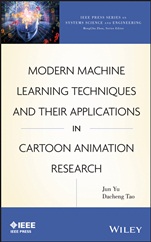
Modern Machine Learning Techniques and Their Applications in Cartoon Animation Research
ISBN 9781118115145
Autor: Jun Yu, Dacheng Tao
Wydawca: Wiley
Dostępność: 3-6 tygodni
Cena: 468,30 zł
Przed złożeniem zamówienia prosimy o kontakt mailowy celem potwierdzenia ceny.
ISBN13: |
9781118115145 |
ISBN10: |
1118115147 |
Autor: |
Jun Yu, Dacheng Tao |
Oprawa: |
Hardback |
Rok Wydania: |
2013-04-26 |
Ilość stron: |
208 |
Wymiary: |
242x155 |
Tematy: |
TJ |
Helps readers learn the latest machine learning techniquesand presents their applications in cartoon animationresearch
Machine learning techniques have been widely used in many fieldsincluding machine perception, computer vision, natural languageprocessing, syntactic pattern recognition, and search engines.Recently, many modern techniques have been proposed in machinelearning and the integration of these techniques and cartoonanimation research is fast becoming a hot topic.
This book helps readers learn the latest machine learningtechniques, including patch alignment framework; spectralclustering, graph cuts, and convex relaxation; ensemble manifoldlearning; multiple kernel learning; multiview subspace learning;and multiview distance metric learning. It then presents theapplications of these modern machine learning techniques in cartoonanimation research. With these techniques, users can efficientlyutilize the cartoon materials to generate animations in areas suchas virtual reality, video games, animation films, and sportsimulations.
Modern Machine Learning Techniques and Their Applications inCartoon Animation Research covers:
Manifold, semisupervised, and multiview learning Example–based motion reuse Crowd and facial animation Discriminative locality alignment Spectral clustering and graph cut SVM with multiple unweighted sum kernels Hypothesis space selection Cartoon texture and reuse systems for animation synthesis Video clip reuse Stroke correspondence construction via stroke Cartoon character extraction Skeleton feature Cartoon clip synthesisPreface xi
1 Introduction 1
1.1 Perception 2
1.2 Overview of Machine Learning Techniques 2
1.2.1 Manifold Learning 3
1.2.2 Semi–supervised Learning 5
1.2.3 Multiview Learning 8
1.2.4 Learning–based Optimization 9
1.3 Recent Developments in Computer Animation 11
1.3.1 Example–Based Motion Reuse 11
1.3.2 Physically Based Computer Animation 26
1.3.3 Computer–Assisted Cartoon Animation 33
1.3.4 Crowd Animation 42
1.3.5 Facial Animation 51
1.4 Chapter Summary 60
2 Modern Machine Learning Techniques 63
2.1 A Unified Framework for Manifold Learning 65
2.1.1 Framework Introduction 65
2.1.2 Various Manifold Learning Algorithm Unifying 67
2.1.3 Discriminative Locality Alignment 69
2.1.4 Discussions 71
2.2 Spectral Clustering and Graph Cut 71
2.2.1 Spectral Clustering 72
2.2.2 Graph Cut Approximation 76
2.3 Ensemble Manifold Learning 81
2.3.1 Motivation for EMR 81
2.3.2 Overview of EMR 81
2.3.3 Applications of EMR 84
2.4 Multiple Kernel Learning 86
2.4.1 A Unified Mulitple Kernel Learning Framework 87
2.4.2 SVM with Multiple Unweighted–Sum Kernels 89
2.4.3 QCQP Multiple Kernel Learning 89
2.5 Multiview Subspace Learning 90
2.5.1 Approach Overview 90
2.5.2 Techinique Details 90
2.5.3 Alternative Optimization Used in PA–MSL 93
2.6 Multiview Distance Metric Learning 94
2.6.1 Motivation for MDML 94
2.6.2 Graph–Based Semi–supervised Learning 95
2.6.3 Overview of MDML 95
2.7 Multi–task Learning 98
2.7.1 Introduction of Structural Learning 99
2.7.2 Hypothesis Space Selection 100
2.7.3 Algorithm for Multi–task Learning 101
2.7.4 Solution by Alternative Optimization 102
2.8 Chapter Summary 103
3 Animation Research: A Brief Introduction 105
3.1 Traditional Animation Production 107
3.1.1 History of Traditional Animation Production 107
3.1.2 Procedures of Animation Production 108
3.1.3 Relationship Between Traditional Animation and Computer Animation 109
3.2 Computer–Assisted Systems 110
3.2.1 Computer Animation Techniques 111
3.3 Cartoon Reuse Systems for Animation Synthesis 117
3.3.1 Cartoon Texture for Animation Synthesis 118
3.3.2 Cartoon Motion Reuse 120
3.3.3 Motion Capture Data Reuse in Cartoon Characters 122
3.4 Graphical Materials Reuse: More Examples 124
3.4.1 Video Clips Reuse 124
3.4.2 Motion Captured Data Reuse by Motion Texture 126
3.4.3 Motion Capture Data Reuse by Motion Graph 127
3.5 Chapter Summary 129
4 Animation Research: Modern Techniques 131
4.1 Automatic Cartoon Generation with Correspondence Construction 131
4.1.1 Related Work in Correspondence Construction 132
4.1.2 Introduction of the Semi–supervised Correspondence Construction 133
4.1.3 Stroke Correspondence Construction via Stroke Reconstruction Algorithm 138
4.1.4 Simulation Results 141
4.2 Cartoon Characters Represented by Multiple Features 146
4.2.1 Cartoon Character Extraction 147
4.2.2 Color Histogram 148
4.2.3 Hausdorff Edge Feature 148
4.2.4 Motion Feature 150
4.2.5 Skeleton Feature 151
4.2.6 Complementary Characteristics of Multiview Features 153
4.3 Graph–based Cartoon Clips Synthesis 154
4.3.1 Graph Model Construction 155
4.3.2 Distance Calculation 155
4.3.3 Simulation Results 156
4.4 Retrieval–based Cartoon Clips Synthesis 161
4.4.1 Constrained Spreading Activation Network 162
4.4.2 Semi–supervised Multiview Subspace Learning 165
4.4.3 Simulation Results 168
4.5 Chapter Summary 173
References 174
Index 195
JUN YU, PhD, is an Associate Professor in the ComputerScience Department, School of Information Science and Engineering,Xiamen University, Xiamen, China. His current research interestsinclude computer graphics, computer visions, and machine learning.He has authored or coauthored more than thirty scientific articlesin journals including IEEE T–IP, IEEE TSMC–B, and PatternRecognition.
DACHENG TAO, PhD, is Professor of Computer Science withthe Centre for Quantum Computation & Intelligent Systems andthe Faculty of Engineering & Information Technology, Universityof Technology, Sydney, Australia. His research applies statisticsand mathematics to data analysis problems in computer vision, datamining, machine learning, multimedia, and video surveillance. Hehas authored more than 100 scientific articles.
Koszyk
Książek w koszyku: 0 szt.
Wartość zakupów: 0,00 zł
Informacje


Kontakt
Gambit
Centrum Oprogramowania
i Szkoleń Sp. z o.o.
Al. Pokoju 29b/22-24
31-564 Kraków
Siedziba Księgarni
ul. Kordylewskiego 1
31-542 Kraków
+48 12 410 5991
+48 12 410 5987
+48 12 410 5989
Subskrypcje
Administratorem danych osobowych jest firma Gambit COiS Sp. z o.o. Na podany adres będzie wysyłany wyłącznie biuletyn informacyjny.
Autoryzacja płatności

Informacje na temat autoryzacji płatności poprzez PayU.

© Copyright 2012: GAMBIT COiS Sp. z o.o. Wszelkie prawa zastrzeżone.
Projekt i wykonanie: Alchemia Studio Reklamy