


Wydawcy
Katalog tematyczny
- Archeologia (109)
- Ekonomia, finanse, business (13704)
- Filozofia (1445)
- Historia (3040)
- Języki i językoznawstwo (2356)
- Lifestyle, hobby i rozrywka (475)
- Medycyna (9704)
- Chirurgia (272)
- Inne gałęzie medycyny (1871)
- Medycyna kliniczna (4187)
- Choroby wewnętrzne (514)
- Dermatologia (51)
- Diagnostyka medyczna (3)
- Endokrynologia (144)
- Gastroenterologia (27)
- Geriatria (50)
- Ginekologia i położnictwo (134)
- Hematologia (46)
- Hepatologia (10)
- Kardiologia (71)
- Laryngologia (12)
- Nefrologia (10)
- Neurologia (500)
- Oftalmologia (50)
- Pediatria (33)
- Pulmunologia (32)
- Reumatologia (14)
- Terapia genowa (1)
- Układ mięśniowo-szkieletowy (1)
- Urologia (14)
- Medycyna niekonwencjonalna (14)
- Medycyna przedkliniczna (269)
- Medycyna, ogólnie (1740)
- Medyczne służby pomocnicze (745)
- Studia medyczne (16)
- Weterynaria (548)
- Nauki humanistyczne (4)
- Nauki o Ziemi i środowisku (2638)
- Nauki ścisłe (20412)
- Nauki społeczne (8486)
- Nauki techniczne (13450)
- Prawo (1696)
- Publikacje informacyjne i interdyscyplinarne (1288)
- Religia i wierzenia (917)
- Technika komputerowa (4067)
- Zdrowie, relacje międzyludzkie i rozwój osobisty (657)





Informacje szczegółowe o książce
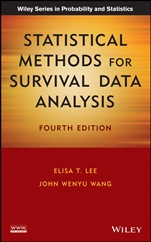
Statistical Methods for Survival Data Analysis
ISBN 9781118095027
Autor: Elisa T. Lee, John Wenyu Wang
Wydawca: Wiley
Dostępność: 3-6 tygodni
Cena: 619,50 zł
Przed złożeniem zamówienia prosimy o kontakt mailowy celem potwierdzenia ceny.
ISBN13: |
9781118095027 |
ISBN10: |
1118095022 |
Autor: |
Elisa T. Lee, John Wenyu Wang |
Oprawa: |
Hardback |
Rok Wydania: |
2013-11-19 |
Numer Wydania: |
4th Edition |
Ilość stron: |
512 |
Wymiary: |
229x152 |
Tematy: |
MJ |
Praise for the Third Edition ". . . an easy-to read introduction to survival analysis which covers the major concepts and techniques of the subject." Statistics in Medical Research Updated and expanded to reflect the latest developments, Statistical Methods for Survival Data Analysis, Fourth Edition continues to deliver a comprehensive introduction to the most commonly-used methods for analyzing survival data. Authored by a uniquely well-qualified author team, the Fourth Edition is a critically acclaimed guide to statistical methods with applications in clinical trials, epidemiology, areas of business, and the social sciences. The book features many real-world examples to illustrate applications within these various fields, although special consideration is given to the study of survival data in biomedical sciences. Emphasizing the latest research and providing the most up-to-date information regarding software applications in the field, Statistical Methods for Survival Data Analysis, Fourth Edition also includes: Marginal and random effect models for analyzing correlated censored or uncensored data Multiple types of two-sample and K-sample comparison analysis Updated treatment of parametric methods for regression model fitting with a new focus on accelerated failure time models Expanded coverage of the Cox proportional hazards model Exercises at the end of each chapter to deepen knowledge of the presented material Statistical Methods for Survival Data Analysis is an ideal text for upper-undergraduate and graduate-level courses on survival data analysis. The book is also an excellent resource for biomedical investigators, statisticians, and epidemiologists, as well as researchers in every field in which the analysis of survival data plays a role.
Preface Chapter 1 Introduction 1.1 Preliminaries 1.2 Censored Data 1.3 Scope of the Book Chapter 2 Functions of Survival Time 2.1 Definitions 2.2 Relationships of the Survival Functions Exercises Chapter 3 Examples of Survival Data Analysis 3.1 Example 3.1: Comparison of Two Treatments and Three Diets 3.2 Example 3.2: Comparison of Two Survival Patterns Using Life Tables 3.3 Example 3.3: Fitting Survival Distributions to Tumor Free Times 3.4 Example 3.4: Comparing Survival of A Cohort With That Of A General population – Relative Survival 3.5 Example 3.5: Identification of Risk Factors For Incident Events 3.6 Example 3.6: Identification of Risk Factors for the Prevalence of Age–Related Macular Degeneration 3.7 Example 3.7: Identification of Significant Risk Factors For Incident Hypertension Using Related Data (Repeated Measurements) In A Longitudinal Study Exercises Chapter 4 Nonparametric Methods of Estimating Survival Functions 4.1 Product–Limit Estimates of Survivorship Function 4.2 Nelson–Aalen Estimates Of Survivorship Function 4.3 Life–Table Analysis 4.4 Relative Survival Rates 4.5 Standardized Rates and Ratios Exercises Chapter 5 Nonparametric Methods for Comparing Survival Distributions 5.1 Comparison of Two Survival Distributions 5.2 The Mantel and Haenszel Test 5.3 Comparison of K ( K >2) Samples Exercises Chapter 6 Some Well–Known Parametric Survival Distribution and Their Applications 6.1 The Exponential Distribution 6.2 The Weibull Distribution 6.3 The Lognormal Distribution 6.4 Gamma, Generalized Gamma And Extended Generalized Gamma Distributions 6.5 The Log–Logistic Distribution 6.6 Other survival Distributions Exercises Chapter 7 Estimation Procedures for Parametric Survival Distributions Without Covariates 7.1 General Maximum Likelihood Estimation Procedures 7.2 The Exponential Distribution 7.3 The Weibull Distribution 7.4 The Lognormal Distribution 7.5 The Extended Generalized Gamma Distribution 7.6 The Log–Logistic Distribution 7.7 Gompertz Distribution 7.8 Graphical Methods Exercises Chapter 8 Tests of Goodness–of–Fit and Distribution Selection 8.1 Goodness–of–Fit Test Statistics Based on Asymptotic Likelihood Inference 8.2 Tests for Appropriateness of a Family of Distributions 8.3 Selection of A Family of Distributions By Using BIC or AIC Procedure 8.4 Tests For A Specific Distribution With Known Parameters 8.5 Hollander and Proschan’s Test for Appropriateness of a Given Distribution with Known Parameters Exercises Chapter 9 Parametric Methods for Comparing Two Survival Distributions 9.1 Log–Likelihood Ratio Test for Comparing Two Survival Distributions 9.2 Comparison of Two Exponential Distributions 9.3 Comparison of Two Weibull Distributions 9.4 Comparison of Two Gamma Distributions Exercises Chapter 10 Parametric Methods for Regression Model Fitting and Identification of Prognostic Factors 10.1 Preliminary Examination of Data 10.2 General Structure of Parametric Regression Models and Their Asymptotic Likelihood Inference 40.3 The Exponential AFT Model 10.4 The Weibull AFT Model 10.5 The Lognormal AFT Model 10.6 The Extended Generalized Gamma AFT Model 10.7 The Log–logistic AFT Model 10.8 Other Parametrical Regression Models 10.9 Model Selection Methods Exercises Chapter 11 Identification of Risk Factors Related to Survival Time: Cox Proportional Hazards Model 11.1 The Proportional Hazards Model 11.2 Partial Likelihood Function 11.3 Identification of Significant Covariates 11.4 Estimation of the Survivorship Function with Covariates 11.5 Adequacy assessment of the Proportional Hazards Model Exercises Chapter 12 Identification of Prognostic Factors Related to Survival Time: Non–Proportional Hazards Models 12.1 Models with Time–Dependent Covariates 12.2 Stratified Proportional Hazards Models 12.3 Competing Risks Model 12.4 Recurrent Event Models 12.5 Models for Related Observations Exercises Chapter 13 Identification of Risk Factors Related to Dichotomous and Polychotomous Outcomes 13.1 Univariate Analysis 13.2 Logistic, Conditional Logistic, and Other Regression Models For Dichotomous Outcomes 13.3 Models for Polychotomous Outcomes 13.4 Models for Related Observations Exercises Appendix Statistical Tables References
ELISA T. LEE, PhD, is Regents Professor and George Lynn Cross Research Professor of Biostatistics and Epidemiology and Director of the Center for American Indian Health Research at the University of Oklahoma Health Sciences Center. JOHN Wenyu WANG, PhD, is Professor of Research at the Center for American Indian Health Research at the University of Oklahoma Health Sciences Center.
Koszyk
Książek w koszyku: 0 szt.
Wartość zakupów: 0,00 zł
Informacje


Kontakt
Gambit
Centrum Oprogramowania
i Szkoleń Sp. z o.o.
Al. Pokoju 29b/22-24
31-564 Kraków
Siedziba Księgarni
ul. Kordylewskiego 1
31-542 Kraków
+48 12 410 5991
+48 12 410 5987
+48 12 410 5989
Subskrypcje
Administratorem danych osobowych jest firma Gambit COiS Sp. z o.o. Na podany adres będzie wysyłany wyłącznie biuletyn informacyjny.
Autoryzacja płatności

Informacje na temat autoryzacji płatności poprzez PayU.

© Copyright 2012: GAMBIT COiS Sp. z o.o. Wszelkie prawa zastrzeżone.
Projekt i wykonanie: Alchemia Studio Reklamy