


Wydawcy
Katalog tematyczny
- Archeologia (109)
- Ekonomia, finanse, business (13704)
- Filozofia (1445)
- Historia (3040)
- Języki i językoznawstwo (2356)
- Lifestyle, hobby i rozrywka (475)
- Medycyna (9704)
- Nauki humanistyczne (4)
- Nauki o Ziemi i środowisku (2638)
- Nauki ścisłe (20412)
- Nauki społeczne (8486)
- Nauki techniczne (13450)
- Prawo (1696)
- Publikacje informacyjne i interdyscyplinarne (1288)
- Religia i wierzenia (917)
- Technika komputerowa (4067)
- Zdrowie, relacje międzyludzkie i rozwój osobisty (657)





Informacje szczegółowe o książce
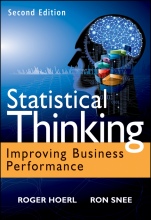
Statistical Thinking: Improving Business Performance
ISBN 9781118094778
Autor: Roger W. Hoerl, Ronald D. Snee
Wydawca: Wiley
Dostępność: 3-6 tygodni
Cena: 611,10 zł
Przed złożeniem zamówienia prosimy o kontakt mailowy celem potwierdzenia ceny.
ISBN13: |
9781118094778 |
ISBN10: |
1118094778 |
Autor: |
Roger W. Hoerl, Ronald D. Snee |
Oprawa: |
Hardback |
Rok Wydania: |
2012-04-27 |
Numer Wydania: |
2nd Edition |
Ilość stron: |
544 |
Wymiary: |
263x179 |
Tematy: |
KM |
"Probably the most practical basic statistics textbook that has ever been written within a business context." Technometrics
Develop your capacity to apply statistical thinking to enhance business processes with the straightforward and insightful guidance found in Statistical Thinking: Improving Business Performance, Second Edition.
Offering a solid and well–organized foundation, authors and business statistics specialists Roger Hoerl and Ron Snee show you how to successfully derive actionable conclusions from data analysis, solve real problems, and streamline real processes.
Filled with realistic, step–by–step case study examples, the new edition explores:
Today′s business realities and the need to improve
The dynamic nature of business processes
Process improvement and problem–solving tools
Building models with one or several predictor variables
Using process experimentation to build models
The process of applying statistical inference
With an in–depth discussion of JMP® software, Statistical Thinking, Second Edition focuses on skills to enrich business processes, including collecting data appropriate for a specified purpose, recognizing limitations in existing data, and understanding the limitations of statistical analyses.
Preface xiii
Introduction to JMP xvii
Part One Statistical Thinking Concepts 1
Chapter 1 Need for Business Improvement 3
Today s Business Realities and the Need to Improve 4
We Now Have Two Jobs: A Model for Business Improvement 7
New Management Approaches Require Statistical Thinking 10
Principles of Statistical Thinking 15
Applications of Statistical Thinking 18
Summary 20
Notes 20
Chapter 2 Statistical Thinking Strategy 23
Case Study: The Effect of Advertising on Sales 24
Case Study: Improvement of a Soccer Team s Performance 30
Statistical Thinking Strategy 39
Context of Statistical Thinking: Statistics Discipline as a System 43
Variation in Business Processes 45
Synergy between Data and Subject Matter Knowledge 50
Dynamic Nature of Business Processes 51
Summary 53
Project Update 53
Notes 54
Chapter 3 Understanding Business Processes 55
Examples of Business Processes 56
SIPOC Model for Processes 62
Identifying Business Processes 64
Analysis of Business Processes 65
Systems of Processes 79
Measurement Process 82
Summary 87
Project Update 88
Notes 89
Part Two Statistical Engineering: Frameworks and Basic Tools 91
Chapter 4 Statistical Engineering: Tactics to Deploy Statistical Thinking 93
Statistical Engineering 94
Case Study: Reducing Resin Output Variation 95
Case Study: Reducing Telephone Waiting Time at a Bank 101
Basic Process Improvement Framework 105
Case Study: Resolving Customer Complaints of Baby Wipe Flushability 111
Case Study: The Realized Revenue Fiasco 117
Basic Problem–Solving Framework 123
DMAIC Framework 128
DMAIC Case Study: Newspaper Accuracy 130
Summary 137
Project Update 137
Notes 138
Chapter 5 Process Improvement and Problem–Solving Tools 139
Stratification 141
Data Collection Tools 142
Basic Graphical Analysis Tools 156
Knowledge–Based Tools 172
Process Stability and Capability Tools 205
Summary 226
Project Update 227
Notes 227
Part Three Formal Statistical Methods 229
Chapter 6 Building and Using Models 231
Examples of Business Models 232
Types and Uses of Models 235
Regression Modeling Process 238
Building Models with One Predictor Variable 246
Building Models with Several Predictor Variables 254
Multicollinearity: Another Model Check 261
Some Limitations of Using Existing Data 264
Summary 265
Project Update 267
Notes 267
Chapter 7 Using Process Experimentation to Build Models 269
Why Do We Need a Statistical Approach? 270
Examples of Process Experiments 273
Statistical Approach to Experimentation 279
Two–Factor Experiments: A Case Study 286
Three–Factor Experiments: A Case Study 292
Larger Experiments 299
Blocking, Randomization, and Center Points 301
Summary 303
Project Update 304
Notes 305
Chapter 8 Applications of Statistical Inference Tools 307
Examples of Statistical Inference Tools 310
Process of Applying Statistical Inference 314
Statistical Confidence and Prediction Intervals 317
Statistical Hypothesis Tests 330
Tests for Continuous Data 339
Test for Discrete Data: Comparing Two or More Proportions 344
Test for Regression Analysis: Test on a Regression Coefficient 345
Sample Size Formulas 346
Summary 352
Project Update 353
Notes 353
Chapter 9 Underlying Theory of Statistical Inference 355
Applications of the Theory 356
Theoretical Framework of Statistical Inference 358
Types of Data 363
Probability Distributions 366
Sampling Distributions 382
Linear Combinations 389
Transformations 392
Summary 411
Project Update 411
Notes 412
Chapter 10 Summary and Path Forward 413
A Personal Case Study by Tom Pohlen 414
Review of the Statistical Thinking Approach 420
Text Summary 422
Potential Next Steps to Deeper Understanding of Statistical Thinking 425
Project Summary and Debriefing 427
Notes 427
Appendix A Effective Teamwork 429
Appendix B Presentations and Report Writing 439
Appendix C More on Surveys 445
Appendix D More on Regression 453
Appendix E More on Design of Experiments 467
Appendix F More on Inference Tools 479
Appendix G More on Probability Distributions 483
Appendix H Process Design (Reengineering) 491
Appendix I t Critical Values 497
Appendix J Standard Normal Probabilities (Cumulative z Curve Areas) 499
Index 503
ROGER HOERL leads the Applied Statistics Laboratory at GE Global Research, which focuses on new product and service development within each of the GE businesses. In 2006, he received the Coolidge Fellowship from GE Global Research, honoring one scientist a year from among the four global GE Research and Development sites for lifetime technical achievement. Dr. Hoerl has authored five books in the areas of statistics and business improvement, two book chapters, and over thirty–five refereed journal articles.
RON SNEE is founder and President of Snee Associates, an authority on designing and implementing improvement and cost reduction solutions for a variety of organizational environments. Dr. Snee has an outstanding record of leadership in process and organizational improvement in a variety of industries including pharmaceutical, biotech, clinical diagnostics, and telecommunications. Among his other achievements, he is credited with leading the design of the first company–wide continuous improvement curriculum for the global giant E. I. DuPont de Nemours. He holds a host of awards and honors, has coauthored four books, and published more than 200 articles on process improvement, quality, management, and statistics.
Koszyk
Książek w koszyku: 0 szt.
Wartość zakupów: 0,00 zł
Informacje


Kontakt
Gambit
Centrum Oprogramowania
i Szkoleń Sp. z o.o.
Al. Pokoju 29b/22-24
31-564 Kraków
Siedziba Księgarni
ul. Kordylewskiego 1
31-542 Kraków
+48 12 410 5991
+48 12 410 5987
+48 12 410 5989
Subskrypcje
Administratorem danych osobowych jest firma Gambit COiS Sp. z o.o. Na podany adres będzie wysyłany wyłącznie biuletyn informacyjny.
Autoryzacja płatności

Informacje na temat autoryzacji płatności poprzez PayU.

© Copyright 2012: GAMBIT COiS Sp. z o.o. Wszelkie prawa zastrzeżone.
Projekt i wykonanie: Alchemia Studio Reklamy