


Wydawcy
Katalog tematyczny
- Archeologia (109)
- Ekonomia, finanse, business (13704)
- Filozofia (1445)
- Historia (3040)
- Języki i językoznawstwo (2356)
- Lifestyle, hobby i rozrywka (475)
- Medycyna (9704)
- Nauki humanistyczne (4)
- Nauki o Ziemi i środowisku (2638)
- Nauki ścisłe (20412)
- Nauki społeczne (8486)
- Nauki techniczne (13450)
- Budownictwo lądowe (1045)
- Chemia przemysłowa (2258)
- Elektronika i telekomunikacja (3287)
- Energetyka (1122)
- Inne nauki stosowane (363)
- Inżynieria biochemiczna (507)
- Inżynieria transportu (232)
- Mechanika i materiały (3316)
- Nauka o środowisku (321)
- Rolnictwo (507)
- Technika, ogólnie (475)
- Prawo (1696)
- Publikacje informacyjne i interdyscyplinarne (1288)
- Religia i wierzenia (917)
- Technika komputerowa (4067)
- Zdrowie, relacje międzyludzkie i rozwój osobisty (657)





Informacje szczegółowe o książce
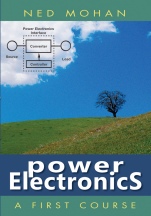
Power Electronics: A First Course
ISBN 9781118074800
Autor: Ned Mohan
Wydawca: Wiley
Dostępność: 3-6 tygodni
Cena: 849,45 zł
Przed złożeniem zamówienia prosimy o kontakt mailowy celem potwierdzenia ceny.
ISBN13: |
9781118074800 |
ISBN10: |
1118074807 |
Autor: |
Ned Mohan |
Oprawa: |
Hardback |
Rok Wydania: |
2011-11-18 |
Ilość stron: |
288 |
Wymiary: |
267x177 |
Tematy: |
TJ |
Author Ned Mohan has been a leader in EES education and research for decades. His three–book series on Power Electronics focuses on three essential topics in the power sequence based on applications relevant to this age of sustainable energy such as wind turbines and hybrid electric vehicles. The three topics include power electronics, power systems and electric machines.
Key features in the first Edition build on Mohan′s successful MNPERE texts; his systems approach which puts dry technical detail in the context of applications; and substantial pedagogical support including PPT′s, video clips, animations, clicker questions and a lab manual. It follows a top–down systems–level approach to power electronics to highlight interrelationships between these sub–fields. It′s intended to cover fundamental and practical design. This book also follows a building–block approach to power electronics that allows an in–depth discussion of several important topics that are usually left. Topics are carefully sequenced to maintain continuity and interest.
Spis treści:
PREFACE xiii
CHAPTER 1 POWER ELECTRONICS: AN ENABLING TECHNOLOGY 1
1.1 Introduction to Power Electronics 1
1.2 Applications and the Role of Power Electronics 2
1.3 Energy and the Environment 4
1.4 Need for High Efficiency and High Power Density 8
1.5 Structure of Power Electronics Interface 9
1.6 Voltage–Link–Structure 11
1.7 Recent and Potential Advancements 16
References 16
Problems 16
CHAPTER 2 DESIGN OF SWITCHING POWER–POLES 21
2.1 Power Transistors and Power Diodes 21
2.2 Selection of Power Transistors 22
2.3 Selection of Power Diodes 24
2.4 Switching Characteristics and Power Losses in
Power–Poles 25
2.5 Justifying Switches and Diodes as ideal 30
2.6 Design Considerations 30
2.7 The PWM IC 33
References 33
Problems 34
Appendi
x 2A Diode Reverse–Recovery and power losses 35
CHAPTER 3 SWITCH–MODE DC–DC CONVERTERS: SWITCHING ANALYSIS, TOPOLOGY SELECTION AND DESIGN 38
3.1 DC–DC Converters 38
3.2 Switching Power–Pole in DC Steady State 38
3.3 Simplifying Assumptions 42
3.4 Common Operating Principles 43
3.5 Buck Converter Switching Analysis in DC Steady State 43
3.6 Boost Converter Switching Analysis in DC Steady State 45
3.7 Buck–Boost Converter Analysis in DC Steady State 50
3.8 Topology Selection 56
3.9 Worst–Case Design 57
3.10 Synchronous–Rectified Buck Converter for Very Low Output Voltages 57
3.11 Interleaving of Converters 58
3.12 Regulation of DC–DC Converters by PWM 58
3.13 Dynamic Average Representation of Converters in CCM 59
3.14 Bi–Directional Switching Power–Pole 61
3.15 Discontinuous–Conduction Mode (DCM) 62
References 68
Problems 68
Appendix A on the accompanying
CHAPTER 4 DESIGNING FEEDBACK CONTROLLERS IN SWITCH–MODE DC POWER SUPPLIES 74
4.1 Introduction and Objectives of Feedback Control 74
4.2 Review of Linear Control Theory 75
4.3 Linearization of Various Transfer Function Blocks 77
4.4 Feedback Controller Design in Voltage–Mode Control 83
4.5 Peak–Current Mode Control 86
4.6 Feedback Controller Design in DCM 91
References 93
Problems 93
Appendix 4A Bode Plots of Transfer Functions with
Poles and Zeros 94
Appendix 4B Transfer Functions in Continuous
Conduction Mode (CCM)
(on accompanying website) 97
Appendix 4C Derivation of Parameters of the
Controller Transfer Functions
(on accompanying website) 97
CHAPTER 5 RECTIFICATION OF UTILITY INPUT USING DIODE RECTIFIERS 98
5.1 Introduction 98
5.2 Distortion and Power Factor 99
5.3 Classifying the “Front–End” of Power Electronic Systems 107
5.4 Diode–Rectifier Bridge “F
ront–Ends” 107
5.5 Means to Avoid Transient Inrush Currents at
Starting 113
5.6 Front–Ends with Bi–Directional Power Flow 114
References 114
Problems 114
CHAPTER 6 POWER–FACTOR–CORRECTION (PFC) CIRCUITS AND DESIGNING THE FEEDBACK CONTROLLER 116
6.1 Introduction 116
6.2 Operating Principle of Single–Phase PFCs 116
6.3 Control of PFCs 120
6.4 Designing the Inner Average–Current–Control Loop 120
6.5 Designing the Outer Voltage–Control Loop 122
6.6 Example of Single–Phase PFC Systems 124
6.7 Simulation Results 126
6.8 Feedforward of the Input Voltage 127
6.9 Other Control Methods for PFCs 127
References 127
Problems 127
Appendix 6A Proving that
Appendix 6B Proving that
1þsðR=2ÞC 129
CHAPTER 7 MAGNETIC CIRCUIT CONCEPTS 130
7.1 Ampere–Turns and Flux 130
7.2 Inductance L 131
7.3 Faraday’s Law: Induced Voltage in a Coil Due to
Time–Rate of Change of Flux Linkage 133
7.4 Leakage and Magnetizing Inductances 134
7.5 Transformers 136
Reference 139
Problems 139
CHAPTER 8 SWITCH–MODE DC POWER SUPPLIES 141
8.1 Applications of Switch–Mode DC Power Supplies 141
8.2 Need for Electrical Isolation 142
8.3 Classification of Transformer–Isolated DC–DC Converters 142
8.4 Flyback Converters 142
8.5 Forward Converters 145
8.6 Full–Bridge Converters 148
8.7 Half–Bridge and Push–Pull Converters 152
8.8 Practical Considerations 152
References 152
Problems 153
CHAPTER 9 DESIGN OF HIGH–FREQUENCY INDUCTORS AND TRANSFORMERS 155
9.1 Introduction 155
9.2 Basics of Magnetic Design 155
9.3 Inductor and Transformer Construction 156
9.4 Area–Product Method 156
9.5 Design Example of an Inductor 159
9.6 Design Example of a Transformer for
a Forward Converter 161
9.7 Thermal Consider
ations 161
References 161
Problems 162
CHAPTER 10 SOFT–SWITCHING IN DC–DC CONVERTERS AND CONVERTERS FOR INDUCTION HEATING
AND COMPACT FLUORESCENT LAMPS 163
10.1 Introduction 163
10.2 Hard–Switching in Switching Power–Poles 163
10.3 Soft–Switching in Switching Power–Poles 165
10.4 Inverters for Induction Heating and Compact
Fluorescent Lamps 169
References 170
Problems 170
CHAPTER 11 APPLICATIONS OF SWITCH–MODE POWER ELECTRONICS IN MOTOR DRIVES,
UNINTERRUPTIBLE POWER SUPPLIES, AND POWER SYSTEMS 172
11.1 Introduction 172
11.2 Electric Motor Drives 172
11.3 Uninterruptible Power Supplies (UPS) 184
11.4 Utility Applications of Switch–Mode Power Electronics 185
References 187
Problems 187
CHAPTER 12 SYNTHESIS OF DC AND LOW–FREQUENCY SINUSOIDAL AC VOLTAGES FOR MOTOR DRIVES,
UPS AND POWER SYSTEMS APPLICATIONS 189
12.1 Introduction 189
12.2 Bi–Directional Switching Power–Pole as
the Building–Block 190
12.3 Converters for DC Motor Drives (2Vd , vo , Vd ) 194
12.4 Synthesis of Low–Frequency AC 200
12.5 Single–Phase Inverters 201
12.6 Three–Phase Inverters 204
12.7 Multilevel Inverters 212
12.8 Converters for Bi–Directional Power Flow 213
12.9 Matrix Converters (Direct Link System) 214
References 221
Problems 221
Appendix 12A Space Vector Pulse–Width–Modulation
(SV–PWM) 223
CHAPTER 13 THYRISTOR CONVERTERS 230
13.1 Introduction 230
13.2 Thyristors (SCRs) 230
13.3 Single–Phase, Phase–Controlled Thyristor Converters 232
13.4 Three–Phase, Full–Bridge Thyristor Converters 237
13.5 Current–Link Systems 243
References 244
Problems 245
CHAPTER 14 UTILITY APPLICATIONS OF POWER ELECTRONICS 247
14.1 Introduction 247
14.2 Power Semiconductor Devices and Th
eir Capabilities 248
14.3 Categorizing Power Electronic Systems 248
14.4 Distributed Generation (DG) Applications 250
14.5 Power Electronic Loads 255
14.6 Power Quality Solutions 255
14.7 Transmission and Distribution (T&D) Applications 256
References 261
Problems 261
Koszyk
Książek w koszyku: 0 szt.
Wartość zakupów: 0,00 zł
Informacje


Kontakt
Gambit
Centrum Oprogramowania
i Szkoleń Sp. z o.o.
Al. Pokoju 29b/22-24
31-564 Kraków
Siedziba Księgarni
ul. Kordylewskiego 1
31-542 Kraków
+48 12 410 5991
+48 12 410 5987
+48 12 410 5989
Subskrypcje
Administratorem danych osobowych jest firma Gambit COiS Sp. z o.o. Na podany adres będzie wysyłany wyłącznie biuletyn informacyjny.
Autoryzacja płatności

Informacje na temat autoryzacji płatności poprzez PayU.

© Copyright 2012: GAMBIT COiS Sp. z o.o. Wszelkie prawa zastrzeżone.
Projekt i wykonanie: Alchemia Studio Reklamy