


Wydawcy
Katalog tematyczny
- Archeologia (109)
- Ekonomia, finanse, business (13704)
- Filozofia (1445)
- Historia (3040)
- Języki i językoznawstwo (2356)
- Lifestyle, hobby i rozrywka (475)
- Medycyna (9704)
- Nauki humanistyczne (4)
- Nauki o Ziemi i środowisku (2638)
- Nauki ścisłe (20412)
- Nauki społeczne (8486)
- Nauki techniczne (13450)
- Budownictwo lądowe (1045)
- Chemia przemysłowa (2258)
- Elektronika i telekomunikacja (3287)
- Energetyka (1122)
- Inne nauki stosowane (363)
- Inżynieria biochemiczna (507)
- Inżynieria transportu (232)
- Mechanika i materiały (3316)
- Nauka o środowisku (321)
- Rolnictwo (507)
- Technika, ogólnie (475)
- Prawo (1696)
- Publikacje informacyjne i interdyscyplinarne (1288)
- Religia i wierzenia (917)
- Technika komputerowa (4067)
- Zdrowie, relacje międzyludzkie i rozwój osobisty (657)





Informacje szczegółowe o książce
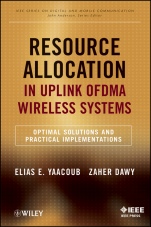
Resource Allocation in Uplink OFDMA Wireless Systems: Optimal Solutions and Practical Implementations
ISBN 9781118074503
Autor: Elias Yaacoub, Zaher Dawy
Wydawca: Wiley
Dostępność: 3-6 tygodni
Cena: 538,65 zł
Przed złożeniem zamówienia prosimy o kontakt mailowy celem potwierdzenia ceny.
ISBN13: |
9781118074503 |
ISBN10: |
1118074505 |
Autor: |
Elias Yaacoub, Zaher Dawy |
Oprawa: |
Hardback |
Rok Wydania: |
2012-03-27 |
Ilość stron: |
296 |
Wymiary: |
240x159 |
Tematy: |
TJ |
Tackling problems from the least complicated to the most,Resource Allocation in Uplink OFDMA Wireless Systems providesreaders with a comprehensive look at resource allocation andscheduling techniques (for both single and multi–cell deployments)in uplink OFDMA wireless networks relying on convexoptimization and game theory to thoroughly analyze performance.
Inside, readers will find topics and discussions on:
Formulating and solving the uplink ergodic sum–rate maximizationproblem
Proposing suboptimal algorithms that achieve a close performanceto the optimal case at a considerably reduced complexity and leadto fairness when the appropriate utility is used
Investigating the performance and extensions of the proposedsuboptimal algorithms in a distributed base station scenario
Studying distributed resource allocation where users take partin the scheduling process, and considering scenarios with andwithout user collaboration
Formulating the sum–rate maximization problem in a multi–cellscenario, and proposing efficient centralized and distributedalgorithms for intercell interference mitigation
Discussing the applicability of the proposed techniques tostate–of–the–art wireless technologies, LTE and WiMAX, andproposing relevant extensions
Along with schematics and figures featuring simulation results,Resource Allocation in Uplink OFDMA Wireless Systems is a valuablebook for?wireless communications and cellular systems professionalsand students.
PREFACE xiii
ACKNOWLEDGMENTS xv
ACRONYMS xvii
CHAPTER 1 INTRODUCTION 1
1.1 Evolution of Wireless Communication Systems 1
1.2 Orthogonal Frequency Division Multiple Access 2
1.3 Organization of this Book 5
CHAPTER 2 BACKGROUND ON DOWNLINK RESOURCE ALLOCATION IN OFDMAWIRELESS NETWORKS 9
2.1 Centralized Single Cell Scheduling 9
2.2 Distributed Scheduling 13
2.3 Scheduling in Multicell Scenarios 14
2.3.1 Multicell Scheduling in LTE 16
2.4 Summary 18
CHAPTER 3 ERGODIC SUM–RATE MAXIMIZATION WITH CONTINUOUS RATES19
3.1 Background 19
3.2 Problem Formulation 21
3.3 Problem Solution 23
3.4 Achievable Rate Region 28
3.5 Results and Discussion 35
3.6 Summary 41
CHAPTER 4 ERGODIC SUM–RATE MAXIMIZATION WITH DISCRETE RATES43
4.1 Background 43
4.2 Problem Formulation 44
4.3 Problem Solution 46
4.4 Results and Discussion 52
4.5 Summary 57
CHAPTER 5 GENERALIZATION TO UTILITY MAXIMIZATION 59
5.1 Background 59
5.2 Ergodic Utility Maximization with Continuous Rates 60
5.3 Ergodic Utility Maximization with Discrete Rates 64
5.4 Summary 68
CHAPTER 6 SUBOPTIMAL IMPLEMENTATION OF ERGODIC SUM–RATEMAXIMIZATION 69
6.1 Background 69
6.2 Suboptimal Approximation of the Continuous Rates Solution71
6.3 Suboptimal Approximation of the Discrete Rates Solution73
6.4 Complexity Analysis of the Suboptimal Algorithms 76
6.5 Results and Discussion 78
6.6 Summary 88
CHAPTER 7 SUBOPTIMAL IMPLEMENTATION WITH PROPORTIONALFAIRNESS 89
7.1 Background 89
7.2 Proportional Fair Scheduling 91
7.3 Low Complexity Utility Maximization Algorithms 94
7.4 Proportional Fair Utilities 100
7.5 Results and Discussion 101
7.6 Summary 112
CHAPTER 8 SCHEDULING WITH DISTRIBUTED BASE STATIONS113
8.1 Background 113
8.2 System Model 115
8.3 Scheduling with Distributed Base Stations 118
8.4 Results and Discussion 120
8.5 Distributed Base Stations Versus Relays 128
8.6 Distributed Base Stations Versus Femtocells 131
8.7 Summary 133
CHAPTER 9 DISTRIBUTED SCHEDULING WITH USER COOPERATION135
9.1 Background 135
9.2 Cooperative Distributed Scheduling Scheme 136
9.3 Distributed Scheduling Algorithm 140
9.4 Results and Discussion 142
9.5 Summary 149
CHAPTER 10 DISTRIBUTED SCHEDULING WITHOUT USER COOPERATION151
10.1 Background 151
10.2 Noncooperative Distributed Scheduling Scheme 153
10.3 Comparison to Existing Schemes 155
10.4 Analysis of Measurement Inaccuracies 156
10.5 Results and Discussion 160
10.6 Optimization of Transmission Probabilities 165
10.7 Practical Considerations 169
10.8 Summary 171
CHAPTER 11 CENTRALIZED MULTICELL SCHEDULING WITH INTERFERENCEMITIGATION 173
11.1 Background 173
11.2 Problem Formulation 175
11.3 Iterative Pricing–Based Power Control Solution 178
11.4 Pricing Game with Centralized Control 184
11.5 Suboptimal Scheduling Scheme Using Pricing–Based PowerControl 186
11.6 Suboptimal Scheduling Scheme Using ProbabilisticTransmission 190
11.7 Results and Discussion 191
11.8 Summary 201
CHAPTER 12 DISTRIBUTED MULTICELL SCHEDULING WITH INTERFERENCEMITIGATION 203
12.1 Background 203
12.2 System Model 204
12.3 Intracell Cooperation: Distributed Scheduling 205
12.4 Intercell Interference Mitigation/Avoidance 206
12.5 Results and Discussion 209
12.6 Practical Aspects 217
12.6.3 Application in a CR Network 219
12.6.4 Application in a Network with Femtocell Deployment219
12.6.5 Distributed Multicell Scheduling without User Cooperation220
12.7 Summary 221
CHAPTER 13 SCHEDULING IN STATE–OF–THE–ART OFDMA–BASEDWIRELESS SYSTEMS 223
13.1 WiMAX Scheduling Overview 223
13.2 LTE Scheduling Overview 228
13.3 SCFDMA Versus OFDMA Scheduling 235
13.4 Comparison to the LTE Power Control Scheme 240
13.5 Summary 245
CHAPTER 14 FUTURE RESEARCH DIRECTIONS 247
14.1 Resource Allocation with Multiple Service Classes 247
14.2 Network MIMO 247
14.3 Coalitional Game Theory 248
14.4 Resource Allocation with Femtocells 249
14.5 Green Networks and Self–Organizing Networks 249
14.6 Joint Uplink/Downlink Resource Allocation 250
14.7 Joint Resource Allocation in Heterogeneous Networks 251
14.8 Resource Allocation in Cognitive Radio Networks 252
BIBLIOGRAPHY 255
INDEX 269
ELIAS E. YAACOUB, PhD, is currently a research scientist at the Qatar University Wireless Innovations Center. His research interests include scheduling and interference mitigation in multi–cell OFDMA and LTE networks. He has authored numerous journal and conference papers on these topics. Dr. Yaacoub is a member of the IEEE and a member of the Lebanese Order of Engineers.
ZAHER DAWY, PhD, is an associate professor at the American University of Beirut (AUB). His research interests include cooperative and distributed communications, resource allocation, cellular technologies, and computational biology. He received the IEEE Communications Society Outstanding Young Researcher Award for Europe, Middle East, and Africa Region in 2011 and the AUB 2008 Teaching Excellence Award. Dr. Dawy is a senior member of the IEEE and Chair of the IEEE Communications Society, Lebanon Chapter.
Koszyk
Książek w koszyku: 0 szt.
Wartość zakupów: 0,00 zł
Informacje


Kontakt
Gambit
Centrum Oprogramowania
i Szkoleń Sp. z o.o.
Al. Pokoju 29b/22-24
31-564 Kraków
Siedziba Księgarni
ul. Kordylewskiego 1
31-542 Kraków
+48 12 410 5991
+48 12 410 5987
+48 12 410 5989
Subskrypcje
Administratorem danych osobowych jest firma Gambit COiS Sp. z o.o. Na podany adres będzie wysyłany wyłącznie biuletyn informacyjny.
Autoryzacja płatności

Informacje na temat autoryzacji płatności poprzez PayU.

© Copyright 2012: GAMBIT COiS Sp. z o.o. Wszelkie prawa zastrzeżone.
Projekt i wykonanie: Alchemia Studio Reklamy