


Wydawcy
Katalog tematyczny
- Archeologia (109)
- Ekonomia, finanse, business (13704)
- Filozofia (1445)
- Historia (3040)
- Języki i językoznawstwo (2356)
- Lifestyle, hobby i rozrywka (475)
- Medycyna (9704)
- Nauki humanistyczne (4)
- Nauki o Ziemi i środowisku (2638)
- Nauki ścisłe (20412)
- Nauki społeczne (8486)
- Edukacja (229)
- Kryminologia, opieka spełeczna (284)
- Obronność (10)
- Polityka (1389)
- Psychologia (777)
- Socjologia (410)
- Społeczeństwo i kultura (187)
- Nauki techniczne (13450)
- Prawo (1696)
- Publikacje informacyjne i interdyscyplinarne (1288)
- Religia i wierzenia (917)
- Technika komputerowa (4067)
- Zdrowie, relacje międzyludzkie i rozwój osobisty (657)





Informacje szczegółowe o książce
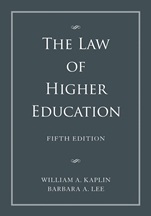
The Law of Higher Education: A Comprehensive Guide to Legal Implications of Administrative Decision Making 2 Volume Set
ISBN 9781118032015
Autor: William A. Kaplin, Barbara A. Lee
Wydawca: Wiley
Dostępność: 3-6 tygodni
Cena: 1 314,60 zł
Przed złożeniem zamówienia prosimy o kontakt mailowy celem potwierdzenia ceny.
ISBN13: |
9781118032015 |
ISBN10: |
1118032012 |
Autor: |
William A. Kaplin, Barbara A. Lee |
Oprawa: |
Hardback |
Rok Wydania: |
2013-09-24 |
Numer Wydania: |
5th Edition |
Ilość stron: |
2128 |
Wymiary: |
335x255 |
Tematy: |
JD |
Make sure you have a copy on your bookshelf. The Law of Higher Education, Fifth Edition, is the most up–to–date and comprehensive reference, research source, and practical legal guide for college and university administrators, campus attorneys, legal counsel, and institutional researchers, addressing all the major legal issues and regulatory developments in higher education. In the increasingly litigious environment of higher education, William A. Kaplin and Barbara A. Lee’s clear, cogent, and contextualized legal guide proves more and more indispensable every year. Over 3,000 new cases related to higher education have been decided since the publication of the previous edition, and scores of changes to higher education law are made each year. Every section of the fifth edition contains new material, including those related to: Hate speech and free speech rights of faculty in public universities Sharing of research with international colleagues Intellectual property and peer–to–peer file sharing Student suicide Campus safety Police and administrators’ right to search students’ residence hall rooms Governmental support for religious institutions and religious autonomy rights of individual public institutions Collective bargaining and antidiscrimination laws Nondiscrimination and affirmative action in employment, admissions, and financial aid Family and Medical Leave Act and workers’ compensation FERPA (Family Educational Rights and Privacy Act)
Notice to Instructors Notice of Web Site and Periodic Supplements Preface Acknowledgments The Authors PART ONE: PERSPECTIVES AND FOUNDATIONS 1 Overview of Higher Education Law Section 1.1. How Far the Law Reaches and How Loudly It Speaks Section 1.2. Evolution of Higher Education Law Section 1.3. The Governance of Higher Education Section 1.4. Sources of Higher Education Law Section 1.5. The Public–Private Dichotomy Section 1.6. Religion and the Public–Private Dichotomy Section 1.7. The Relationship Between Law and Policy Selected Annotated Bibliography 2 Legal Planning and Dispute Resolution Section 2.1. Legal Liability Section 2.2. Litigation in the Courts Section 2.3. Alternative Dispute Resolution Section 2.4. Legal Services Section 2.5. Institutional Management of Liability Risk17 Selected Annotated Bibliography PART TWO: THE COLLEGE AND ITS GOVERNING BOARD, PERSONNEL, AND AGENTS 3 The College and Its Trustees and Officers Section 3.1. The Question of Authority Section 3.2. Sources and Scope of Authority and Liability Section 3.3. Institutional Tort Liability Section 3.4. Institutional Contract Liability Section 3.5. Institutional Liability for Violating Federal Constitutional Rights (Section 1983 Liability) Section 3.6. Captive and Affiliated Organizations30 Selected Annotated Bibliography 4 The College and Its Employees Section 4.1. Overview of Employment Relationships Section 4.2. Pre–hire Considerations Section 4.3. Employment Contracts Section 4.4. Civil Service Rules Section 4.5. Collective Bargaining Section 4.6. Other Employee Protections Section 4.7. Personal Liability of Employees Section 4.8. Performance Management Issues Selected Annotated Bibliography 5 Nondiscrimination and Affirmative Action in Employment Section 5.1. The Interplay of Statutes, Regulations, and Constitutional Protections Section 5.2. Sources of Law Section 5.3. The Protected Classes Section 5.4. Affirmative Action Section 5.5. Application of Nondiscrimination Laws to Religious Institutions Selected Annotated Bibliography PART THREE: THE COLLEGE AND ITS FACULTY 6 Faculty Employment Issues Section 6.1. Overview Section 6.2. Faculty Contracts Section 6.3. Faculty Collective Bargaining Section 6.4. Application of Nondiscrimination Laws to Faculty Employment Decisions Section 6.5. Affirmative Action in Faculty Employment Decisions Section 6.6. Standards and Criteria for Faculty Personnel Decisions Section 6.7. Procedures for Faculty Employment Decisions Section 6.8. Closure, Merger, and Reduction in Force Selected Annotated Bibliography 7 Faculty Academic Freedom and Freedom of Expression Section 7.1. General Concepts and Principles Section 7.2. Academic Freedom in Teaching Section 7.3. Academic Freedom in Research and Publication Section 7.4. Academic Freedom in Institutional Affairs Section 7.5. Academic Freedom in Private Life Section 7.6. Administrators’ Authority Regarding Faculty Academic Freedom and Freedom of Expression Section 7.7. Protection of Confidential Academic Information: The “Academic Freedom Privilege” Section 7.8. Academic Freedom in Religious Colleges and Universities Selected Annotated Bibliography PART FOUR: THE COLLEGE AND ITS STUDENTS 8 The Student–Institution Relationship Section 8.1. The Legal Status of Students Section 8.2. Admissions Section 8.3. Financial Aid Section 8.4. Student Housing Section 8.5. Campus Computer Networks Section 8.6. Campus Security Section 8.7. Other Support Services Section 8.8 Student Records Selected Annotated Bibliography 9 Student Academic Issues Section 9.1. Overview Section 9.2. Grading and Academic Standards Section 9.3. Online Programs Section 9.4. Academic Accommodations for Students with Disabilities. Section 9.5. Sexual Harassment of Students by Faculty Members Section 9.6. Academic Dismissals and Other Academic Sanctions Section 9.7. Degree Revocation Selected Annotated Bibliography 10 Student Disciplinary Issues Section 10.1. Disciplinary and Grievance Systems Section 10.2. Disciplinary Rules and Regulations Section 10.3. Procedures for Suspension, Dismissal, and Other Sanctions Section 10.4. Student Protests and Freedom of Speech Section 10.5. Speech Codes and the Problem of Hate Speech19 Selected Annotated Bibliography 11 Rights and Responsibilities of Student Organizations and Their Members Section 11.1. Student Organizations Section 11.2. Fraternities and Sororities Section 11.3. The Student Press Section 11.4. Athletic Teams and Clubs Selected Annotated Bibliography PART FIVE: THE COLLEGE AND LOCAL, STATE, AND FEDERAL GOVERNMENTS 12 Local Governments and the Local Community Section 12.1. General Principles Section 12.2. Zoning and Land Use Regulation Section 12.3. Local Government Taxation Section 12.4. Student Voting in the Community Section 12.5. Relations with Local Police Section 12.6. Community Access to the College’s Campus Section 12.7. Community Activities of Faculty Members and Students Selected Annotated Bibliography 13 The College and the State Government Section 13.1. Overview Section 13.2. State Provision of Public Postsecondary Education Section 13.3. State Chartering and Licensure of Private Postsecondary Institutions Section 13.4. State Regulation of Out–of–State Institutions and Programs Section 13.5. Other State Regulatory Laws Affecting Postsecondary Education Programs Selected Annotated Bibliography 14 The College and the Federal Government Section 14.1. Federal Constitutional Powers over Education Section 14.2. Federal Regulation of Postsecondary Education Section 14.3. Federal Taxation of Postsecondary Education82 Section 14.4. Federal Aid–to–Education Programs Section 14.5. Civil Rights Compliance107 Section 14.6. Dealing with the Federal Government Selected Annotated Bibliography 15 The College and the Education Associations Section 15.1. Overview of the Education Associations Section 15.2. Applicable Legal Principles Section 15.3. The College and the Accrediting Agencies Section 15.4. Athletic Associations and Conferences17 Selected Annotated Bibliography 16 The College and the Business and Industrial Community Section 16.1. The Contract Context for College Business Transactions Section 16.2. The College as Purchaser Section 16.3. The College as Seller and Competitor Section 16.4. The College as Research Collaborator and Partner Selected Annotated Bibliography Indexes
WILLIAM A. KAPLIN is Research Professor of Law at The Catholic University of America, Columbus School of Law, and Distinguished Professorial Lecturer at Stetson University College of Law. He is the past chair of the Education Law Section of the Association of American Law Schools, the former editor of the Journal of College and University Law, and a former member of the Education Appeal Board of the U.S. Department of Education. He is senior fellow at the Center for Excellence in Higher Education Law and Policy at Stetson University, editorial board member for the Journal of College and University Law, and a mentor/leader for the biannual Houston Higher Education Law Roundtable; since 1991 he has been a faculty member/presenter for the Annual National Conference on Law and Higher Education. He has received multiple awards and has been named a fellow of the National Association of College and University Attorneys. BARBARA A. LEE is professor of human resource management at Rutgers University’s School of Management and Labor Relations. An attorney, she teaches employment law and higher education law and has served as department chair, associate dean, associate provost, and dean at Rutgers. She is also of counsel to the law firm of Edwards, Angell, Palmer & Dodge, LLP, and serves on the Executive Committee of the New Jersey Bar Association’s Labor and Employment Law Section. Her work has been published in the Industrial and Labor Relations Review, Industrial Relations, Human Resource Management, the Journal of College and University Law, and the Journal of Higher Education. She is the coauthor of Academics in Court: The Consequences of Faculty Discrimination Litigation, which deals with the effects of discrimination litigation on plaintiffs and employer defendants.
“[ The Law of Higher Education ] transcends the law—an important enough topic in itself—to be essential reading for anyone interested in understanding the complexities of organizing and managing American Higher Education Institutions.” — The Journal of Higher Education
Koszyk
Książek w koszyku: 0 szt.
Wartość zakupów: 0,00 zł
Informacje


Kontakt
Gambit
Centrum Oprogramowania
i Szkoleń Sp. z o.o.
Al. Pokoju 29b/22-24
31-564 Kraków
Siedziba Księgarni
ul. Kordylewskiego 1
31-542 Kraków
+48 12 410 5991
+48 12 410 5987
+48 12 410 5989
Subskrypcje
Administratorem danych osobowych jest firma Gambit COiS Sp. z o.o. Na podany adres będzie wysyłany wyłącznie biuletyn informacyjny.
Autoryzacja płatności

Informacje na temat autoryzacji płatności poprzez PayU.

© Copyright 2012: GAMBIT COiS Sp. z o.o. Wszelkie prawa zastrzeżone.
Projekt i wykonanie: Alchemia Studio Reklamy