


Wydawcy
Katalog tematyczny
- Archeologia (109)
- Ekonomia, finanse, business (13704)
- Filozofia (1445)
- Historia (3040)
- Języki i językoznawstwo (2356)
- Lifestyle, hobby i rozrywka (475)
- Medycyna (9704)
- Nauki humanistyczne (4)
- Nauki o Ziemi i środowisku (2638)
- Nauki ścisłe (20412)
- Astronomia (294)
- Biologia (5119)
- Chemia (6540)
- Fizyka (3309)
- Elektryczność i magnetyzm (90)
- Fizyka atomowa i molekularna (110)
- Fizyka cząstek elementarnych (36)
- Fizyka jądra atomowego (36)
- Fizyka kwantowa (210)
- Fizyka matematyczna (121)
- Fizyka relatywistyczna (36)
- Fizyka statystyczna (51)
- Fizyka stosowana (498)
- Mechanika klasyczna (186)
- Optyka i światło (133)
- Stany materii (202)
- Matematyka (4574)
- Nauki ścisłe, ogólnie (503)
- Nauki społeczne (8486)
- Nauki techniczne (13450)
- Prawo (1696)
- Publikacje informacyjne i interdyscyplinarne (1288)
- Religia i wierzenia (917)
- Technika komputerowa (4067)
- Zdrowie, relacje międzyludzkie i rozwój osobisty (657)





Informacje szczegółowe o książce
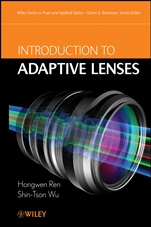
Introduction to Adaptive Lenses
ISBN 9781118018996
Autor: Hongwen Ren, Shin–Tson Wu
Wydawca: Wiley
Dostępność: 3-6 tygodni
Cena: 581,70 zł
Przed złożeniem zamówienia prosimy o kontakt mailowy celem potwierdzenia ceny.
ISBN13: |
9781118018996 |
ISBN10: |
1118018990 |
Autor: |
Hongwen Ren, Shin–Tson Wu |
Oprawa: |
Hardback |
Rok Wydania: |
2012-05-15 |
Ilość stron: |
286 |
Wymiary: |
236x164 |
Tematy: |
PH |
Presents readers with the basic science, technology, andapplications for every type of adaptive lens
An adaptive lens is a lens whose shape has been changed to adifferent focal length by an external stimulus such as pressure,electric field, magnetic field, or temperature. Introduction toAdaptive Lenses is the first book ever to address all of thefundamental operation principles, device characteristics, andpotential applications of various types of adaptive lenses.
This comprehensive book covers basic material properties, devicestructures and performance, image processing and zooming, opticalcommunications, and biomedical imaging. Readers will find homeworkproblems and solutions included at the end of each chapter andbased on the described device structures, they will have theknowledge to fabricate adaptive lenses for practical applicationsor develop new adaptive devices or concepts for advancedinvestigation.
Introduction to Adaptive Lenses includes chapters on:
Optical lenses
Elastomeric membrane lenses
Electro–wetting lenses
Dielectrophoretic lenses
Mechanical–wetting lenses
Liquid crystal lenses
This is an important reference for optical engineers, researchscientists, graduate students, and undergraduate seniors.
Preface ix
1. Optical Lens 1
1.1. Introduction 1
1.2. Conventional Lens 3
1.2.1. Refraction of Light 3
1.2.2. A Simple Lens 4
1.2.3. A Compound Lens 6
1.3. Aberration and Resolution 7
1.3.1. Paraxial Optics 7
1.3.2. Aberration 9
1.3.3. Resolution 13
1.4. Merits and Demerits of Solid Lens 15
1.5. Adaptive Optical Lenses 16
1.5.1. Eye Structure 16
1.5.2. Lens Character 17
1.5.3. Performances 18
1.5.4. The Eye–Inspired Lens 19
1.6. Homework Problems 21
References 21
2. Elastomeric Membrane Lens 23
2.1. Polydimethylsiloxane (PDMS) Membrane 23
2.1.1. PDMS Chemical Structure 24
2.1.2. Basic Material Properties 24
2.1.3. Optical Transmission 24
2.1.4. Fabrication of PDMS Membrane 25
2.2. Device Structure 27
2.2.1. Requirements of the Liquid 28
2.2.2. Surface Configuration 29
2.2.3. PDMS Lens Cell Fabrication 34
2.2.4. Performance Evaluation Method 36
2.3. Actuators 39
2.3.1. Syringe Pump 39
2.3.2. Motor Pumps 40
2.3.3. Piezoelectric Linear Actuator 50
2.3.4. Artificial Muscles 60
2.3.5. Voice Coil Actuator (VCA) 63
2.3.6. Other Liquid Lenses 64
2.4. PDMS Microlens Array 65
2.4.1. Device Configuration 65
2.4.2. Fabrication Method 66
2.4.3. Performance Evaluation 67
2.5. Solid PDMS Lenses 70
2.5.1. Squeezing the Lens s Border 70
2.5.2. Elongating the Lens s Diameter 72
2.6. Hybrid Lens System 73
2.7. Summary and Technical Challenges 74
2.8. Homework Problems 75
References 76
3. Electrowetting Lens 80
3.1. Introduction 80
3.2. Surface Tension 81
3.3. Contact Angle and Wetting 84
3.4. Basic Theory of Electrowetting 86
3.5. Droplet Deformation 88
3.6. Electrowetting Lens 90
3.6.1. Shape of Droplet Surface 90
3.6.2. Focal Length Equation 90
3.7. Tunable Electrowetting Lens 91
3.8. Desired Properties of the Liquids 93
3.9. Singlet Lens with Two Liquids 93
3.9.1. Lens Cell 1 94
3.9.2. Lens Cell 2 96
3.10. Microlens Array 97
3.11. Remaining Challenges 102
3.12. Summary 103
3.13. Homework Problems 103
References 104
4. Dielectrophoretic Lens 107
4.1. Introduction 107
4.2. Dielectrophoretic Force 108
4.3. Dielectric Liquid Materials 112
4.4. Singlet Lens 112
4.4.1. Continuous Flat Electrodes 112
4.4.2. Hole Patterned Electrode 117
4.4.3. Well–Shaped Electrode 122
4.4.4. Fringing Field 127
4.5. Microlens Array 130
4.6. Switchable Lens 137
4.6.1. Operation Principle 138
4.6.2. Beam Diffuser 140
4.6.3. Light Shutter 141
4.6.4. Display 144
4.6.5. Noncontact Electro–optic Inspection 144
4.7. Gravity Effect 148
4.7.1. Measurement Method 148
4.7.2. Operation Principles 149
4.7.3. Experimental Results 150
4.8. Applications 153
4.9. Summary 154
4.10. Homework Problems 154
References 155
5. Other Adaptive Liquid Lenses 159
5.1. Introduction 159
5.2. Mechanical–Wetting Lens 159
5.2.1. Out–of–Plane Tuning 159
5.2.2. Hydrodynamic Liquid Air In–Plane Tuning 162
5.2.3. Hydrodynamic Liquid Liquid In–Plane Tuning 163
5.3. Ferrofluidic Transducer Lens 165
5.3.1. Ferrofluidic Material 166
5.3.2. First Example 166
5.3.3. Second Example 169
5.3.4. Third Example 171
5.4. Electromagnetic Actuator Lens 173
5.5. Stimuli Response Hydrogel Lens 175
5.6. Acoustic Liquid Lens 177
5.6.1. Acoustic Radiation Force 178
5.6.2. Structure of an Acoustic Lens 178
5.6.3. Lens Performance 180
5.7. Electrochemical Actuation Lens 181
5.8. Electrostatic Force Actuation 183
5.9. Summary 184
5.10. Homework Problems 185
References 186
6. Liquid Crystal Lens 189
6.1. Introduction 189
6.2. Physical Properties 190
6.2.1. Phase Transitions and Order Parameter 190
6.2.2. Rod–like Structure 192
6.2.3. Dipole Moment 192
6.2.4. Optical Anisotropy 193
6.2.5. Dielectric Anisotropy 195
6.3. LC Device 196
6.3.1. Device Fabrication 196
6.3.2. Optical Path Difference (OPD) 197
6.4. Focal Length Equation 199
6.5. Curved Electrode 201
6.5.1. Curved Electrode and Nonuniform Cell Gap 201
6.5.2. Curved Electrode and Planar Cell Gap 202
6.6. Strip–Patterned Electrode 214
6.7. Hole–Patterned Electrode 216
6.7.1. Hole Pattern Inside the Lens Cell 216
6.7.2. Hole Pattern Outside the Lens Cell 219
6.7.3. Magnification of LC Lens System 223
6.8. Modal Addressing 225
6.9. Cylindrical LC Lens 229
6.10. Polymer LC Composite Lens 234
6.10.1. Anisotropic Phase Separation 234
6.10.2. Polymer–Dispersed Liquid Crystal 237
6.10.3. Polymer Network Liquid Crystal (PNLC) 243
6.10.4. Blue Phase Liquid Crystal Lens 246
6.11. Diffractive LC Lens 248
6.12. LC Microlens Array 253
6.12.1. Lenticular Microlens Array 253
6.12.2. Microlens Array with Curved Electrode 255
6.12.3. Polymer–Stabilized LC Microlens Array 257
6.13. Summary 261
6.14. Homework Problems 264
References 265
Index 271
HONGWEN REN, PhD, is an associate professor in the Department of Polymer–Nano Science Technology at Chonbuk National University in South Korea. A former research scientist at the University of Central Florida′s College of Optics and Photonics, Dr. Ren has published over fifty journal papers, one book chapter, and obtained eight U.S. patents.
SHIN–TSON WU, PhD, is a Pegasus Professor at CREOL, the College of Optics and Photonics, University of Central Florida. He is a recipient of the 2011 SID Slottow–Owaki Prize, 2010 OSA Joseph Fraunhofer Award/Robert M. Burley Prize, 2008 SPIE G. G. Stokes Award, and 2008 SID Jan Rajchman Prize. He is a Fellow of the IEEE, OSA, SID, and SPIE. Dr. Wu has coauthored six books and over 400 journal papers, and holds over seventy issued U.S. patents. He was also the founding editor–in–chief of the IEEE/OSA Journal of Display Technology.
The description of each is very thorough andwell–referenced. Ren and Wu have made liberal use of diagrams andimages, making the book easy to understand. Readers will find itstimulating and informative. (Optics &Photonics News, 1 February 2013)
Koszyk
Książek w koszyku: 0 szt.
Wartość zakupów: 0,00 zł
Informacje


Kontakt
Gambit
Centrum Oprogramowania
i Szkoleń Sp. z o.o.
Al. Pokoju 29b/22-24
31-564 Kraków
Siedziba Księgarni
ul. Kordylewskiego 1
31-542 Kraków
+48 12 410 5991
+48 12 410 5987
+48 12 410 5989
Subskrypcje
Administratorem danych osobowych jest firma Gambit COiS Sp. z o.o. Na podany adres będzie wysyłany wyłącznie biuletyn informacyjny.
Autoryzacja płatności

Informacje na temat autoryzacji płatności poprzez PayU.

© Copyright 2012: GAMBIT COiS Sp. z o.o. Wszelkie prawa zastrzeżone.
Projekt i wykonanie: Alchemia Studio Reklamy