


Wydawcy
Katalog tematyczny
- Archeologia (109)
- Ekonomia, finanse, business (13704)
- Filozofia (1445)
- Historia (3040)
- Języki i językoznawstwo (2356)
- Lifestyle, hobby i rozrywka (475)
- Medycyna (9704)
- Nauki humanistyczne (4)
- Nauki o Ziemi i środowisku (2638)
- Nauki ścisłe (20412)
- Astronomia (294)
- Biologia (5119)
- Chemia (6540)
- Chemia analityczna (361)
- Chemia fizyczna (346)
- Chemia nieorganiczna (137)
- Chemia organiczna (535)
- Krystalografia (27)
- Minerologia (46)
- Fizyka (3309)
- Matematyka (4574)
- Nauki ścisłe, ogólnie (503)
- Nauki społeczne (8486)
- Nauki techniczne (13450)
- Prawo (1696)
- Publikacje informacyjne i interdyscyplinarne (1288)
- Religia i wierzenia (917)
- Technika komputerowa (4067)
- Zdrowie, relacje międzyludzkie i rozwój osobisty (657)






Informacje szczegółowe o książce
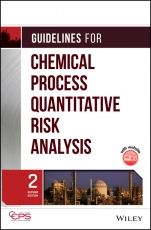
Guidelines for Chemical Process Quantitative Risk Analysis
ISBN 9780816907205
Autor: CCPS (Center for Chemical Process Safety)
Wydawca: Wiley
Dostępność: 3-6 tygodni
Cena: 1 324,05 zł
Przed złożeniem zamówienia prosimy o kontakt mailowy celem potwierdzenia ceny.
ISBN13: |
9780816907205 |
ISBN10: |
081690720X |
Autor: |
CCPS (Center for Chemical Process Safety) |
Oprawa: |
Hardback |
Rok Wydania: |
1999-01-10 |
Numer Wydania: |
2nd Edition |
Ilość stron: |
784 |
Wymiary: |
261x177 |
Tematy: |
PN |
Chemical process quantitative risk analysis (CPQRA) as applied to the CPI was first fully described in the first edition of this CCPS Guidelines book. This second edition is packed with information reflecting advances in this evolving methodology, and includes worked examples on a CD–ROM. CPQRA is used to identify incident scenarios and evaluate their risk by defining the probability of failure, the various consequences and the potential impact of those consequences. It is an invaluable methodology to evaluate these when qualitative analysis cannot provide adequate understanding and when more information is needed for risk management. This technique provides a means to evaluate acute hazards and alternative risk reduction strategies, and identify areas for cost–effective risk reduction. There are no simple answers when complex issues are concerned, but CPQRA2 offers a cogent, well–illustrated guide to applying these risk–analysis techniques, particularly to risk control studies.
Special Details: Includes CD–ROM with example problems worked using Excel and Quattro Pro. For use with Windows 95, 98, and NT.
Spis treści:
Preface.
Preface to the First Edition.
Acknowledgments.
Acknowledgments to the First Edition.
Management Overview.
Organization of the Guidelines.
Acronyms.
1. CHEMICAL PROCESS QUANTITATIVE RISK ANALYSIS.
1.1 CPQRA Definitions.
1.2 Component Techniques of CPQRA.
1.2.1 Complete CPQRA Procedure.
1.2.2 Prioritized CPQRA Procedure.
1.3 Scope of CPQRA Studies.
1.3.1 The Study Case.
1.3.2 Typical Goals of CPQRAs.
1.4 Management of Incident Lists.
1.4.1 Enumeration.
1.4.2 Selection.
1.4.3 Tracking.
1.5 Applications of CPQRA.
1.5.1 Screening Techniques.
1.5.2 Applications within Existing Facilities.
1.5.3 Applications within New Projects.
1.6 Limitations of CPQRA.
1.7 Current P
ractices.
1.8 Utilization of CPQRA Results.
1.9 Project Management.
1.91. Study Goals.
1.9.2 Study Objectives.
1.9.3 Depth of Study.
1.9.4 Special User Requirements.
1.9.5 Construction of a Project Plan.
1.9.6 Project Execution.
1.10 Maintenance of Study Results.
1.11 References.
2. CONSEQUENCE ANALYSIS.
2.1 Source Models.
2.1.1 Discharge Rate Models.
2.1.2 Flash and Evaporation.
2.1.3 Dispersion Models.
2.2 Explosions and Fires.
2.2.1 Vapor Cloud Explosions (VCE).
2.2.2 Flash Fires.
2.2.3 Physical Explosion.
2.2.4 BLEVE and Fireball.
2.2.5 Confined Explosions.
2.2.6 Pool Fries.
2.2.7 Jet Fires.
2.3 Effect Models.
2.3.1 Toxic Gas Effects.
2.3.2 Thermal Effects.
2.3.3 Explosion Effects.
2.4 Evasive Actions.
2.4.1 Background.
2.4.2 Description.
2.4.3 Example Problem.
2.4.4 Discussion.
2.5 Modeling Systems.
2.6 References.
3. EVENT PROBABILITY AND FAILURE FREQUENCY ANALYSIS.
3.1 Incident Frequencies from the Historical Record.
3.1.1 Background.
3.1.2 Description.
3.1.3 Sample Problem.
3.1.4 Discussion.
3.2 Frequency Modeling Techniques.
3.2.2 Event Tree Analysis.
3.3 Complementary Plant–Modeling Techniques.
3.3.1 Common Cause Failure Analysis.
3.3.2 Human Reliability Analysis.
3.3.3 External Events Analysis.
3.4 References.
4. MEASUREMENT, CALCULATION, AND PRESENTATION OF RISK ESTIMATES.
4.1 Risk Measures.
4.1.1 Risk Indices.
4.1.2 Individual Risk.
4.1.3 Societal Risk.
4.1.4 Injury Risk Measures.
4.2 Risk Presentation.
4.2.1 Risk Indices.
4.2.2 Individual Risk.
4.2.3 Societal Risk.
4.3 Selection of Risk Measures and Presentation Format.
4.3.1 Selection of Risk Measures.
4.3.2 Selection of Presentation Format.
4.4 Risk Calculations.
4.4.1 Individual Risk.
4.4.2 Societal Risk.
4.4.3 Risk Indices.
4.4.4 General Comments.
4.4.5 Example Risk Calculation Problem.
4.4.6 Sample Problem Illustrating That F–N Curves Cannot be Calculated from individual Risk Contours.
4.5 Risk Uncertainty, Sensitivity, and Importance.
4.5.1 Uncertainty.
4.5.2 Sensitivity.
4.5.3 Importance.
4.6 References.
5. CREATION OF CPQRA DATA BASE.
5.1 Historical Incident Data.
5.1.1 Types of Data.
5.1.2 Sources.
5.2 Process and Plant Data.
5.2.1 Plant Layout and System Description.
5.2.2 Ignition Sources and Data.
5.3 Chemical Data.
5.3.1 Types of Data.
5.3.2 Sources.
5.4 Environmental Data.
5.4.1 Population Data.
5.4.2 Meteorological Data.
5.4.3 Geographical Data.
5.4.4 Topographic Data.
5.4.5 External Event Data.
5.5 Equipment Reliability Data.
5.5.1 Terminology.
5.5.2 Types and Sources of Failure Rate Data.
5.5.3 Key Factors Influencing Equipment Failure Rates.
5.5.4 Failure Rate Adjustment Factors.
5.5.5 Data Requirements and Estimated Accuracy.
5.5.6 Collection and Processing of Raw Plant Data.
5.5.7 Preparation of the CPQRA Equipment Failure Rate Data Set.
5.5.8 Sample Problem.
5.6 Human Reliability Data.
5.7 Use of Expert Opinions.
5.8 References.
6. SPECIAL TOPICS AND OTHER TECHNIQUES.
6.1 Domino Effects.
6.1.1 Background.
6.1.2 Description.
6.1.3 Sample Problem.
6.1.4 Discussion.
6.2 Unavailability Analysis of Protective Systems.
6.2.1 Background.
6.2.2 Description.
6.2.3 Sample Problem.
6.2.4 Discussion.
6.3 Reliability Analysis of Programmable Electronic Systems.
6.3.1 Background.
6.3.2 Description.
6.3.3 Sample Problem.
6.3.4 Discussion.
6.4 Other techniques.
6.4.1 MORT Analysis.
6.4.2 IFAL Analysis.
6.4.3 Hazard Warning Structure.
6.4.4 Markov Processes.
6.4.5 Monte Carlo Techniques.
6.4.6 GO Methods.
6.4.7 Reliability Book Diagrams.
6.4.8 Cause–Consequence Analysis.
6.4.9 Multiple Failure/Error Analysis (MFEA).
6.4.10 Sneak Analysis.
6.5 References.
7. CPQRA APPLICATION EXAMPLES.
7.1 Simple/Consequence CPQRA Examples.
7.1.1 Sample/Consequence CPQRA Characterization.
7.1.2 Application to a New Process Unit.
7.1.3 Application to an Existing Process Unit.
7.2 Intermediate/Frequency CPQRA Examples.
7.2.1 Intermediate/Frequency CPQRA Characterization.
7.2.2 Application to a New Process Unit.
7.2.3 Application to Existing Process Unit.
7.3 Complex/Risk CPQRA Examples.
7.3.1 Complex/Risk Cpqra Characterization.
7.3.2 Application to a New or Existing Process Unit.
7.4 References.
8. CASE STUDIES.
8.1 Chlorine Rail Tank Car Loading Facility.
8.1.1 Introduction.
8.1.2 Description.
8.1.3 Identification, Enumeration, and Selection of Incidents.
8.1.4 Incident Consequence Estimation.
8.1.5 Incident Frequency Estimation.
8.1.6 Risk Estimation.
8.1.7 Conclusions.
8.2 Distillation Column.
8.2.1 Introduction.
8.2.2 Description.
8.2.3 Identification, Enumeration, and Selection of Incidents.
8.2.4 Incident Consequence Estimation.
8.2.5 Incident Frequency Estimation.
8.2.6 Risk Estimation.
8.2.7 Conclusions.
8.3 References.
9. FUTURE DEVELOPMENTS.
9.1 Hazard Identification.
9.2 Source and Dispersion Models.
9.2.1 Source Emission Models.
9.2.2 Transport and Dispersion Models.
9.2.3 Transient Plume Behavior.
9.2.4 Concentration Fluctuations and the Time Averaging of Dispersion Plumes.
9.2.5 Input Data Uncertainties and Model Validation.
9.2.6 Field Experiments.
9.2.7 Model Evaluation.
9.3 Consequence Models.
9.3.1 Unconfined Vapor Cloud Explosion (UVCE).
9
Koszyk
Książek w koszyku: 0 szt.
Wartość zakupów: 0,00 zł
Informacje


Kontakt
Gambit
Centrum Oprogramowania
i Szkoleń Sp. z o.o.
Al. Pokoju 29b/22-24
31-564 Kraków
Siedziba Księgarni
ul. Kordylewskiego 1
31-542 Kraków
+48 12 410 5991
+48 12 410 5987
+48 12 410 5989
Subskrypcje
Administratorem danych osobowych jest firma Gambit COiS Sp. z o.o. Na podany adres będzie wysyłany wyłącznie biuletyn informacyjny.
Autoryzacja płatności

Informacje na temat autoryzacji płatności poprzez PayU.

© Copyright 2012: GAMBIT COiS Sp. z o.o. Wszelkie prawa zastrzeżone.
Projekt i wykonanie: Alchemia Studio Reklamy