


Wydawcy
Katalog tematyczny
- Archeologia (109)
- Ekonomia, finanse, business (13704)
- Filozofia (1445)
- Historia (3040)
- Języki i językoznawstwo (2356)
- Lifestyle, hobby i rozrywka (475)
- Medycyna (9704)
- Chirurgia (272)
- Inne gałęzie medycyny (1871)
- Medycyna kliniczna (4187)
- Medycyna niekonwencjonalna (14)
- Medycyna przedkliniczna (269)
- Medycyna, ogólnie (1740)
- Historia medycyny (3)
- Lekarze, sprawy zawodowe (8)
- Medycyna, aspekty prawne (10)
- Służba zdrowia (36)
- Wyposażenie medyczne (157)
- Zdrowie publiczne (460)
- Medyczne służby pomocnicze (745)
- Studia medyczne (16)
- Weterynaria (548)
- Nauki humanistyczne (4)
- Nauki o Ziemi i środowisku (2638)
- Nauki ścisłe (20412)
- Nauki społeczne (8486)
- Nauki techniczne (13450)
- Prawo (1696)
- Publikacje informacyjne i interdyscyplinarne (1288)
- Religia i wierzenia (917)
- Technika komputerowa (4067)
- Zdrowie, relacje międzyludzkie i rozwój osobisty (657)





Informacje szczegółowe o książce
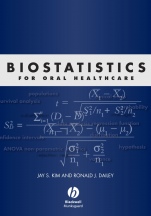
Biostatistics for Oral Healthcare
ISBN 9780813828183
Autor: Jay S. Kim, Ronald J. Dailey
Wydawca: Wiley
Dostępność: 3-6 tygodni
Cena: 844,20 zł
Przed złożeniem zamówienia prosimy o kontakt mailowy celem potwierdzenia ceny.
ISBN13: |
9780813828183 |
ISBN10: |
081382818X |
Autor: |
Jay S. Kim, Ronald J. Dailey |
Oprawa: |
Hardback |
Rok Wydania: |
2007-11-26 |
Ilość stron: |
344 |
Wymiary: |
264x184 |
Tematy: |
MBNS |
Biostatistics for Oral Healthcare offers students, practitioners and instructors alike a comprehensive guide to mastering biostatistics and their application to oral healthcare. Drawing on situations and methods from dentistry and oral healthcare, this book provides a thorough treatment of statistical concepts in order to promote in–depth and correct comprehension, supported throughout by technical discussion and a multitude of practical examples.
Spis treści:
Chapter 1. Introduction.
1. What Is Biostatistics?.
2. Why Do I Need Statistics?.
3. How Much Mathematics Do I Need?.
4. How to Study Statistics?.
5. Reference.
Chapter 2. Summarizing Data.
1. Raw Data and Basic Terminology.
2. The Levels of Measurements.
3. Frequency Distributions.
Frequency Tables.
Relative Frequency.
4. Graphs.
Bar Graphs.
Pie Charts.
Line Graphs.
Histograms.
Stem and Leaf Plots.
5. Clinical Trials.
6. Confounding Variables.
7. Exercises.
8. References.
Chapter 3. Measures of Central Tendency, Dispersion, and Skewness.
1. Introduction.
2. Mean.
3. Weighted Mean.
4. Median.
5. Mode.
6. Geometric Mean.
7. Harmonic Mean.
8. Mean and Median of Grouped Data.
9. Mean of Two or More Means.
10. Range.
11. Percentiles and Interquartile Range.
12. Box–whisker Plot.
13. Variance and Standard Deviation.
14. Coefficient of Variation.
15. Variance of the Grouped Data.
16. Skewness.
17. Exercises.
18. References.
Chapter 4. Probability.
1. Introduction.
2. Sample Space and Events.
3. Basic Properties of Probability.
4. Independence and Mutually Exclusive Events.
5. Conditional Probability.
6. Bayes Theorem.
7. Rates and Proportions.
Prevalence and Incidence.
Sensitivity and Specificity.
Relative Risk and Odds Ratio.
8. Exercises.
9. References.
Chapter 5. Probability Distrib
utions.
1. Introduction.
2. Binomial Distribution.
3. Poisson Distribution.
4. Poisson Approximation to Binomial Distribution.
5. Normal Distribution.
Properties of Normal Distributions.
Standard Normal Distribution.
Using Normal Probability Table.
Further Applications of Normal Probability.
Normal Approximation to the Binomial Distribution.
6. Exercises.
7. References.
Chapter 6. Sampling Distributions.
1. Introduction.
2. Sampling Distribution of the Mean.
Standard Error of the Sample Mean.
Central Limit Theorem.
3. Student′s t Distribution.
4. Exercises.
5. References.
Chapter 7. Confidence Intervals and Sample Size.
1. Introduction.
2. Confidence Intervals for the Mean and Sample Size n when Is Known.
3. Confidence Intervals for the Mean when is Not Known.
4. Confidence Intervals for the Binomial Parameter p.
5. Confidence Intervals for the Variances and Standard Deviations.
6. Exercises.
7. References.
Chapter 8. Hypothesis Testing: One Sample Case.
1. Introduction.
2. Concept of Hypothesis Testing.
3. One–tailed Z Test of the Mean of a Normal Distribution When Is Known.
4. Two–tailed Z Test of the Mean of a Normal Distribution When Is Known.
5. t Test of the Mean of a Normal Distribution.
6. The Power of a Test and Sample Size.
7. One–Sample Test for a Binomial Proportion.
8. One–Sample Test for the Variance of a Normal Distribution.
9. Exercises.
10. References.
Chapter 9. Hypothesis Testing: Two–Sample Case.
1. Introduction.
2. Two Sample Z Test for Comparing Two Means.
3. Two Sample t Test for Comparing Two Means with Equal Variances.
4. Two Sample t Test for Comparing Two Means with Unequal Variances.
5. The Paired t Test.
6. Z Test for Comparing Two Binomial Proportions.
7. The Sample Si
ze and Power of a Two Sample Test.
Estimation of a Sample Size.
The Power of a Two Sample Test.
8. The F Test for the Equality of Two Variances.
9. Exercises.
10. References.
Chapter 10. Categorical Data Analysis.
1. Introduction.
2. 2 x 2 Contingency Table.
3. r x c Contingency Table.
4. The Cochran–Mantel–Haenszel Test.
5. The McNemar Test.
6. The Kappa Statistic.
7. Goodness of Fit Test.
8. Exercises.
9. References.
Chapter 11. Regression Analysis and Correlation.
1. Introduction.
2. Simple Linear Regression.
Description of Regression Model.
Estimation of Regression Function.
Aptness of a Model.
3. Correlation Coefficient.
Significance of Correlation Coefficient.
4. Coefficient of Determination.
5. Multiple Regression.
6. Logistic Regression.
The Logistic Regression Model.
Fitting the Logistic Regression Model.
7. Multiple Logistic Regression Model.
8. Exercises.
9. References.
Chapter 12. One–Way Analysis of Variance.
1. Introduction.
2. Factors and Factor Levels.
3. Statement of the Problem and Model Assumptions.
4. Basic Concepts in ANOVA.
5. F–test for Comparison of k Population Means.
6. Multiple Comparisons Procedures.
Least Significant Difference Method.
Bonferroni Approach.
Scheffe′s Method.
Tukey′s Procedure.
7. One–way ANOVA Random Effects Model.
8. Test for Equality of k Variances.
Bartlett′s Test.
Hartley′s Test.
9. Exercises.
10. References.
Chapter 13. Two–Way Analysis of Variance.
1. Introduction.
2. General Model.
3. Sum of Squares and Degrees of Freedom.
4. F Test.
5. Exercises.
6. References.
Chapter 14. Non–Parametric Statistics.
1. Introduction.
2. The Sign Test.
3. The Wilcoxon Rank Sum Test.
4. The Wilcoxon Signed Rank Test.
5. The Median Te
st.
6. The Kruskal–Wallis Test.
7. The Friedman Test.
8. The Permutation Test.
9. The Cochran Test.
10. The Squared Rank Test For Variances.
11. Spearman′s Rank Correlation Coefficient.
12. Exercises.
13. References.
Chapter 15. Survival Analysis.
1. Introduction.
2. Person–Time Method and Mortality Rate.
3. Life Table Analysis.
4. Hazard Function.
5. Kaplan–Meier Product Limit Estimator.
6. Comparing Survival Functions.
Gehan′s Generalized Wilcoxon Test.
The Logrank Test.
The Mantel and Haenszel Test.
7. Piecewise Exponential Estimator (PEXE).
Small Sample Illustration.
General Description of PEXE.
An Example.
Properties of PEXE and Comparisons with Kaplan–Meier Estimator.
8. References.
Appendix.
Solutions to Selected Exercises.
Table A. Table of Random Numbers.
Table B. Table of Binomial Probabilities.
Table C. Table of Poisson Probabilities.
Table D. Standard Normal Probabilities.
Table E. Percentiles of the t Distribution.
Table F. Percentiles of the Distribution.
Table G. Percentiles of the F Distribution
Nota biograficzna:
Jay S. Kim, Ph.D., is Professor of Biostatistics at Loma Linda University, CA. A specialist in this area, he has been teaching biostatistics since 1977 to students in public health, medical school, and dental school. Currently his primary responsibility is teaching biostatistics courses to dental hygiene students, pre–doctoral dental students and students in advanced dental education. He also collaborates with the faculty and students on a variety of research projects.
Ronald J. Dailey, Ph.D., M.A., is the Associate Dean for Academic Affairs at Loma Linda University School of Dentistry. He has taught dental, dental hygiene and college students for the past 32 years.
Okładka tylna:
Biostatistics for Oral Healthcare offe
Koszyk
Książek w koszyku: 0 szt.
Wartość zakupów: 0,00 zł
Informacje


Kontakt
Gambit
Centrum Oprogramowania
i Szkoleń Sp. z o.o.
Al. Pokoju 29b/22-24
31-564 Kraków
Siedziba Księgarni
ul. Kordylewskiego 1
31-542 Kraków
+48 12 410 5991
+48 12 410 5987
+48 12 410 5989
Subskrypcje
Administratorem danych osobowych jest firma Gambit COiS Sp. z o.o. Na podany adres będzie wysyłany wyłącznie biuletyn informacyjny.
Autoryzacja płatności

Informacje na temat autoryzacji płatności poprzez PayU.

© Copyright 2012: GAMBIT COiS Sp. z o.o. Wszelkie prawa zastrzeżone.
Projekt i wykonanie: Alchemia Studio Reklamy