


Wydawcy
Katalog tematyczny
- Archeologia (109)
- Ekonomia, finanse, business (13704)
- Filozofia (1445)
- Historia (3040)
- Języki i językoznawstwo (2356)
- Lifestyle, hobby i rozrywka (475)
- Medycyna (9704)
- Nauki humanistyczne (4)
- Nauki o Ziemi i środowisku (2638)
- Nauki ścisłe (20412)
- Nauki społeczne (8486)
- Nauki techniczne (13450)
- Budownictwo lądowe (1045)
- Chemia przemysłowa (2258)
- Elektronika i telekomunikacja (3287)
- Energetyka (1122)
- Inne nauki stosowane (363)
- Inżynieria biochemiczna (507)
- Inżynieria transportu (232)
- Mechanika i materiały (3316)
- Nauka o środowisku (321)
- Rolnictwo (507)
- Technika, ogólnie (475)
- Prawo (1696)
- Publikacje informacyjne i interdyscyplinarne (1288)
- Religia i wierzenia (917)
- Technika komputerowa (4067)
- Zdrowie, relacje międzyludzkie i rozwój osobisty (657)





Informacje szczegółowe o książce
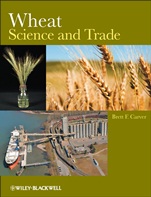
Wheat: Science and Trade
ISBN 9780813820248
Autor: Brett F. Carver
Wydawca: Wiley
Dostępność: 3-6 tygodni
Cena: 1 419,60 zł
Przed złożeniem zamówienia prosimy o kontakt mailowy celem potwierdzenia ceny.
ISBN13: |
9780813820248 |
ISBN10: |
0813820243 |
Autor: |
Brett F. Carver |
Oprawa: |
Hardback |
Rok Wydania: |
2009-05-29 |
Ilość stron: |
616 |
Wymiary: |
253x190 |
Tematy: |
TV |
As one of the world’s largest and most versatile crops, wheat has been the subject of much research from around the globe. Wheat: Science and Trade compiles classic principles of existing research and expands them to include recent advancements in genetics and industry trade for the most comprehensive reference work to date.
Wheat: Science and Trade is divided into four major sections covering all aspects of the wheat plant, crop, cultivar and industry. Section one offers a firm grounding in the development and domestication of wheat with an extensive overview of diseases and pathogens following in Section two. Section three focuses on genetic strategies including QTL detection and marker–assisted selection, genome organization and comparative genomics, and synthetic wheat as an emerging technology. Section four concludes the text with a discussion of changes in industry trade, quality assessment, and new uses for wheat and modified wheat products.
Written by a global team of expert authors, Wheat: Science and Trade is presented in a user–friendly format making it equally accessible to a wide variety of readers. Applicable for the academic, research, consulting, and end–user communities, this text is a must have reference on this key staple crop.
Key Features:Provides an up–to–date authoritative reference on a globally consumed and produced cropFocuses on the most economically significant production constraints and impactsIncludes interconnecting sections on the wheat plant, crop, cultivar, and industryIncludes chapters from a world–wide team of leading expertsProvides concise summaries for each chapter and perspectives on emerging research areas
Spis treści:
Foreword.
Preface.
Acknowledgements.
Contributors.
Section I: Making of a Wheat Plant.
1 Wheat evolution
, domestication, and improvement.
Summary.
Introduction.
Wheat domestication and human civilization.
Wheat cultivation.
Origin, domestication, and evolution of wheat.
Polyploidy, a form of plant evolution.
Origin of the A genome.
Origin of the B genome.
Emmer and durum wheat.
Origin of Triticum turgidum.
Origin of Triticum dicoccoides (wild emmer).
Origin of hexaploid wheat.
Genome evolution and modification.
Mechanisms for chromosome evolution.
Chromosomal rearrangements and repetitive DNA.
Heterochromatin.
Repetitive DNA.
Repatterning of rDNA arrays in the wheat genome.
Repetitive DNA and mobile elements as perpetual generators of diversity and evolution.
The potential of wild emmer in wheat improvement.
Concluding remarks on the process of wheat evolution.
Future perspectives.
References.
2 Development of the wheat plant.
Summary.
Introduction.
Scales of plant development.
Canopies.
Shoots or tillers.
Phytomers.
Morphological naming schemes.
Leaves.
Tillers.
Inflorescence parts.
Roots.
Shoot development.
Phenology.
Shoot apex.
Integrating phenology, the shoot apex, and phytomers.
Environmental factors influencing shoot development.
Temperature.
Nontemperature environmental factors.
Digital technologies for wheat development.
Linking molecular biology and functional genomics to development.
Future perspectives.
References.
3 The flowering pathway in wheat.
Summary.
Overview of flowering induction in wheat.
Genetic locations of flowering time genes.
Genetic loci regulating vernalization response.
VRN–1 on the long arm of homoeologous chromosomes 5.
VRN–Am2 on chromosome 5Am in a genomic region translocated from chromosome 4Am.
VRN–B3 on the short arm of chromosome 7B.
Other vernalization genes in wheat.
Genetic loci
regulating photoperiod sensitivity.
Genetic loci regulating plant development processes.
Quantitative trait loci affecting flowering time.
Epistatic interactions.
Positional cloning of flowering time genes in wheat.
VRN–Am1, an orthologue of AP1, promotes flowering.
VRN–Am2, a cct–domain–containing gene, represses flowering.
VRN–B3, an orthologue of FT, promotes flowering.
Successes in positional cloning of vernalization genes.
Orthologues of other known flowering time genes.
Concomitant transcriptional profiles of flowering time genes.
Comparative studies on flowering pathways in plants.
Flowering pathways in model species.
A model for the wheat flowering pathway.
Future perspectives.
References.
Section II: Making of a Wheat Crop.
4 Systems–based wheat management strategies.
Summary.
Introduction.
Advances in wheat management.
Yield building versus yield protecting factors.
Intensive wheat management.
Matching cultivar to environment.
Fertility and pest management.
Timeliness and precision.
Previous crop management.
Limitations of the system.
Dual–purpose wheat.
Description of the system and area of adaptation.
Characterizing a suitable dual–purpose cultivar.
Fertility management.
Grazing termination and impact on grain yield.
No–till wheat production.
Why no–till has increased.
Long–term experiments.
Future perspectives.
References.
5 Diseases which challenge global wheat production—the wheat rusts.
Summary.
Introduction.
Wheat leaf rust.
Distribution and epidemiology.
Origin and historical importance.
Effects on grain and flour quality.
Taxonomy, life cycle, and host range.
Genetic variation in P. triticina.
Virulence variation.
Molecular variation.
Leaf rust resistance in wheat.
Race–specific resistance.
Durable leaf rust resistance in wheat.
Association with other disease resistance genes.
Leaf rust resistance in durum wheat.
Wheat stripe rust.
Distribution and epidemiology.
Origin and historical importance.
Taxonomy, life cycle, and host range.
Genetic variation in Puccinia striiformis f. sp. tritici.
Virulence variation.
Molecular variation.
Stripe rust resistance in wheat.
Race–specific resistance.
High–temperature adult–plant resistance.
Slow–rusting resistance.
Wheat stem rust.
Distribution and epidemiology.
Origin and historical importance
Taxonomy, life cycle, and host range.
Genetic variation in Puccinia graminis f. sp. tritici.
Stem rust resistance in wheat.
Future perspectives.
References.
6 Diseases which challenge global wheat production—root, crown, and culm rots.
Summary.
Introduction.
Common root rot.
Symptoms and epidemiology.
Causal organism.
Disease management.
Fusarium crown rot.
Symptoms and epidemiology.
Causal organisms.
Disease management.
Pythium root rot.
Symptoms and epidemiology.
Causal organisms.
Disease management.
Rhizoctonia root rot and bare patch.
Symptoms and epidemiology.
Causal organisms.
Disease management.
Take–all.
Symptoms and epidemiology.
Causal organism.
Disease management.
Cephalosporium stripe.
Symptoms and epidemiology.
Causal organism.
Disease management.
Eyespot.
Symptoms and epidemiology.
Causal organisms.
Disease management.
Future perspectives.
References.
7 Diseases which challenge global wheat production—powdery mildew and leaf and head blights.
Summary.
Introduction.
Powdery mildew.
Taxonomy and life history.
Identification and symptomology.
Distribution and losses.
Patho
gen variability.
Stagonospora nodorum blotch.
Taxonomy and life history.
Identification and symptomology.
Distribution and losses.
Pathogen variability.
Septoria tritici blotch.
Taxonomy and life history.
Identification and symptomology.
Distribution and losses.
Pathogen variability.
Tan spot.
Taxonomy and life history.
Identification and symptomology.
Distribution and losses.
Pathogen variability.
Fusarium head blight.
Taxonomy and life history.
Identification and symptomology.
Distribution and losses.
Pathogen variability.
Management of residue–borne diseases.
Crop diversity.
Host–plant resistance.
Powdery mildew.
Stagonospora nodorum blotch.
Septoria tritici blotch.
Tan spot.
Fusarium head blight.
Future perspectives.
References.
8 Nematodes which challenge global wheat production.
Summary.
Introduction.
Cereal cyst nematode.
Symptoms and epidemiology.
Causal organisms.
Management.
Root–lesion nematode.
Symptoms and epidemiology.
Causal organisms.
Management.
Future perspectives.
References.
9 Insects which challenge global wheat production.
Summary.
Hessian fly.
Economic impact and distribution.
Biology, plant damage, and control methods.
Utilization of host–plant resistance.
Bird cherry–oat aphid.
Biology, plant damage, and control methods.
Utilization of host–plant resistance.
Greenbug.
Economic impact and distribution.
Biology, plant damage, and control methods.
Utilization of host–plant resistance.
Russian wheat aphid.
Economic impact and distribution.
Biology, plant damage, and control methods.
Utilization of host–plant resistance.
Future perspectives.
References.
10 Temporally and spatially dependent nitrogen management for diverse.
environments.
Summary.
Introduction.
Nitrogen–
;use efficiency as a driver of new technology.
Case study: What defines diverse environments.
Is nitrogen needed.
Importance of spatial variability on N requirement.
Importance of temporal and spatial variability combined.
Nutrient deficiencies other than N.
Prediction of yield potential.
Prediction of N responsiveness independent of yield potential.
Midseason N applications can result in maximum yields.
Determination of midseason N rate.
“Ramp” method of determining midseason N rate.
Future perspectives.
References.
11 Grain yield improvement in water–limited environments.
Summary.
Introduction.
Climate and crop growth.
Water–limited yield potential.
Characterizing target environments.
Breeding for improved performance under drought.
Yield potential and genetic gain in water–limited environments.
Physiological breeding.
Breeding tools.
Indirect selection via correlated traits.
High–throughput phenotyping.
Quantitative trait loci.
Functional genomics and beyond.
Defining the breeding target.
Increasing water uptake.
Stem carbohydrate production.
Tiller production.
Early leaf area development.
Transpiration efficiency.
Maintenance of leaf area.
Future perspectives.
References.
12 Cutting down on weeds to cut a cleaner wheat crop.
Summary.
Impact of weeds on wheat.
Competition.
Nutrients.
Light (shading).
Water.
Wheat grain yield.
Wheat grain quality and marketability.
Controlling weeds with integrated weed management systems.
Preventative control.
Cultural control.
Mechanical control by tillage.
Chemical control.
Biological control.
Weed spatial variation and precision farming.
Putting it all together: Examples of effective systems.
Winter wheat in North America: Winter wheat–summer crop–fallow.
Spring wheat in North America.
Spring wheat in A
ustralia.
Future perspectives.
References.
Section III: Making of a Wheat Cultivar.
13 Wheat breeding: Procedures and strategies.
Summary.
Brief history of wheat breeding.
The context of applied wheat breeding.
Accessing genetic resources.
Methods to generate genetic variation.
Hybridization.
Mutations.
Variation from in vitro tissue culture.
Transgenic wheat and its impact on wheat breeding.
Methods to assess genetic variation.
Methods of selecting while inbreeding to develop a cultivar.
Pedigree selection.
Bulk selection.
Single–seed descent.
Doubled haploid breeding.
Backcrossing.
Major issues all wheat breeders face.
Early– vs late–generation selection.
Impact of molecular markers on wheat breeding.
The practice of wheat breeding.
Extension of the theory.
Cultivar release.
Understanding the phenotype.
Breeding hybrid wheat.
Importance of technology.
Future perspectives.
Webliography.
References.
14 State of qtl detection and marker–assisted selection in wheat improvement.
Summary.
Introduction.
Breeding by visual selection.
Complex traits and gene pyramiding.
Genetic mapping.
Early progress and developments.
Genetic maps.
Consensus map.
Progress in marker technology.
Current progress in qtl analysis and deployment of mas.
Single–gene traits and complex traits.
Recurrent selection.
Replicated field analysis.
Haplotype analysis.
Gene cloning and perfect markers.
Complex traits.
Future developments and uses of qtl analysis and mapping.
Association mapping.
Gene expression analysis.
Future perspectives.
References.
15 Genome organization and comparative genomics.
Summary.
Mapping.
Genetic mapping.
Deletion mapping.
Comparative genetics.
Comparative mapping.
Triticeae tribe.
Pooideae subfamily.
Poaceae family.
Colinearity at the dna sequence level.
Map–based cloning.
Disease resistance genes.
Lr21.
Lr10.
Lr1.
Pm3.
Genes involved in adaptation.
Vrn–1, vrn–2, and vrn–3.
Q.
Ph1.
Physical mapping in hexaploid wheat.
Constructing subgenomic bac resources.
Advantages of subgenomic bac resources.
Chromosome–based approach offers more than subgenomic bac libraries.
Physical map of chromosome 3B—a case study.
Organization and evolution of the wheat genome.
Organization of genes and repeats.
Evolution of the wheat genome.
Toward sequencing the wheat genome.
Sanger sequencing.
Hierarchical genome sequencing.
Whole–genome shotgun sequencing.
Sequencing of gene–rich bac clones.
Sequencing the gene space using gene–enrichment methodologies.
New–generation sequencing technologies.
Future perspectives.
References.
16 Synthetic wheat—an emerging genetic resource.
Summary.
Introduction.
Primary synthetic hexaploid wheat.
New genetic variability for tolerance to biotic stress.
Rust diseases.
Septoria diseases and tan spot.
Karnal bunt.
Fusarium and powdery mildew diseases.
Insect pests.
Soilborne nematodes.
New genetic variability for tolerance to abiotic stress.
Drought.
Salinity and waterlogging.
Micronutrient imbalance.
Temperature stress.
Preharvest sprouting.
Grain quality attributes.
Strategies for using primary synthetics in applied wheat breeding.
Performance of derived synthetics.
Resistance to biotic stress.
Tolerance to abiotic stress.
Future perspectives.
References.
17 Success in wheat improvement.
Summary.
World yield gains.
Genetic component of grain yield improvement.
Empirical estimation of genetic gain.
Grain yield.
Yield components.
Wheat yield gains
Koszyk
Książek w koszyku: 0 szt.
Wartość zakupów: 0,00 zł
Informacje


Kontakt
Gambit
Centrum Oprogramowania
i Szkoleń Sp. z o.o.
Al. Pokoju 29b/22-24
31-564 Kraków
Siedziba Księgarni
ul. Kordylewskiego 1
31-542 Kraków
+48 12 410 5991
+48 12 410 5987
+48 12 410 5989
Subskrypcje
Administratorem danych osobowych jest firma Gambit COiS Sp. z o.o. Na podany adres będzie wysyłany wyłącznie biuletyn informacyjny.
Autoryzacja płatności

Informacje na temat autoryzacji płatności poprzez PayU.

© Copyright 2012: GAMBIT COiS Sp. z o.o. Wszelkie prawa zastrzeżone.
Projekt i wykonanie: Alchemia Studio Reklamy