


Wydawcy
Katalog tematyczny
- Archeologia (109)
- Ekonomia, finanse, business (13704)
- Filozofia (1445)
- Historia (3040)
- Języki i językoznawstwo (2356)
- Lifestyle, hobby i rozrywka (475)
- Medycyna (9704)
- Nauki humanistyczne (4)
- Nauki o Ziemi i środowisku (2638)
- Nauki ścisłe (20412)
- Nauki społeczne (8486)
- Edukacja (229)
- Kryminologia, opieka spełeczna (284)
- Obronność (10)
- Polityka (1389)
- Psychologia (777)
- Socjologia (410)
- Społeczeństwo i kultura (187)
- Nauki techniczne (13450)
- Prawo (1696)
- Publikacje informacyjne i interdyscyplinarne (1288)
- Religia i wierzenia (917)
- Technika komputerowa (4067)
- Zdrowie, relacje międzyludzkie i rozwój osobisty (657)





Informacje szczegółowe o książce
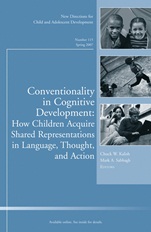
Conventionality in Cognitive Development: How Children Acquire Shared Representations in Language, Thought, and Action: New Directions for Child and Adolescent Development, Number 115
ISBN 9780787996970
Autor: Charles W. Kalish, Mark A. Sabbagh
Wydawca: Wiley
Dostępność: 3-6 tygodni
Cena: 162,75 zł
Przed złożeniem zamówienia prosimy o kontakt mailowy celem potwierdzenia ceny.
ISBN13: |
9780787996970 |
ISBN10: |
0787996971 |
Autor: |
Charles W. Kalish, Mark A. Sabbagh |
Oprawa: |
Paperback |
Rok Wydania: |
2007-04-18 |
Ilość stron: |
112 |
Wymiary: |
228x152 |
Tematy: |
JC |
An important part of cognitive development is coming to think in culturally normative ways. Children learn the right names for objects, proper functions for tools, appropriate ways to categorize, and the rules for games. In each of these cases, what makes a given practice normative is not naturally given. There is not necessarily any objectively better or worse way to do any of these things. Instead, what makes them correct is that people agree on how they should be done, and each of these practices therefore has an important conventional basis. The chapters in this volume highlight the fact that successful participation in practices of language, cognition, and play depends on children′s ability to acquire representations that other members of their social worlds share. Each of these domains poses problems of identifying normative standards and achieving coordination across agents. This volume brings together scholars from diverse areas in cognitive development to consider the psychological mechanisms supporting the use and acquisition of conventional knowledge.
Spis treści:
1. Conventionality and Cognitive Development: Learning to Think the Right Way (Charles W. Kalish, Mark A. Sabbagh)
Language, object categorization, tool use, and game playing are all characterized by conventionality, which has important implications for describing development in these fundamental domains.
2. Conventionality and Contrast in Language and Language Acquisition (Eve V. Clark)
When acquiring word meaning, syntax, and phonology, young children show evidence that they are especially motivated to acquire conventional forms that are provided by experts in their linguistic environment.
3. How an Appreciation of Conventionality Shapes Early Word Learning (Mark A. Sabbagh, Annette M. E. Henderson)
An assumption of conventionality provides children a basis for extending knowledge of words to other speakers, avoiding errors they
might encounter in everyday speech, and learning the meanings of new words.
4. Pragmatic and Prescriptive Aspects of Children’s Categorization (Charles W. Kalish)
When learning how to categorize, children face the general problem that conventionalized domains involve flexible, optional activities as well as normative, standardized practices.
5. Play, Games, and the Development of Collective Intentionality (Hannes Rakoczy)
Through children’s play, researchers can gain insight into the developmental trajectory of children’s ability to negotiate agreements about the right way to share goals and intentions in a given setting.
6. The Role of Information About "Convention," "Design," and "Goal" in Representing Artificial Kinds (Tim P. German, Danielle Truxaw, Margaret Anne Defeyter)
When determining the correct function of a given artifact, children seem to weigh information about the creator’s intended use more heavily than other sources of information, including community agreement.
7. Conventionality in Family Conversations About Everyday Objects (Maureen A. Callanan, Deborah R. Siegel, Megan R. Luce)
During everyday conversations in various contexts, parents subtly promote an understanding of conventionality by providing young children with information that particular ways of using words or artifacts are more normative than others.
INDEX.
Okładka tylna:
An important part of cognitive development is coming to think in culturally normative ways. Children learn the right names for objects, proper functions for tools, appropriate ways to categorize, and the rules for games. In each of these cases, what makes a given practice normative is not naturally given. There is not necessarily any objectively better or worse way to do any of these things. Instead, what makes them correct is that people agree on how they should be done, and each of these practices therefore has an im
portant conventional basis. The chapters in this volume highlight the fact that successful participation in practices of language, cognition, and play depends on children′s ability to acquire representations that other members of their social worlds share. Each of these domains poses problems of identifying normative standards and achieving coordination across agents. This volume brings together scholars from diverse areas in cognitive development to consider the psychological mechanisms supporting the use and acquisition of conventional knowledge.
Koszyk
Książek w koszyku: 0 szt.
Wartość zakupów: 0,00 zł
Informacje


Kontakt
Gambit
Centrum Oprogramowania
i Szkoleń Sp. z o.o.
Al. Pokoju 29b/22-24
31-564 Kraków
Siedziba Księgarni
ul. Kordylewskiego 1
31-542 Kraków
+48 12 410 5991
+48 12 410 5987
+48 12 410 5989
Subskrypcje
Administratorem danych osobowych jest firma Gambit COiS Sp. z o.o. Na podany adres będzie wysyłany wyłącznie biuletyn informacyjny.
Autoryzacja płatności

Informacje na temat autoryzacji płatności poprzez PayU.

© Copyright 2012: GAMBIT COiS Sp. z o.o. Wszelkie prawa zastrzeżone.
Projekt i wykonanie: Alchemia Studio Reklamy