


Wydawcy
Katalog tematyczny
- Archeologia (109)
- Ekonomia, finanse, business (13704)
- Filozofia (1445)
- Historia (3040)
- Języki i językoznawstwo (2356)
- Lifestyle, hobby i rozrywka (475)
- Medycyna (9704)
- Nauki humanistyczne (4)
- Nauki o Ziemi i środowisku (2638)
- Nauki ścisłe (20412)
- Nauki społeczne (8486)
- Nauki techniczne (13450)
- Prawo (1696)
- Publikacje informacyjne i interdyscyplinarne (1288)
- Religia i wierzenia (917)
- Technika komputerowa (4067)
- Zdrowie, relacje międzyludzkie i rozwój osobisty (657)





Informacje szczegółowe o książce
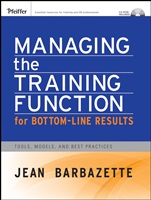
Managing the Training Function For Bottom Line Results: Tools, Models and Best Practices
ISBN 9780787982430
Autor: Jean Barbazette
Wydawca: Wiley
Dostępność: 3-6 tygodni
Cena: 300,30 zł
Przed złożeniem zamówienia prosimy o kontakt mailowy celem potwierdzenia ceny.
ISBN13: |
9780787982430 |
ISBN10: |
0787982431 |
Autor: |
Jean Barbazette |
Oprawa: |
Paperback |
Rok Wydania: |
2007-12-18 |
Ilość stron: |
300 |
Wymiary: |
235x190 |
Tematy: |
KM |
The hands–on survival guide for workplace learning professionals
No matter what type of training you are required to produce, Managing the Training Function for Bottom–Line Results will help you assess, clarify, and develop ten key activities of the training function. Written by Jean Barbazette—an expert in the field of training and development—this book is filled with best practices, illustrative success stories, and practical ideas for moving the training function to the next level.
No matter how large or small your training department may be, this important resource gathers in one place all the tools you need for effectively managing the function including?staff management, setting the learning agenda, hiring consultants and vendors, managing content, creating and managing a learning resource center, building internal?support for training, integrating learning into the business, and much more.?The book also provides a unique opportunity to learn from organizations such as Maryland Transit Association, Baxter BioScience, the Utah National Guard, and University of Toyota.
Praise for Managing the Training Function for Bottom–Line Results
"If you want to improve the value of your training department and improve the capabilities of your organization,?start with this excellent book."
—Captain Richard Harper, Training Division Commander, SALETC/Public Safety Academy, Tucson Police Department
"Managing the Training Function helps identify the desired versus existing training practices and also how to prioritize the list and work on factors critical to business first and then the least important factors."
—Harpreet Ghumman, training manager, Hutch Telecom, India
"I would like to recommend this book to everyone managing a training function, even if your training department has only a single person in charge, it will be of great help to you and your organization."
—Patrick Maetens, manager trainin
g, Johnson & Johnson Pharmaceutical Research and Development, Belgium
Spis treści:
Case Studies, Tools, and Exhibits.
Contents of the CD–ROM.
Acknowledgments.
Introduction.
Chapter 1: Training Function Systems Audit.
Define a Training Function.
Clarify which roles and responsibilities apply to ten key areas your current function.
Benchmark major activities performed by training managers and generate a report card score for the training function.
Identify performance gaps and target parts of this book that will be of greatest help in developing the training manager′s skills.
Learn how one organization used the training department systems audit to improve its operation.
Chapter 2: Prioritize Training Responsibilities.
Identify Key Duties and Responsibilities for the Training Function.
Develop Priorities Consistent with the Business Plan.
Link Assessments to Vision, Mission, and Business Plan.
Develop a Training Department "Mission Statement".
Anticipate Future Needs and Use Short–Term and Long–Term Planning.
Develop Your Own Job Description.
Prepare, Monitor, and Modify a Budget.
Ensure Legal, Ethical, and Regulatory Compliance.
Participate in Outside Professional Organizations.
Keep Up–to–Date with Training Trends.
Chapter 3: The Performance Consulting Approach to Managing a Training Function.
What a Performance Consulting Approach Is.
Benefits of a Performance Consulting Approach.
Performance Consulting Roles, Multiple Roles of a Trainer.
Performance Consulting Role Choices.
Eight–Step Performance Consulting Process.
Strategies in Transitioning to a Performance Consulting Approach.
Chapter 4: Gain Support for the Training Function.
Identify the Benefits of Building a Partnership Between Managers/Supervisors and the Training Function.
Identify Tactics to Build the Partnership Before
Performance Interventions.
Identify Tactics to Build the Partnership During Performance Interventions.
Identify Tactics to Build the Partnership Following Performance Interventions.
A Final Strategy.
Chapter 5: Project Management Skills for Training Managers.
Project Management and the Eight–Step Consulting Process
Initiate a Project by Assessing the Need to Create a Project Team and Gain Authorization.
Plan the Project.
Use Project Management Tools Appropriately to Execute the Project.
Use Project Management Tools to Control the Project.
Close Projects Appropriately.
Chapter 6: Select Training Programs and Packages.
Identify Essential Elements of the Buying Process.
Write a Request for Proposal (RFP).
Identify External Resources.
Set Criteria to Review Training Program Proposals.
Determine Lessons Learned from Purchasing Pitfalls.
Chapter 7: How to Hire a Consultant or External Trainer.
Select a Consultant or External Trainer.
Find the Right Kind of Consulting Help.
Interview a Consultant.
Monitor the Consultant′s Work.
Chapter 8: How to Manage a Training Staff.
Make Staffing Choices.
Select Internal Trainers.
Give Feedback to Internal Trainers.
Improve Internal Trainer Skills.
Use Different Types of Training Methodologies.
Use a Variety of Trainer Roles.
Maintain Courses.
Develop a Leader′s Guide.
Use Competencies to Supervise, Coach, and Develop Trainers and Course Designers.
Appreciate the Benefits of Certification Programs.
Chapter 9: Select and Coach Subject–Matter Experts as Internal Trainers.
Select Subject–Matter Experts as Internal Trainers.
Establish an Internal Trainer Selection Process.
Chapter 10: Successful Strategies for Marketing Training Internally.
Define Marketing.
Identify Successful Techniques to Market the Training Function.
Create a Partnership with Superv
isors to Avoid "No Shows" at Training Events.
Chapter 11: Publicize Training Events.
Publicize a Variety of Training Services.
Prepare Training Announcements, Course Catalogues, and Brochures.
Write Training Announcements.
Publicize Training Results.
Use Recognition Tools.
Brown Bag Seminars.
Decide How Often to Maintain the Website.
Chapter 12: Smoothly Administer Training Events.
Plan Training Events.
Scheduling Training Events.
Workshop Registration Process.
Common Features of Software.
Workshop Confirmation Process.
Final Workshop Preparation.
Workshop Follow–Up.
Chapter 13: Set Up Off–Site Training Events.
Negotiate and Coordinate with Hotels for Off–Site Meeting Rooms.
Make Travel Arrangements for Instructors and Training Participants.
Chapter 14: Set Up and Run a Corporate Resource Center.
Maintain a Corporate Library and Resource Center.
Purchase Audiovisual Equipment.
Maintain Equipment and Inventory.
Order Training Materials and Supplies.
Produce Audiovisual and Written Materials.
Monitor Tuition Reimbursement Programs.
Appendix A: Bibliography.
Appendix B: Training Resources.
Appendix C: Five Steps of Adult Learning.
Nota biograficzna:
Jean Barbazette is the president of The Training Clinic, a training and consulting firm she founded in 1977. Her company focuses on training trainers throughout the United States for major profit, non–profit, and government organizations. The Training Clinic has three international licensees in the Netherlands, Hungary, and Colombia. Prior books include The Art of Great Training Delivery, Successful New Employee Orientation (2nd ed.), Instant Case Studies, The Trainer′s Journey to Competence, and Training Needs Assessment, all from Pfeiffer, and The Trainer′s Support Handbook from McGraw–Hill. She is a frequent contributor to ASTD Training & De
Koszyk
Książek w koszyku: 0 szt.
Wartość zakupów: 0,00 zł
Informacje


Kontakt
Gambit
Centrum Oprogramowania
i Szkoleń Sp. z o.o.
Al. Pokoju 29b/22-24
31-564 Kraków
Siedziba Księgarni
ul. Kordylewskiego 1
31-542 Kraków
+48 12 410 5991
+48 12 410 5987
+48 12 410 5989
Subskrypcje
Administratorem danych osobowych jest firma Gambit COiS Sp. z o.o. Na podany adres będzie wysyłany wyłącznie biuletyn informacyjny.
Autoryzacja płatności

Informacje na temat autoryzacji płatności poprzez PayU.

© Copyright 2012: GAMBIT COiS Sp. z o.o. Wszelkie prawa zastrzeżone.
Projekt i wykonanie: Alchemia Studio Reklamy