


Wydawcy
Katalog tematyczny
- Archeologia (109)
- Ekonomia, finanse, business (13704)
- Filozofia (1445)
- Historia (3040)
- Języki i językoznawstwo (2356)
- Lifestyle, hobby i rozrywka (475)
- Medycyna (9704)
- Nauki humanistyczne (4)
- Nauki o Ziemi i środowisku (2638)
- Nauki ścisłe (20412)
- Nauki społeczne (8486)
- Nauki techniczne (13450)
- Prawo (1696)
- Publikacje informacyjne i interdyscyplinarne (1288)
- Religia i wierzenia (917)
- Technika komputerowa (4067)
- Zdrowie, relacje międzyludzkie i rozwój osobisty (657)





Informacje szczegółowe o książce
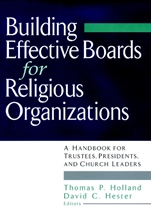
Building Effective Boards for Religious Organizations: A Handbook for Trustees, Presidents, and Church Leaders
ISBN 9780787945633
Autor: Thomas P. Holland, David C. Hester
Wydawca: Wiley
Dostępność: 3-6 tygodni
Cena: 190,05 zł
Przed złożeniem zamówienia prosimy o kontakt mailowy celem potwierdzenia ceny.
ISBN13: |
9780787945633 |
ISBN10: |
0787945633 |
Autor: |
Thomas P. Holland, David C. Hester |
Oprawa: |
Paperback |
Rok Wydania: |
1999-11-02 |
Ilość stron: |
240 |
Wymiary: |
229x154 |
Tematy: |
HRB |
Nonprofit boards are, without question, most effective when they′re structured around the organization′s goals. If an organization′s mission is religious–as it is for about half of all nonprofits–the board must interpret its roles and responsibilities accordingly if it is to function properly. Building Effective Boards for Religious Organizations–a first–ever look at a board′s crucial role in a religious nonprofit–is a comprehensive, practical handbook for any religious organization. Drawing clear insights from a wide variety of religious board experts, Building Effective Boards for Religious Organizations addresses the challenges of understanding how and why religious boards operate as they do. Through case studies and concrete recommendations, this dynamic guide shows how boards can replace the hierarchical management model with a cooperative model of trusteeship that encourages a faithful, and more effective, practice of governance. It illuminates the board′s proper role in strategic planning, offers insights on how to deal with mergers, provides a process for reading the current health of the organization, and shows how a deep appreciation of the organization′s mission enables boards to organize for greater impact. Focusing close attention on specific dimensions of the board–from its structure and communication functions to its application of religious beliefs and traditions in its work–the authors offer many practical ways a board can work to improve effectiveness. They show how to get started on change, how to identify shared priorities for action, how to generate movement and sustain ongoing growth, and how to make better use of information and communication formats to support greater effectiveness. Building Effective Boards for Religious Organizations gives religious boards precisely the perspectives, models, and tools they need to advance a wide range of issues and shows them how to work together more creatively and productively. Members of the boards of local congregations of every denomination, judicatories and denominational bodies, seminaries and religious universities, religiously sponsored health care organizations, social service agencies, community ministries, and others who want their religious commitments to provide a stronger ground for their governance responsibilities will find essential knowledge and tools here. Everything a Religious Board Needs to Know to Work More Effectively Through their admirable energy, dedication, and leadership, religious board members sustain our world′s most invaluable organizations. This in–depth handbook offers essential insights from respected veterans of religious and nonprofit work on governing an organization with a religious mission. Drawing on years of research, consulting, and hands–on religious nonprofit work, the authors show how board members can clearly define their roles and mission, transform hierarchical structures into models of collaborative leadership, and organize for greater impact. From congregations and seminaries to soup kitchens, hospital chains, and social service agencies, Building Effective Boards for Religious Organizations examines both the nature and nurture of religious boards. Interfaith in scope and brimming with real–life examples, it skillfully demonstrates how a religious board can escape common problems, and how understanding the full depth of the organization′s mission can help it best fulfill its intended purpose. "This book is truly masterful. It matches our situation so well it is uncanny. The book will act as the sailor′s basic navigation tools for nonprofit managers and trustees. It is very learning–community oriented and has high value for everyone."—William Andersen, executive director, The Episcopal Church Foundation "Should be on the desk in every religious organization. Holland and Hester guide the reader through governance basics, from purpose to planning, with faithful attention to the special role of shared leadership."—Pat Murrell, professor, University of Memphis "This book is an excellent resource for boards of religious organizations. Each essay contains at least one model on which to reflect or a tool with which to strengthen a board."—Margaret M. Healy, president, Rosemont College "If you want to improve the governance of religious organizations, read this book. The assembled experts provide a roadmap for how a board can add value to the organization it serves."—Eugene R. Smoley, Jr., senior fellow, The Cheswick Center "This ought to be required reading for any member of a religious board and those who serve with them."—John M. Mulder, president, Louisville Presbyterian Theological Seminary
Preface. PRACTICING FAITHFUL GOVERNANCE. Stewards of Hope: The Work of Trustees (M. Warford). The Duties and Responsibilities of Boards of Religious Organizations (T. Holland). The Religious Mission of the Board (W. Sachs). Practicing Governance in the Light of Faith (D. Hester). IMPROVING THE BOARD′S PERFORMANCE. Developing a More Effective Board (T. Holland). Beyond Hierarchies: Transforming Power and Leadership (T. Savage). Boundary Spanning: Building Bridges Between an Organization and Its Environment (C. Klein). The Merger Challenge: Building a Cohesive Culture (D. Nygren, et al.). The Board′s Role in Shaping Strategy (R. Chait). Providing Meaningful Information for Governance (L. Butler). Conclusion: Turning Toward the Future. Index.
THOMAS P. HOLLAND, Ph.D., is a professor and director of the Institute for Nonprofit Organizations, University of Georgia School of Social Work. He has done extensive research and consulting on strengthening board effectiveness and is the author of many books, including Improving Board Effectiveness (1997). DAVID C. HESTER, Ph.D., is professor of Christian education at Louisville Presbyterian Theological Seminary. Along with Dr. Holland, he was the recipient of a Lilly Endowment grant to study and evaluate board development programs at seminaries throughout the United States.
"This book is truly masterful. It matches our situation so well it is uncanny. The book will act as the sailor′s basic navigation tools for nonprofit managers and trustees. It is very learning–community oriented and has high value for everyone." ––William Andersen, executive director, The Episcopal Church Foundation "Should be on the desk in every religious organization. Holland and Hester guide the reader through governance basics, from purpose to planning, with faithful attention to the special role of shared leadership." ––Pat Murrell, professor, University of Memphis "This book is an excellent resource for boards of religious organizations. Each essay contains at least one model on which to reflect or a tool with which to strengthen a board." ––Margaret M. Healy, president, Rosemont College "If you want to improve the governance of religious organizations, read this book. The assembled experts provide a roadmap for how a board can add value to the organization it serves." ––Eugene R. Smoley, Jr., senior fellow, The Cheswick Center "This ought to be required reading for any member of a religious board and those who serve with them." ––John M. Mulder, president, Louisville Presbyterian Theological Seminary "A rare opportunity to encounter the experience of the most respected leaders in the governance of theological education. Presidents should not miss it." ––Ansley Coe Throckmorton, president, Bangor Theological Seminary
Koszyk
Książek w koszyku: 0 szt.
Wartość zakupów: 0,00 zł
Informacje


Kontakt
Gambit
Centrum Oprogramowania
i Szkoleń Sp. z o.o.
Al. Pokoju 29b/22-24
31-564 Kraków
Siedziba Księgarni
ul. Kordylewskiego 1
31-542 Kraków
+48 12 410 5991
+48 12 410 5987
+48 12 410 5989
Subskrypcje
Administratorem danych osobowych jest firma Gambit COiS Sp. z o.o. Na podany adres będzie wysyłany wyłącznie biuletyn informacyjny.
Autoryzacja płatności

Informacje na temat autoryzacji płatności poprzez PayU.

© Copyright 2012: GAMBIT COiS Sp. z o.o. Wszelkie prawa zastrzeżone.
Projekt i wykonanie: Alchemia Studio Reklamy