


Wydawcy
Katalog tematyczny
- Archeologia (6)
- Ekonomia, finanse, business (87)
- Historia (5)
- Medycyna (1123)
- Nauki o Ziemi i środowisku (299)
- Nauki ścisłe (2368)
- Nauki społeczne (35)
- Nauki techniczne (950)
- Prawo (8)
- Publikacje informacyjne i interdyscyplinarne (36)
- Technika komputerowa (126)
- Zdrowie, relacje międzyludzkie i rozwój osobisty (2)





Informacje szczegółowe o książce
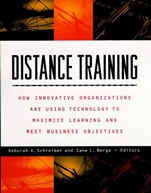
Distance Training: How Innovative Organizations are Using Technology to Maximize Learning and Meet Business Objectives
ISBN 9780787943134
Autor: Deborah A. Schreiber, Zane L. Berge
Wydawca: Wiley
Dostępność: 3-6 tygodni
Cena: 233,10 zł
Przed złożeniem zamówienia prosimy o kontakt mailowy celem potwierdzenia ceny.
ISBN13: |
9780787943134 |
ISBN10: |
0787943134 |
Autor: |
Deborah A. Schreiber, Zane L. Berge |
Oprawa: |
Paperback |
Rok Wydania: |
1998-11-06 |
Ilość stron: |
496 |
Wymiary: |
235x191 |
Tematy: |
JD |
For the distance training provider, today′s amazing array of advanced communications technologies poses many exciting possibilities. But it also makes for a daunting challenge. How can you employ these technologies–each with its inherent strengths and limitations–to implement the most effective distance and distributed learning? And how can you use them to best meet your organization′s strategic goals?
Through the use of sixteen lively case studies, Distance Training shows readers the innovative ways in which organizations have used various communications technologies to maximize employee learning and meet business objectives.
Each study illustrates distance–training applications ranging from the dissemination of information to building skills in critical thinking and problem solving, to changing attitudes, and to shaping organizational culture. Taken from corporations, nonprofits, and government agencies, these studies also show how providers managed to overcome the many organizational and technical obstacles that stood between them and the successful realization of their learning events, programs, and designs.
Readers will benefit from the best practices embedded in each case study, which are summarized at the end of the book. They will also gain from the set of guiding principles that provides a framework for discussing distance learning in organizations–principles that represent systems engineering strategies for the design, development, and implementation of distance training processes.
Including a history of distance training and in–depth advice on instructional design, policy issues, organizational restructuring, and technical and electronic systems development, Distance Training gives practitioners and aspirants to the field a concrete, real–world look at how state–of–the–art distance learning can actually be achieved.
Spis treści:
Introduction.
Organ
izational Technology and Its Impact on Distance Training (D. Schreiber).
Conceptual Frameworks in Distance Training and Education (Z. Berge).
Instructional Design of Distance Training (D. Screiber).
DISTRIBUTING INFORMATION AND INCREASING KNOWLEDGE.
Building Customer Relations: Web–Based Training for the Home Improvement Industry.
Increasing Employee Knowledge and Understanding of Operational Systems: Integrating Multiple Technologies at NYNEX (B. Howard).
Disseminating Time–Sensitive Information: Using Interactive Distance Learning to Deliver Training and Education in the American Red Cross Biomedical Services (L. Klueter & E. Kalweit).
Disseminating Time– and Regualtion–Sensitive Information: Online Training Seminars at Mortgage Bankers Association of America (T. Monahan).
Graduate Programs at a Distance: A Partnership Between the California Department of Rehabilitation and San Diego State University (M. Warn, et al.).
BUILDING SKILLS (TECHNICAL AND CRITICAL THINKING).
Reskilling Employees for Competitve Advantage: Reinventing Learning at Unisys Corporation.
Delivering Technical Training to Advance Mechanical Skills: Interactive Video Teletraining in the Federal Aviation Administration (L. Payneand & H. Payne).
Delivering Clinical– Based Training in a Public Health Setting (J. Place, et al.).
Skills–Based Distance Training for a Global Environment: Malaysia′s Virtual University (M. Ress & P. Sonberg).
The Value of Building Skills with Online Technology: Online Training Costs and Evaluation at the Texas Natural Resource Conservation Commission (S. Walker).
Building Intranet Courseware Using Multidisciplinary Teams: The Story of Quantum Solutions, Inc. and Colombia/
HCA Healthcare Corporation (A. Yakimivicz).
CHANGING ATTITUDES AND ENHANCING MOTIVATION.
Eliciting Community Beliefs and Changing Attitudes Through Education: Innovative Distance Learning at the C
olombus Center (R. Bento, et al.).
Measuring attitudes to Assess Trainig: The Interactive Distance Learning Group Looks at Learning and Transfer from Satellite Training (J. Dessinger, et al.).
Unanticipated Attitudianl Cahnge: The Progression Toward Self– Directed Distance Training at H.B. Zachry (L. Dooley, et al.).
Utilizing Telelearning as a Strategic Media Choice to Enhance Executive Development and Affect Organizational Perspective: The U.S. Navy′s Bureau of Medicine and Surgery (BUMED) (J. Suchan & A. Crawford).
Conclusion.
Best Practices of Distance Training (D. Schreiber).
Nota biograficzna:
DEBORAH A. SCHREIBER is founder and president of D.A. Schreiber, Inc., a distance learning consulting group that specializes in the corporate application of distance training. She also serves on the faculty of the University of Maryland Baltimore County in the Instructional Systems Development and Technology Graduate Program. ZANE L. BERGE is director of training systems in the Instructional Systems Development and Technology Graduate Program at UMBC. He has edited seven books, written numerous articles, and conducts workshops and presentations on distance teaching and learning.
Okładka tylna:
For the distance training provider, today′s amazing array of advanced communications technologies poses many exciting possibilities. But it also makes for a daunting challenge. How can you employ these technologies–each with its inherent strengths and limitations–to implement the most effective distance and distributed learning? And how can you use them to best meet your organization′s strategic goals?
Through the use of sixteen lively case studies, Distance Training shows readers the innovative ways in which organizations have used various communications technologies to maximize employee learning and meet business objectives.
Each study illustrates distance–training applicat
ions ranging from the dissemination of information to building skills in critical thinking and problem solving, to changing attitudes, and to shaping organizational culture. Taken from corporations, nonprofits, and government agencies, these studies also show how providers managed to overcome the many organizational and technical obstacles that stood between them and the successful realization of their learning events, programs, and designs.
Readers will benefit from the best practices embedded in each case study, which are summarized at the end of the book. They will also gain from the set of guiding principles that provides a framework for discussing distance learning in organizations–principles that represent systems engineering strategies for the design, development, and implementation of distance training processes.
Including a history of distance training and in–depth advice on instructional design, policy issues, organizational restructuring, and technical and electronic systems development, Distance Training gives practitioners and aspirants to the field a concrete, real–world look at how state–of–the–art distance learning can actually be achieved.
Koszyk
Książek w koszyku: 0 szt.
Wartość zakupów: 0,00 zł
Informacje


Kontakt
Gambit
Centrum Oprogramowania
i Szkoleń Sp. z o.o.
Al. Pokoju 29b/22-24
31-564 Kraków
Siedziba Księgarni
ul. Kordylewskiego 1
31-542 Kraków
+48 12 410 5991
+48 12 410 5987
+48 12 410 5989
Subskrypcje
Administratorem danych osobowych jest firma Gambit COiS Sp. z o.o. Na podany adres będzie wysyłany wyłącznie biuletyn informacyjny.
Autoryzacja płatności

Informacje na temat autoryzacji płatności poprzez PayU.

© Copyright 2012: GAMBIT COiS Sp. z o.o. Wszelkie prawa zastrzeżone.
Projekt i wykonanie: Alchemia Studio Reklamy