


Wydawcy
Katalog tematyczny
- Archeologia (109)
- Ekonomia, finanse, business (13704)
- Filozofia (1445)
- Historia (3040)
- Języki i językoznawstwo (2356)
- Lifestyle, hobby i rozrywka (475)
- Medycyna (9704)
- Nauki humanistyczne (4)
- Nauki o Ziemi i środowisku (2638)
- Nauki ścisłe (20412)
- Astronomia (294)
- Biologia (5119)
- Chemia (6540)
- Fizyka (3309)
- Matematyka (4574)
- Nauki ścisłe, ogólnie (503)
- Nauki społeczne (8486)
- Nauki techniczne (13450)
- Prawo (1696)
- Publikacje informacyjne i interdyscyplinarne (1288)
- Religia i wierzenia (917)
- Technika komputerowa (4067)
- Zdrowie, relacje międzyludzkie i rozwój osobisty (657)





Informacje szczegółowe o książce
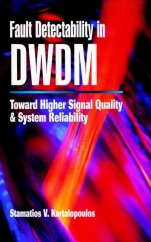
Fault Detectability in DWDM: Toward Higher Signal Quality and System Reliability
ISBN 9780780360440
Autor: Stamatios V. Kartalopoulos
Wydawca: Wiley
Dostępność: 3-6 tygodni
Cena: 560,70 zł
Przed złożeniem zamówienia prosimy o kontakt mailowy celem potwierdzenia ceny.
ISBN13: |
9780780360440 |
ISBN10: |
0780360443 |
Autor: |
Stamatios V. Kartalopoulos |
Oprawa: |
Hardback |
Rok Wydania: |
2001-03-09 |
Ilość stron: |
156 |
Wymiary: |
238x156 |
Tematy: |
P |
Enhance your understanding of the failure mechanisms of optical components, and draft fault detection guidelines to design a robust Dense Wavelength Digital Multiplexing (DWDM) system and network that exhibits and maintains optical signal quality and system reliability.
This valuable reference builds on Dr. Kartalopoulos′ seminal book on the subject, Introduction to DWDM Technology: Data in a Rainbow, providing an analytical approach to degradations and ′photonic′ faults that affect the quality of the multiwavelength transmission of optical signals.
Organized in six chapters, FAULT DETECTABILITY IN DWDM includes detailed descriptions of the properties of light and optical communications, optical components, interaction of wavelengths and faults affecting the quality of the optical signal and the system, correlation of faults, aspects of fault management, and current issues in DWDM.
This comprehensive book directs practicing electrical engineers, optical systems designers, optical network architects, fault management engineers, technical managers, optical systems technical marketing and optical communications students on how to use DWDM technology efficiently, effectively and reliably.
Spis treści:
Preface.
Acknowledgments.
Introduction.
Chapter 1: Properties of Light and Matter.
1.1: Introduction.
1.2: Nature of Light.
1.3: Reflection, Refraction, and Diffraction.
1.4: Polarization of Light.
1.5: Propagation of Light.
1.6: Fiber Birefringence and Polarization.
1.7: Dispersion.
1.8: Fiber Attenuation and Loss.
1.9: Fiber Spectrum Utilization.
1.10: Nonlinear Phenomena.
1.11: Spectral Broadening.
1.12: Self–Phase Modulation.
1.13: Self–Modulation or Modulation Instability.
1.14: Effects of Temperature on Matter and Light.
1.15: Light Attributes.
1.16: Material Attributes.
1.17: Measurable Parameters.
References.
Standards.
Chapte
r 2: Optical Components.
2.1: Introduction.
2.2: Laser Sources.
2.3: Optical Comb Generators.
2.4: Chirped–Pulse Laser Sources.
2.5: Modulators.
2.6: Photodetectors.
2.7: Fixed Optical Filters.
2.8: Tunable Optical Filters.
2.9: Diffraction Gratings.
2.10: Arrayed Waveguide Grating.
2.11: Directional Couplers.
2.12: Optical Isolators.
2.13: Polarizers, Rotators, and Circulators.
2.14: Optical Equalizers.
2.15: Superprisms.
2.16: Optical Multiplexers and Demultiplexers.
2.17: Optical Cross–Connects.
2.18: Optical Add–Drop Multiplexers.
2.19: Optical Amplifiers.
2.20: Classification of Optical Fiber Amplifiers.
2.21: Wavelength Converters.
References.
Standards.
Chapter 3: Parameters Affecting the Optical DWDM Signal.
3.1: Introduction.
3.2: Component Parameters.
References.
Standards.
Chapter 4: Faults Affecting the Optical DWDM Signal.
4.1: Introduction.
4.2: Components.
4.3: Filters: Fabry–Perot (Passive, Fixed).
4.4: Filters: Fiber Bragg Grating (Passive, Fixed).
4.5: Filters: Chirped FBG (Passive, Fixed).
4.6: Filters: Acousto–Optic Tunable Ti:LiNbO3.
4.7: SOA: InGaAsP.
4.8: OFA: Factors Affecting Integrity and Quality of Signal.
4.9: OFA: Single Pump.
4.10: OFA: Double Pump.
4.11: Mux/Demux.
4.12: OXC: MEMS.
4.13: OXC: LiNbO3.
4.14: OXC Liquid Crystal.
4.15: OADM: LiNbO3 Based.
4.16: OADM: MEMS with Grating.
4.17: Transmitter: Laser.
4.18: Receiver: PIN Diode.
4.19: Fiber: Single Mode.
References.
Standards.
Chapter 5: Fault Correlation.
5.1: Introduction.
5.2: Correlation of Faults and Component Parameter Changes.
5.3: Open Issues: Nonlinear Effects.
References.
Standards.
Chapter 6: Toward DWDM Fault Management and Current Issues.
6.1: Introduction.
6.2: Toward Fault Management.
6.3: Current Issues.
6.4: Engineering DW
DM Systems: Conclusion.
References.
Standards.
Acronyms.
Index.
About the Author.
Nota biograficzna:
Dr. Stamatios Kartalopoulos′ research interests and expertise include DWDM, IP, SONET/SDH, ATM over SONET/SDH, digital cross–connects, local area networks, transmission and access systems, ultrafast pattern recognition, access and enterprise systems, local area networks, satellite systems, high–efficiency scalable protocols, intelligent signal processing, neural networks and fuzzy logic, control architectures, real–time multitasking, and complex VLSI design. He has led and managed teams in these areas. He holds several patents, seven of which (and seven pending) are in communications and optical communications systems. Dr. Kartalopoulos currently works in the Advanced Optical Networking Center of Lucent Technologies, Bell Labs Innovations. For his accomplishments, he has received the President′s Award, the Award of Excellence, and numerous certificates of appreciation. He is also a distinguished lecturer and a speaker recognized internationally.
Dr. Kartalopoulos is the author of Introduction to DWDM Technology: Data in a Rainbow (IEEE Press, 2000), Understanding SONET/SDH and ATM (IEEE Press, 1999), and Understanding Neural Networks and Fuzzy Logic (IEEE Press, 1996) and has contributed chapters to other books.
Koszyk
Książek w koszyku: 0 szt.
Wartość zakupów: 0,00 zł
Informacje


Kontakt
Gambit
Centrum Oprogramowania
i Szkoleń Sp. z o.o.
Al. Pokoju 29b/22-24
31-564 Kraków
Siedziba Księgarni
ul. Kordylewskiego 1
31-542 Kraków
+48 12 410 5991
+48 12 410 5987
+48 12 410 5989
Subskrypcje
Administratorem danych osobowych jest firma Gambit COiS Sp. z o.o. Na podany adres będzie wysyłany wyłącznie biuletyn informacyjny.
Autoryzacja płatności

Informacje na temat autoryzacji płatności poprzez PayU.

© Copyright 2012: GAMBIT COiS Sp. z o.o. Wszelkie prawa zastrzeżone.
Projekt i wykonanie: Alchemia Studio Reklamy