


Wydawcy
Katalog tematyczny
- Archeologia (109)
- Ekonomia, finanse, business (13704)
- Filozofia (1445)
- Historia (3040)
- Języki i językoznawstwo (2356)
- Lifestyle, hobby i rozrywka (475)
- Medycyna (9704)
- Nauki humanistyczne (4)
- Nauki o Ziemi i środowisku (2638)
- Nauki ścisłe (20412)
- Astronomia (294)
- Biologia (5119)
- Chemia (6540)
- Fizyka (3309)
- Matematyka (4574)
- Nauki ścisłe, ogólnie (503)
- Nauki społeczne (8486)
- Nauki techniczne (13450)
- Prawo (1696)
- Publikacje informacyjne i interdyscyplinarne (1288)
- Religia i wierzenia (917)
- Technika komputerowa (4067)
- Zdrowie, relacje międzyludzkie i rozwój osobisty (657)





Informacje szczegółowe o książce
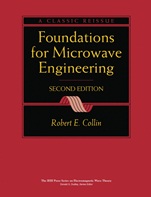
Foundations for Microwave Engineering
ISBN 9780780360310
Autor: Robert E. Collin
Wydawca: Wiley
Dostępność: 3-6 tygodni
Cena: 930,30 zł
Przed złożeniem zamówienia prosimy o kontakt mailowy celem potwierdzenia ceny.
ISBN13: |
9780780360310 |
ISBN10: |
0780360311 |
Autor: |
Robert E. Collin |
Oprawa: |
Hardback |
Rok Wydania: |
2000-12-22 |
Numer Wydania: |
2nd Edition |
Ilość stron: |
944 |
Wymiary: |
234x190 |
Tematy: |
P |
Microwave Engineering / Foundations for Microwave Engineering Second Edition A Classic Reissue in the IEEE Press Series on Electromagnetic Wave Theory Donald G. Dudley, Series Editor
Foundations for Microwave Engineering, Second Edition, covers the major topics of microwave engineering. Its presentation defines the accepted standard for both advanced undergraduate and graduate level courses on microwave engineering An essential reference book for the practicing microwave engineer, it features:Planar transmission lines, as well as an appendix that describes in detail conformal mapping methods for their analysis and attenuation characteristics.Small aperture coupling and its application in practical components such as directional couplers and cavity coupling.Printed circuit components with an emphasis on techniques such as even and odd mode analysis and the use of symmetry properties.Microwave linear amplifier and oscillator design using solid–state circuits such as varactor devices and transistors.
Foundations for Microwave Engineering, Second Edition, has extensive coverage of transmission lines, waveguides, microwave circuit theory, impedance matching, and cavity resonators. It devotes an entire chapter to fundamental microwave tubes, as well as other chapters on periodic structures, microwave filters, small signal solid–state microwave amplifier and oscillator design, and negative resistance devices and circuits. Completely updated in 1992, it is being reissued by the IEEE Press in response to requests from our many members, who found it an invaluable textbook and an enduring reference for practicing microwave engineers.
About the IEEE Press Series on Electromagnetic Wave Theory
The IEEE Press Series on Electromagnetic Wave Theory offers outstanding coverage of the field. It consists of new titles of contemporary interest, as well as reissues and revisions of recognized classics by estab
lished authors and researchers. The series emphasizes works of long–term archival significance in electromagnetic waves and applications. Designed specifically for graduate students, researchers and practicing engineers, the series provides affordable volumes that explore and explain electromagnetic waves beyond the undergraduate level.
Spis treści:
Preface.
1 Introduction.
1.1 Microwave Frequencies.
1.2 Microwave Applications.
1.3 Microwave Circuit Elements and Analysis.
2 Electromagnetic Theory.
2.1 Maxwell′s Equations.
2.2 Constitutive Relations.
2.3 Static Fields.
2.4 Wave Equation.
2.5 Energy and Power.
2.6 Boundary Conditions.
2.7 Plane Waves.
2.8 Reflection from a Dielectric Interface.
2.9 Reflection from a Conducting Plane.
2.10 Potential Theory.
2.11 Derivation of Solution for Vector Potential.
2.12 Lorentz Reciprocity Theorem.
3 Transmission Lines and Waveguides.
Part 1 Waves on Transmission Lines.
3.1 Waves on An Ideal Transmission Line.
3.2 Terminated Transmission Line: Resistive Load.
3.3 Capacitive Termination.
3.4 Steady–State Sinusoidal Waves.
3.5 Waves on a Lossy Transmission Line.
3.6 Terminated Transmission Line: Sinusoidal Waves.
Part 2 Field Analysis of Transmission Lines.
3.7 Classification of Wave Solutions.
3.8 Transmission Lines (Field Analysis).
3.9 Transmission–Line Parameters.
3.10 Inhomogeneously Filled Parallel–Plate Transmission Line.
3.11 Planar Transmission Lines.
3.12 Microstrip Transmission Line.
3.13 Coupled Microstrip Lines.
3.14 Strip Transmission Lines.
3.15 Coupled Strip Lines.
3.16 Coplanar Transmission Lines.
Part 3 Rectangular and Circular Waveguides.
3.17 Rectangular Waveguide.
3.18 Circular Waveguides.
3.19 Wave Velocities.
3.20 Ridge Waveguide.
3.21 Fin Line.
4 Circuit Theory for Waveguiding System
s.
4.1 Equivalent Voltages and Currents.
4.2 Impedance Description of Waveguide Elements and Circuits.
4.3 Foster′s Reactance Theorem.
4.4 Even and Odd Properties of Zin.
4.5 iV–Port Circuits.
4.6 Two–Port Junctions.
4.7 Scattering–Matrix Formulation.
4.8 Scattering Matrix for a Two–Port Junction.
4.9 Transmission–Matrix Representation.
4.10 Signal Flow Graphs.
4.11 Generalized Scattering Matrix for Power Waves.
4.12 Excitation of Waveguides.
4.13 Waveguide Coupling by Apertures.
5 Impedance Transformation and Matching.
5.1 Smith Chart.
5.2 Impedance Matching with Reactive Elements.
5.3 Double–Stub Matching Network.
5.4 Triple–Stub Tuner.
5.5 Impedance Matching with Lumped Elements.
5.6 Design of Complex Impedance Terminations.
5.7 Invariant Property of Impedance Mismatch Factor.
5.8 Waveguide Reactive Elements.
5.9 Quarter–Wave Transformers.
5.10 Theory of Small Reflections.
5.11 Approximate Theory for Multisection Quarter–Wave Transformers.
5.12 Binomial Transformer.
5.13 Chebyshev Transformer.
5.14 Chebyshev Transformer (Exact Results).
5.15 Filter Design Based on Quarter–Wave–Transformer Prototype Circuit.
5.16 Tapered Transmission Lines.
5.17 Synthesis of Transmission–Line Tapers.
5.18 Chebyshev Taper.
5.19 Exact Equation for the Reflection Coefficient.
6 Passive Microwave Devices.
6.1 Terminations.
6.2 Attenuators.
6.3 Phase Shifters.
6.4 Directional Couplers.
6.5 Hybrid Junctions.
6.6 Power Dividers.
6.7 Microwave Propagation in Ferrites.
6.8 Faraday Rotation.
6.9 Microwave Devices Employing Faraday Rotation.
6.10 Circulators.
6.11 Other Ferrite Devices.
7 Electromagnetic Resonators.
7.1 Resonant Circuits.
7.2 Transmission–Line Resonant Circuits.
7.3 Microstrip Resonators.
7.4 Microwave Caviti
es.
7.5 Dielectric Resonators.
7.6 Equivalent Circuits for Cavities.
7.7 Field Expansion in a General Cavity.
7.8 Oscillations in a Source–Free Cavity.
7.9 Excitation of Cavities.
7.10 Cavity Perturbation Theory.
8 Periodic Structures and Filters.
8.1 Capacitively Loaded Transmission–Line–Circuit Analysis.
8.2 Wave Analysis of Periodic Structures.
8.3 Periodic Structures Composed of Unsymmetrical Two–Port Networks.
8.4 Terminated Periodic Structures.
8.5 Matching of Periodic Structures.
8.6 k0–β Diagram.
8.7 Group Velocity and Energy Flow.
8.8 Floquet′s Theorem and Spatial Harmonics.
8.9 Periodic Structures for Traveling–Wave Tubes.
8.10 Sheath Helix.
8.11 Some General Properties of a Helix.
8.12 Introduction to Microwave Filters.
8.13 Image–Parameter Method of Filter Design.
8.14 Filter Design by Insertion–Loss Method.
8.15 Specification of Power Loss Ratio.
8.16 Some Low–Pass–Filter Designs.
8.17 Frequency Transformations.
8.18 Impedance and Admittance Inverters.
8.19 A Microstrip Half–Wave Filter.
8.20 Microstrip Parallel Coupled Filter.
8.21 Quarter–Wave–Coupled Cavity Filters.
8.22 Direct–Coupled Cavity Filters.
8.23 Other Types of Filters.
9 Microwave Tubes.
9.1 Introduction.
9.2 Electron Beams with dc Conditions.
9.3 Space–Charge Waves on Beams with Confined Flow.
9.4 Space–Charge Waves on Unfocused Beams.
9.5 Ac Power Relations.
9.6 Velocity Modulation.
9.7 Two–Cavity Klystron.
9.8 Reflex Klystron.
9.9 Magnetron.
9.10 O–Type Traveling–Wave Tube.
9.11 M–Type Traveling–Wave Tube.
9.12 Gyrotrons.
9.13 Other Types of Microwave Tubes.
10 Solid–State Amplifiers.
10.1 Bipolar Transistors.
10.2 Field–Effect Transistors.<
Koszyk
Książek w koszyku: 0 szt.
Wartość zakupów: 0,00 zł
Informacje


Kontakt
Gambit
Centrum Oprogramowania
i Szkoleń Sp. z o.o.
Al. Pokoju 29b/22-24
31-564 Kraków
Siedziba Księgarni
ul. Kordylewskiego 1
31-542 Kraków
+48 12 410 5991
+48 12 410 5987
+48 12 410 5989
Subskrypcje
Administratorem danych osobowych jest firma Gambit COiS Sp. z o.o. Na podany adres będzie wysyłany wyłącznie biuletyn informacyjny.
Autoryzacja płatności

Informacje na temat autoryzacji płatności poprzez PayU.

© Copyright 2012: GAMBIT COiS Sp. z o.o. Wszelkie prawa zastrzeżone.
Projekt i wykonanie: Alchemia Studio Reklamy